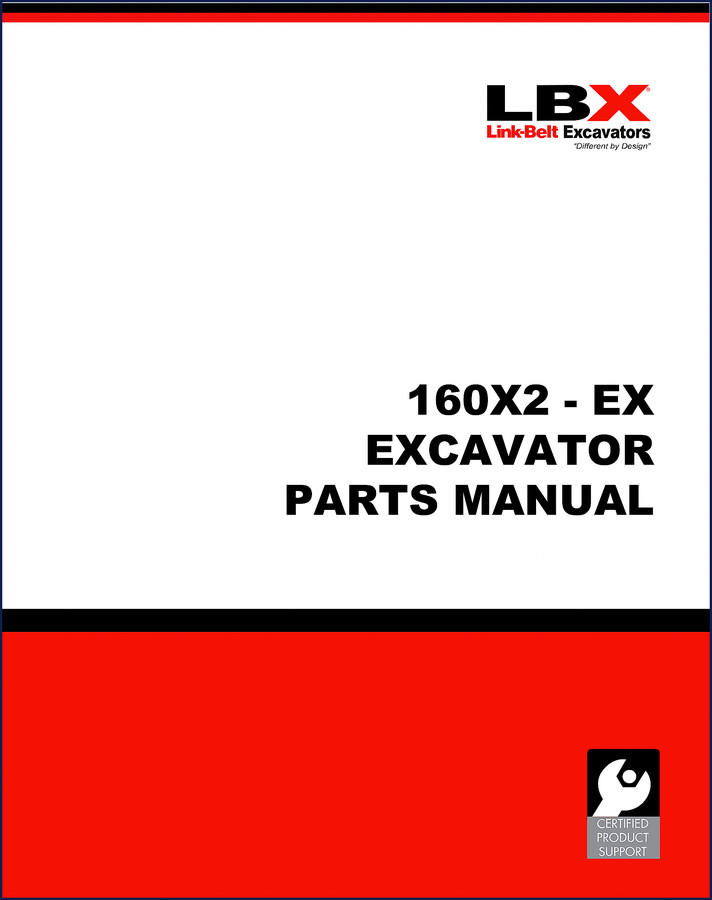
Link-belt 160X2 Parts Catalog
If you are hunting down a part number for a 160X2 excavator and you are sick of guessing from aftermarket websites that give you the wrong idler roller or a seal that doesn’t fit, this Link-belt 160X2 Parts Catalog is the only source you should trust. I have seen guys order three different hydraulic filters because the online cross-reference was garbage. A parts catalog like this one – factory printed, 529 pages thick – saves your shop time and your customer’s wallet. No reprints, no third-party nonsense. Just the exploded views, the OEM part numbers, and the serial number breaks that tell you exactly what fits your machine.
529 Pages of What Exactly?
This is not a service manual. It is a parts manual. Every major assembly on the 160X2 is broken down into horizontal exploded views with callouts. You get part number, description, quantity per machine, and the serial number range where that part applies. The book covers the standard 160X2 EX (excavator) configuration. Page counts per section vary – the undercarriage alone runs over 80 pages because Link-belt used multiple track frame and idler options over the production run.
Does This Catalog Cover Your Serial Number Range?
Look at the serial number plate on your 160X2. The manual lists a starting serial number on page 4 of the PDF (inside the front cover). If your machine falls within that range, the part numbers here are correct. If yours is an early or late build, the catalog uses run-in/run-out marks – little triangles next to the part number – to show when a part was superseded. Miss those marks and you might order a final drive motor that won’t bolt up. Pay attention.
Track Idler and Final Drive: Section Breakdown
The undercarriage chapter (starts around section 20 in a typical Link-belt parts manual) groups every roller, sprocket, track shoe, and guard by assembly group. Final drive is separated into housing, planetary gears, motor – each with its own exploded view. The charge pressure specs? That is in the service manual, not here. But if you need the exact O-ring part number for the final drive cover, this catalog gives it to you. Not a generic size – the OEM part number. Order from that and it will fit the first time.
3 Reasons to Choose OEM Documentation Over Aftermarket
Aftermarket catalogs often merge multiple machine serial numbers into one list, which can give you a part that was replaced three revisions ago. An OEM Link-belt 160X2 Parts Catalog keeps each serial number break separate. Reason two: the illustrations are scanned from original engineering drawings – not redrawn by a third party who might miss a bolt location. Third, the OEM book includes the “Not Shown” notes. Page 73 might list a bracket that is not visible in the main view because it’s behind the hydraulic tank. An aftermarket reprint will leave that out. Then you get the part, it doesn’t match, and you are stuck.
Parts Ordering: What the Manual Doesn’t Do
This catalog will not tell you how to install the part. It does not give torque values, fluid capacities, or adjustment procedures. That is the service manual’s job. If you need that, look at the Link-belt ABS-78A, TC-78A, API-78A, TC-78B Parts Catalog – OEM 142 Pages or the Link-belt RTC-80130 II 2011 Parts Catalog – 453 Pages Factory OEM for those models. For the 160X2 service data, you want the corresponding shop manual. Parts catalog is for ordering. Period. Link-belt HTC-86100 2011 Parts Catalog – OEM Factory Manual might be relevant if you run a mixed fleet of Link-belt rough-terrain cranes.
Who Should Own This Manual?
Fleet managers, heavy equipment mechanics, and owner-operators who rebuild their own undercarriage. If you are a home-garage guy with a compact excavator, this probably isn’t your book – it’s for a 35-ton class machine. But if you work on these for a living, the 529-page PDF pays for itself the first time you avoid ordering the wrong track chain. Industry context matters: the Automotive Industry Overview includes construction equipment as a major segment, and equipment downtime costs real money. Do not waste it on bad parts. Also see the Automotive Industry Overview for broader context on parts supply chains.
FAQ
- Can I use this catalog to look up torque specs for the final drive bolts?
- No. This is a parts catalog, not a service manual. Torque values are not included.
- How do I know if a part number has been superseded?
- Look for the run-in/run-out triangles in the margin of the exploded view. They point to the old and new part numbers. The manual also includes a numerical index at the back – you can look up any old number and see the current replacement.
- Will this file work on a tablet in the field?
- Yes. It’s a standard PDF. You can zoom into the exploded views. The text is searchable if your PDF viewer supports OCR – the original scan is high resolution. No problems.
- Does the catalog cover the 160X2 EX only, or also the LC and other variants?
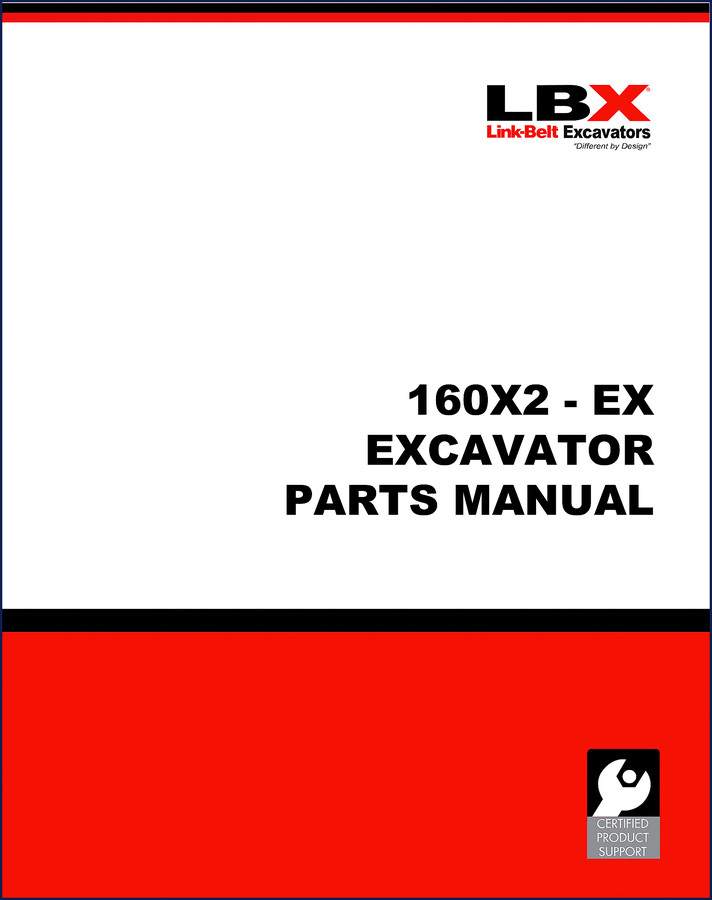
- The cover says 160X2 – EX. That is the standard excavator configuration. Long-carriage (LC) and forestry versions use different parts for the undercarriage and boom. You would need the specific manual for those variants. Check the serial number plate on your machine.
Download the Factory Manual and get the correct part numbers on your bench next time a 160X2 comes in with a blown final drive. Your parts counter will thank you.
workshop_guy –
Great OEM spec sheet. The text is searchable and well indexed. Every spec sheet is provided for Link-belt 160X2. I will definitely buy again.
diy_master –
This is exactly what I required. It is very easy to read on my phone without blur. It guided me to fix my Link-belt 160X2 engine. I will definitely buy again.
Charles W. –
This is exactly what I required. It is very easy to read on my laptop without blur. It guided me to repair my Link-belt 160X2 engine. I will recommend this shop to others.