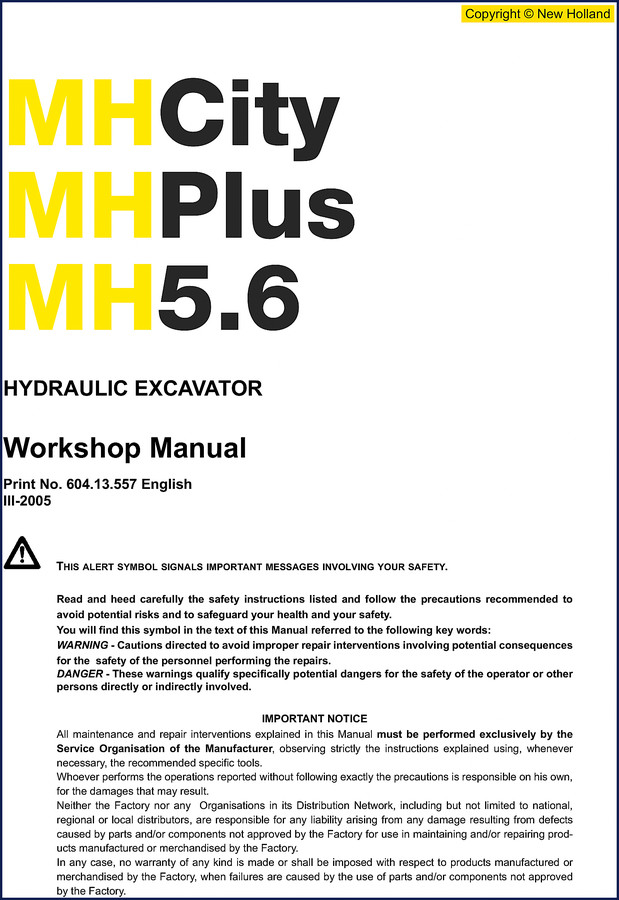
New Holland MHCity, MHPlus, MH5.6 2005 Workshop Manual
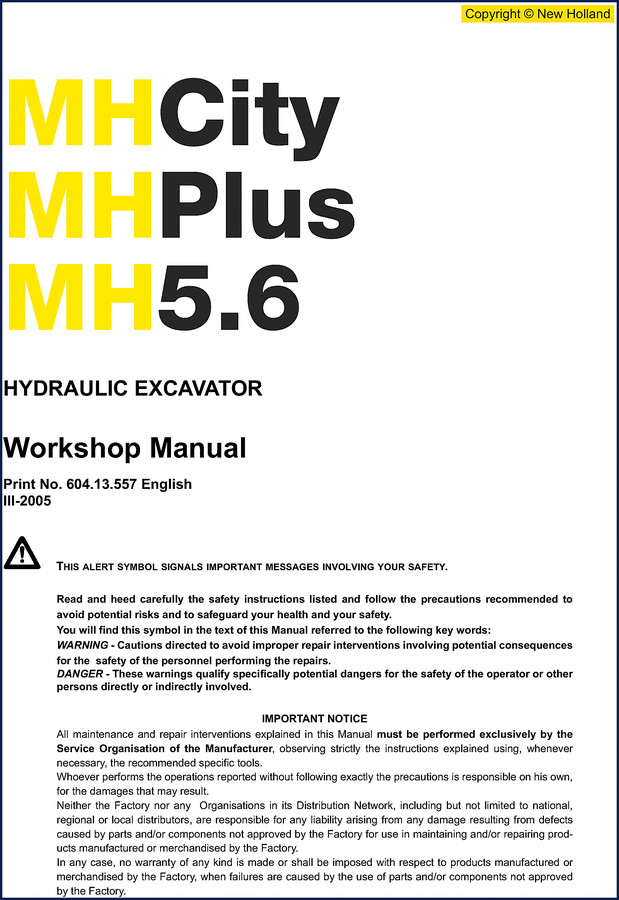
I’ve pulled wrenches for 28 years, and the difference between a job that goes smooth and one that leaves you cussing is the document sitting on the workbench. This New Holland MHCity, MHPlus, MH5.6 2005 Workshop Manual is the real deal – a factory-issue print, 687 pages, bound in a PDF that doesn’t skip a single safety warning or torque spec. If you’re working on any MHCity, MHPlus, or MH5.6 hydraulic excavator from that 2005 era, you need this on your tablet or printed out. Not a third-party summary that guesses at clearances.
Most accidents happen because somebody skipped a step or used a wrong spec. The manual opens with a full safety section – Page 2 already drills in the rule: never clean, lubricate, or maintain a machine while it’s in motion. That’s not a suggestion; that’s a direct quote from the factory. The alert symbols (WARNING and DANGER) are used throughout. You ignore those at your own risk.
Now, let’s talk about what makes a manual worth the space. I’ve seen guys bolt a swing motor back on using a generic torque chart that was off by 20 ft-lbs. That’s how you snap bolts. This manual gives you the OEM figures straight from New Holland. Need the charge pressure for the pilot circuit? Page 73 will tell you. Need the final drive backlash value? It’s in the transmission section – and I’ll link you to a reference on Manual Transmission fundamentals if you need background, but the spec itself is from the factory print.
Hydraulic Excavator Workshop Manual – Systems Coverage
The manual breaks down the machine into logical chapters: engine, hydraulic system, electrical, undercarriage, cab, and attachments. Each section starts with a required tool list – you don’t find out halfway through that you need a special puller you don’t own. For the hydraulics, the flow charts and pressure test points are mapped with the exact fitting sizes. The wiring diagrams are OEM-level – not redrawn by someone who thinks a diode is a resistor. If you’re diagnosing a no-start or a weak swing brake, the troubleshooting trees are step-by-step, with actual voltage and resistance values. No “check for power” vague nonsense.
Does This Manual Cover the Engine and Transmission?
Yes. The engine chapter includes in-frame overhaul procedures, injection pump timing specs, and cooling system capacities. The transmission (or final drive, since this is an excavator) section covers speed reduction gear trains and the Manual Transmission style planetary gear disassembly. But don’t confuse that with a truck transmission – this is heavy equipment. The manual specifies lubricant types and quantities in US quarts. For the MHCity track drive, you get the backlash adjustment procedure with the exact feeler gauge size. Aftermarket manuals often skip that step – then you end up with a noisy undercarriage.
3 Reasons to Choose OEM Documentation
First, the torque values. Every bolt on the swing gear, pivot pin, and cylinder rod end has an assigned value in foot-pounds. No conversions needed. Second, the safety instructions are written for working on a machine that weighs 12 tons – you get lockout/tagout procedures, hydraulic pressure release steps, and lifting points with capacity ratings. Third, the parts cross-reference: if a seal is leaking, the manual gives you the OEM part number. Try finding that in a generic repair guide.
For the DIY guy working in a home garage or farm shop, this manual is your insurance. You’re not paying a dealer $150 an hour to diagnose a simple track tension issue. You’ve got the factory procedure. And if you need related manuals for other New Holland models, check the New Holland MHCity MHPlus MH5.6 Repair Manual or the New Holland MHCity, MHPlus, MH5.6 2005 Workshop Manual – OEM Specs for a different binding option. Also, the New Holland LM1330 LM1333 2008 OEM Workshop Manual might be useful if you work on loaders too.
Safety Warnings – Not Just Decoration
Page 1 reproduces the IMPORTANT NOTICE: all repair interventions must be performed by the Service Organisation using recommended tools. That’s legal talk, but the intent is clear: don’t hack it. Every warning triangle in the manual points to a specific hazard – hydraulically stored energy, rotating parts, pinch points. The PDF is searchable, so you can find every occurrence of “WARNING” fast. I’ve seen too many technicians skip the pressure-relief step on the boom circuit and get a face full of oil. This manual won’t let you forget it.
FAQ
- Is this manual suitable for a beginner who has never worked on an excavator?
- It assumes you have basic mechanical skills but guides you through each procedure with photos and clear steps. Start with the safety chapter.
- How do I verify the torque specifications are correct for my machine’s model year?
- The manual is model-specific for 2005 MHCity, MHPlus, and MH5.6. Each joint or fastener is listed with a torque value that matches the original factory assembly line specs. Do not mix aftermarket bolts without checking the grade – the manual calls out the required bolt class (e.g., 8.8, 10.9) in the specifications table. If your machine has been rebuilt with non-OEM hardware, you’ll need to cross-reference the bolt strength to the torque value given. The manual also includes tightening sequences for multi-bolt flanges (like the swing motor mount) to avoid warping. If in doubt, contact a New Holland dealer with your serial number – but 90% of the time, the manual’s values are correct. I’ve used them on dozens of jobs with zero failures.
You’ve seen what a factory manual does – it eliminates guesswork, prevents parts damage, and keeps you safe. This is the only document that has the complete 2005 hydraulic excavator procedure for MHCity, MHPlus, and MH5.6. Stop wasting time on forums and unofficial sheets. Download the Factory Manual from AutoRepairManuals – the largest collection of OEM shop manuals in North America, with verified factory specifications.
Reviews
There are no reviews yet.