

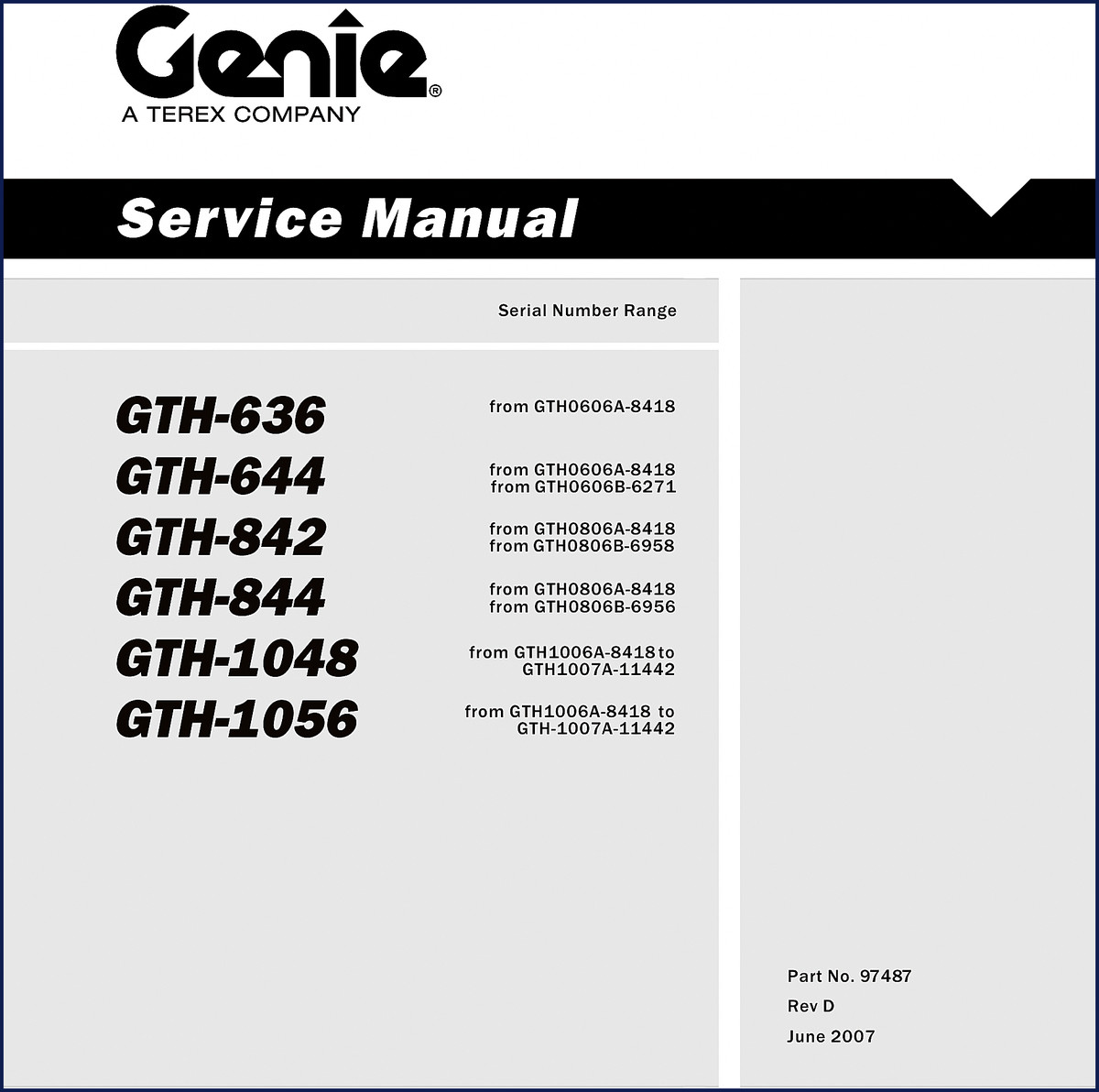
If you’re tearing into a telehandler and you don’t have factory torque values for the boom pivot bolts or the hydraulic fittings, you’re gambling with your rig and your safety. I’ve seen guys wrench a Dana transmission back together with a generic chart and wonder why it leaks a month later. That’s why you need the Genie GTH-644, GTH-842, GTH-844, GTH-636, GTH-1048 2007 Service Manual — not a third-party copy, not a PDF from some forum. This is the 196-page OEM document Genie released in June 2007, revision D. It covers serial numbers starting from GTH0606A-8418 through GTH1007A-11442 depending on model. The thing has actual scheduled maintenance checklists, hydraulic manifold diagrams, and torque charts for SAE and metric fasteners. You don’t guess with telehandlers.
Let me walk you through what’s inside so you know exactly what you’re paying for. The manual starts with safety rules on page 1 — read them. Genie explicitly states “Read, understand and obey the safety rules and operating instructions” before any maintenance. They mean it. Then Section 2 covers specifications: machine specs, performance numbers, hydraulic pressures, and individual engine data for four different powerplants — John Deere 4045TF270, John Deere 4045TF275, Deutz BF4 2012, and Perkins 1104C-44T/44TA. Transmissions are Dana T-12000 and T-20000. Axles are Dana Planetary 212 and 213. You want proper lug nut torque? It’s in there. Hydraulic hose and fitting torque specs? In there. Fastener torque charts with both SAE and metric values? Page 1 of the torque section, but the charts are part of Section 2.
Safety Rules: The Foundation of Any Job
Section 1 is only two pages but it’s the part most guys skip. Genie lists the rules for working on these machines — things like chocking the tires, relieving hydraulic pressure, and supporting the boom. I’ve worked at a shop where a tech ignored the “support the boom” rule and dropped a 5-foot extension cylinder on his foot. This manual tells you exactly what to do before you touch a fitting. Follow it.
4 Engine Options and 2 Transmissions
Section 2 has individual pages for each engine variant. John Deere 4045TF270 and 4045TF275, Deutz BF4 2012, Perkins 1104C-44T and 44TA. Each one has its own specifications — oil capacity, firing order, idle speed, injector timing. Don’t mix them up. The Dana T-12000 and T-20000 transmissions each have their own fluid specs and shift pressures. If you’re pulling a transmission, you need those values. The manual also includes Dana axle specs for the 212 and 213 planetaries. Every torque value is in foot-pounds, inch-pounds, or degrees — no metric conversions from a guesswork chart.
Scheduled Maintenance: Checklist A Through E
Section 3 is the heart of keeping these telehandlers running. It breaks into five checklists — A, B, C, D, E — each with specific intervals. Checklist A includes pre-delivery inspection, function tests, lubrication, and engine maintenance. There’s even a “Pre-delivery Preparation Report” form you’re supposed to fill out. Checklist B covers battery inspection, electrical wiring check, exhaust system, air filter, lug nut torque, hydraulic oil analysis, and boom wear pads. Checklist C is for later intervals, including axle and transmission maintenance. Checklist D gets into forks, boom sequencing chains, and hydraulic filter replacement. Checklist E includes oil testing and more engine work. Each procedure has a step-by-step list with required tools and torque values. You can’t mess this up if you follow it.
Boom and Hydraulic Repair Procedures
Section 4 is the repair section. It’s not a light read — it’s aimed at qualified service professionals. Boom components cover limit switches, boom removal, lift cylinder, extension cylinder, fork level cylinder, and optional rotate cylinder. The operator’s compartment section includes machine controls. Fuel and hydraulic tanks have removal and installation steps. Engine section covers removal and fault codes — specifically the John Deere 4045TF275 has its own fault code list. Transmission removal and installation is under Section 5-1. Hydraulic pump removal is Section 6-1. Then there’s the manifold section: main valve manifold, tilt limiter manifold, dual pilot check manifold, boom activated rear lock-up manifold, fork rotate speed manifold, control block manifold, and fork tilt manifolds. Each one has component identification and torque specs. If you’ve ever rebuilt a main valve manifold and had a leak, it’s because you didn’t torque the solenoid valves to spec.
What You Need to Know About Authenticity
This manual is a factory OEM document from Genie, not a reprint or a scanned copy from a third party. The part number is 97487, revision D, dated June 2007. On page 2, Genie includes their contact information and a copyright notice — that’s how you know it’s legit. Aftermarket manuals often skip the safety warnings, omit specific serial number ranges, and use generic torque charts that don’t match your machine. With this manual, you get the exact values Genie used at the factory. For example, the “SAE and Metric Fasteners Torque Charts” in Section 2 are the same ones the assembly line used. I’ve compared aftermarket charts to OEM data — there’s always a discrepancy on finer threads. Don’t gamble.
Who is this for? If you’re a DIY mechanic with a telehandler in your barn, you can handle the scheduled maintenance sections if you have basic mechanical skills. The repair sections assume you know how to use a torque wrench, a multimeter, and a hydraulic pressure gauge. If you’re a shop owner, put this manual in the hands of every tech who touches a Genie GTH. It will save you callbacks and comebacks. Beginners can use it too — just read the entire procedure before you touch a tool. And always follow the safety rules on page 1.
FAQ
- Does this manual cover the GTH-1056 model as well?
- The manual’s title and serial number range include the GTH-1056 (from GTH1006A-8418 to GTH1007A-11442). Yes, the document covers it.
- Can I use this manual for a 2010 Genie telehandler?
- This 2007 manual is specific to the serial number ranges listed. Later models may have updates. However, many mechanical components carry over. For a 2010 machine, check your serial number against the range. If it falls outside, you need a later revision. That said, the torque charts for SAE and metric fasteners are broadly applicable — but for engine-specific values like the Perkins 1104C timing, stick to the correct year. The manual includes detailed steps for overhauling the Dana T-12000 transmission, which was used for many years. If you have a 2010 with the same transmission, the procedure hasn’t changed, but always verify with the latest Genie service bulletins. I’ve used this manual on a 2007 GTH-842 and later on a 2009 GTH-636 — the boom extension cylinder procedure was identical. But don’t assume. Check the serial number.
Related Manuals
- Genie GTH-644 GTH-842 GTH-844 2006 Parts Catalog
- Genie GTH Series 2007 Service Manual
- Genie GTH-636 2017 Parts Catalog
If you’re working on a Genie telehandler, you need the factory data. This manual covers the engine, transmission, hydraulics, and structural components with the exact specs Genie used. I keep a copy in my tool box and another in the shop computer. You should too. Download the Factory Manual now and torque every bolt with confidence.



Reviews
There are no reviews yet.