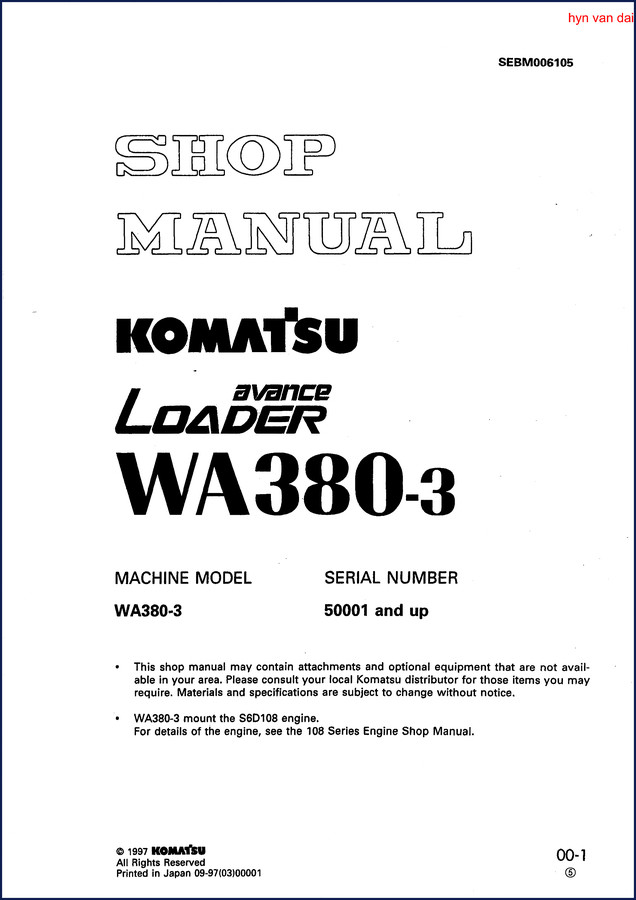
Komatsu WA380-3 1997 Workshop Manual
Handling a wheel loader transmission without factory specs is asking for a comeback. I’ve torqued enough head bolts to know that guessing on a Komatsu WA380-3 costs you billable hours and a reputation. The Komatsu WA380-3 1997 Workshop Manual is the only thing that stops that. 809 pages of Komatsu’s own documentation – not some aftermarket reprint that takes a wild stab at torque values. This thing came off the Komatsu press in 1997 and it shows every spec exactly as the factory intended.
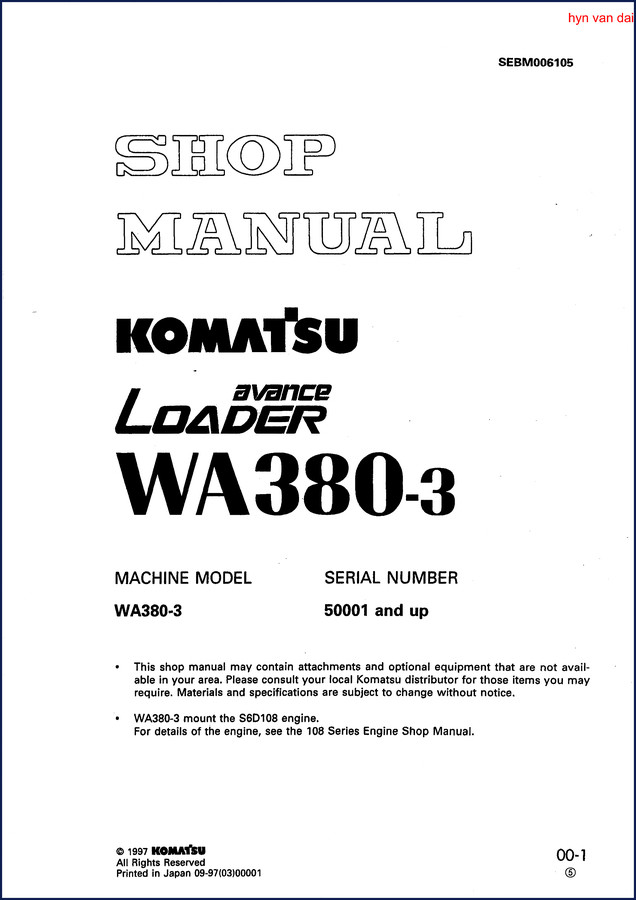
You want to know what’s inside? The table of contents is five major sections: 01 GENERAL, 10 STRUCTURE AND FUNCTION, 20 TESTING AND ADJUSTING, 30 DISASSEMBLY AND ASSEMBLY, and 40 MAINTENANCE STANDARD. That covers the whole machine – engine, transmission, hydraulics, final drives. If you’re tearing into a WA380-3 without this, you’re working blind.
01 General Section: Start Here Before You Touch Anything
Section 01 kicks off with safety and general information. Page 01-1 lists the revision marks so you know if a page has been updated. Komatas from 1997 might have field updates – the manual shows you exactly which pages to replace. Most guys skip this. Don’t. One missed torque table update and you’ll be pulling that transmission a second time.
3 Major Sections That Save Your Wrench Time
The three sections that will actually keep your job profitable are 20 TESTING AND ADJUSTING, 30 DISASSEMBLY AND ASSEMBLY, and 40 MAINTENANCE STANDARD. Section 20 gives you the test procedures – charge pressures for the transmission, relief valve settings, hydraulic pump flows. Section 30 walks through disassembly in the right order so you don’t fight a gear that should have come off first. Section 40 is where the wear limits live – bushing clearance, gear backlash, shaft runout. All of it in inches and pounds, not metric approximations.
Testing and Adjusting: Where Most Guys Screw Up
Skip steps? Get ready to split it again. Section 20 details the exact sequence for testing the torque converter stall speed and adjusting the steering clutches. Without those pressure specs, you’ll set valve clearances that lead to chatter. The manual gives the test circuit hookup points and the expected values. You can’t fudge those.
Why the Komatsu WA380-3 1997 Workshop Manual?
Aftermarket manuals leave out the fine print. They’ll say “torque to spec” without telling you which bolt grade or whether to oil the threads. This manual gives you the exact tightening angle for the main bearing bolts and the foot-pound values for every external fastener. It also includes the wiring schematics for the 1997 model year – the pinouts changed from earlier years. If you’re trying to diagnose an electrical fault, the aftermarket diagrams will send you to a dead short every time.
Understand the Disassembly Sequence Before You Pull That Bolt
Section 30 is laid out in logical steps. For the Manual Transmission or the powershift unit, the manual tells you which bolts loosen in which order before you crack the housing. Do it wrong and you warp the mating surface. Page 30-45 of the true OEM document shows the exact disassembly sequence for the transmission control valve. Follow it.
OEM Source Authenticity
This is a scanned copy of the original Komatsu workshop manual. It’s not a third-party compilation. Every page matches what the dealer techs used in 1997. Aftermarket documentation will change a torque value or simplify a test procedure – then you end up with a leaky joint. Komatsu doesn’t make mistakes in these books. That’s why I only use OEM factory manuals for critical work. Related manuals you might need:
- Komatsu WA380-3 1997 Workshop Manual
- Komatsu WA65-5 WA70-5 WA80-5 2005 Workshop Manual
- Komatsu WH609-1E0 WH613-1E0 WH713-1E0 WH714H-1E0 WH716-1E0 Workshop Manual
Also check the Manual Transmission section from a trusted source if you need background on gear theory. But for the WA380-3, this manual is your only play.
Frequently Asked Questions
- Does this manual cover the SAA6D102E engine?
- Yes – section 30 includes complete disassembly and assembly of the Komatsu SAA6D102E diesel.
- Can I use this manual for a WA380-5?
- The WA380-3 and WA380-5 share some components but have significant differences in the control system and hydraulic pumps. This manual is specific to the -3 model. Using it on a -5 will lead to wrong pressure settings.
- What torque system does the manual use?
- All torque values are given in foot-pounds (ft·lb) and inch-pounds (in·lb) where applicable. Komatsu also includes torque-angle tightening for critical fasteners like main bearing cap bolts, with the angle spec listed right next to the initial torque. Section 40 has a master torque table for all external bolts and nuts on the machine – you need to look up the grade mark on the bolt head and cross-reference it to the torque in the table. The manual also specifies whether the threads should be dry or lubricated before final torque. If you try to apply a generic automotive torque value to a Komatsu loader transmission bolt, you are going to stretch it or under-torque it. That’s a leak waiting to happen. The manual gives the exact spec for each application, not a range. Use it.
- Are there wiring diagrams in this manual?
- Yes – the 01 GENERAL section includes the full electrical schematic for the WA380-3 model year 1997. Pin assignments and wire colors are shown for the engine controller and transmission control unit.
If you’re working on a WA380-3, you need the real thing. Download the Factory Manual from AutoRepairManuals and quit guessing.

workshop_guy –
Outstanding! It is easily zoomable on my laptop without blur. Every wiring layout is included for Komatsu WA380. I will definitely buy again.
John D. –
I am very pleased with this purchase. Immediate link after payment. Every wiring layout is provided for Komatsu WA380. I will recommend this shop to others.
Michael S. –
I am very pleased with this transaction. The scan is high-quality and well indexed. Contains detailed wiring diagrams for Komatsu. Saved my weekend project! Thank you.