Chrysler Cherokee 1999 Technical Manual
You are staring at a Cherokee that won’t start, or the front end clunks every time you hit a pothole. The aftermarket PDF you downloaded says “torque to spec” but doesn’t tell you what spec. That is exactly the kind of garbage that wastes your Saturday and costs you parts. Chrysler Cherokee 1999 Technical Manual changes that. It is the OEM factory document – 462 pages, published in 1999 by Chrysler. No third-party guessing. Every fastener value, every wiring color, every suspension bushing p/n comes straight from the assembly line. If you have ever snapped a bolt because a generic manual said “tighten securely,” you know why this matters.
VIN Plate Decoding – Your First Diagnostic Tool
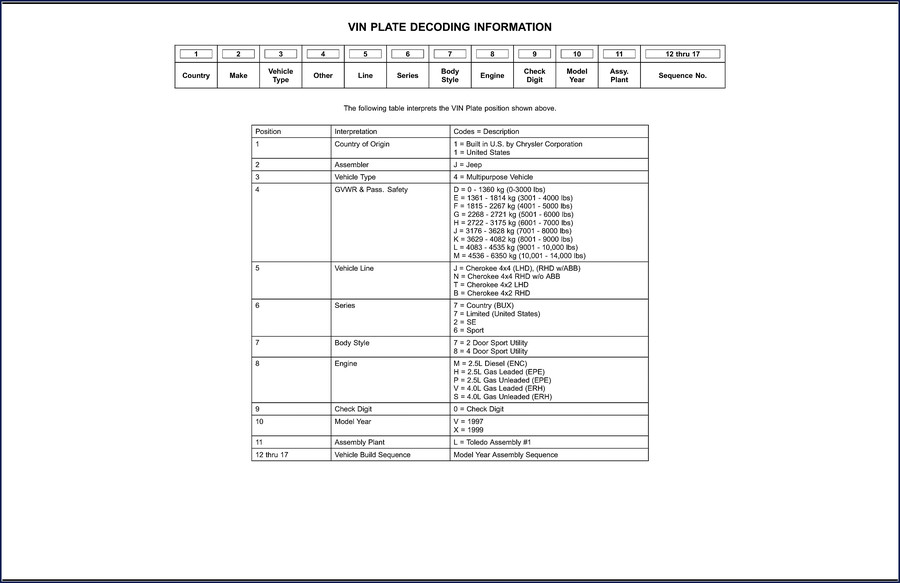
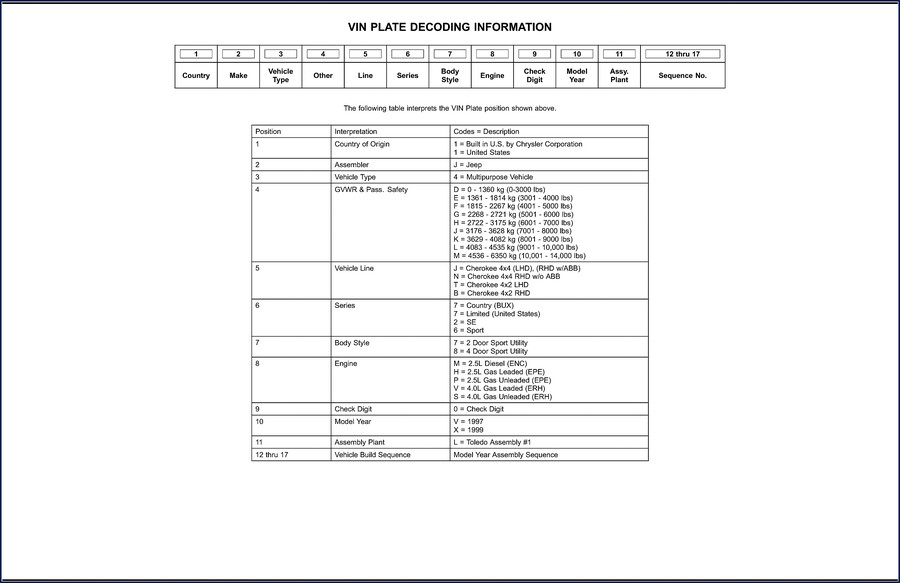
Page 1 of the manual starts with VIN plate decoding. That is not padding – it is a map. The table breaks down every position: country of origin, vehicle line (Cherokee 4×4 or 4×2), series (Sport, Limited, SE), engine code (M for 2.5L diesel, S for 4.0L gas unleaded, etc.), assembly plant, and model year. Need to know if your Cherokee has the 2.5L diesel or the 4.0L? Look at position 8. That saves you from ordering the wrong starter or alternator. The manual does not assume you know the build date; it gives you the code.
Group 2: Front Suspension & Drive – Not Just a Parts List
The **Suspension** chapter (Group 2) covers arms, control – upper and lower (Fig. 2-110), springs and shocks (Fig. 2-120), and the front stabilizer bar and track bar (Fig. 2-130). Each figure is an exploded diagram with part numbers and torque values. No generic “install as shown” nonsense. You get factory R&R steps. If you are replacing control arm bushings, the manual specifies the bushing removal tool and the press fit depth. Front axle drive shafts, housing (2WD and 4WD), and the front differential are all here. The 4-wheel drive axle assembly is broken out separately.
Group 3: Rear Axle – Corporate 8.25 vs Dana 35
Two rear axle assemblies are documented: the Corporate Model 8.25 (code DRA) and the Dana Model 35 (codes DRJ, DRM). Each has its own differential and housing subsection. Trac-Lok differential? Covered in Fig. 3-230 (without) and Fig. 3-240 (with). The rear axle vent and shafts are separate figures. If you are rebuilding a Dana 35, you get the axle shaft removal procedure with the correct slide hammer adapter. Aftermarket manuals often mix up the two axles – this one treats them as distinct assemblies.
Group 5: Service Brakes – Front, Rear, and ABS
Front brakes (Fig. 5-110) and rear brakes (9×2.5 in. and 10×1.75 in. with AHB) are covered. The power brake booster and master cylinder are in Fig. 5-310. ABS models get their own brake line diagrams: front lines for LHD/RHD with anti-lock brakes (Fig. 5-530) and rear lines (Fig. 5-540). The hydraulic control unit is Fig. 5-410. Brake pedal assembly is Fig. 5-610. No guesswork on line routing – the diagrams show every clip and bracket location.
Group 7: Cooling – 2.5L, 4.0L, and Diesel
Three engines have separate radiator and related parts figures: 4.0L (Fig. 7-120), 2.5L gas (Fig. 7-130), and 2.5L diesel (Fig. 7-145). The diesel even gets a charge air cooler (Fig. 7-147). Water pumps are split by engine type. Drive pulleys and belts (Fig. 7-510) cover all variants. Transmission oil cooler lines for LHD and RHD are separate figures. If you have a diesel Cherokee, you need the diesel-specific water manifold – the manual shows it.
Group 8: Electrical – Starters, Alternators, Sensors
Starters are covered for gas engines (Fig. 8-105) and diesel (Fig. 8-110). Alternator mounting differs for LHD vs RHD (Fig. 8-205/207 for gas, 8-210 for diesel). The distributor section shows both 2.5L (Fig. 8-305) and 4.0L (Fig. 8-310) timing marks. Modules, relays, sensors, and the single board engine controller are each in separate figures. Wiring diagrams are not in this manual – it is a technical manual focused on mechanical disassembly and assembly – but the sensor locations and mounting torque are included.
FAQ
- Does this manual cover the 2.5L diesel engine?
- Yes, Group 7 includes the 2.5L diesel cooling system and charge air cooler.
- How are torque specs presented in the manual?
- Every fastener in the factory manual has a torque value listed in the corresponding figure. For example, the front suspension control arm bolts are specified on Fig. 2-110. The manual does not rely on generic ranges; each spec comes from Chrysler’s engineering. If you are rebuilding a Dana 35 rear axle, the ring gear bolt torque is in Group 3. You will not find a single “tighten securely” phrase anywhere. That level of precision is why this manual belongs on your bench, not in a drawer.
If you work on other Chrysler platforms, check the Chrysler Stealth 1991 Technical Manual – Factory OEM Service for a different drivetrain layout. For more VIN decoding references across the XJ range, the Jeep Cherokee XJ 1997-1999 VIN Decoding and Parts Index is a useful companion. The Chrysler Stealth Technical Manual – 284-Page Factory OEM Specs covers the Stealth’s 3.0L engine and AWD system. The manual assumes you understand how a Manual Transmission works before you dive into clutch housing removal. If you need background on clutch operation, read about the Manual Transmission fundamentals – but the factory procedure for the AX-15 and NV3550 is right here.
Stop guessing with aftermarket reprints that skip steps. Download the Factory Manual and get the same data used by dealership techs.


Thomas B. –
This is exactly what I required. The document looks clean. It helped me to fix my Chrysler Cherokee electrical connector. Great value for money.