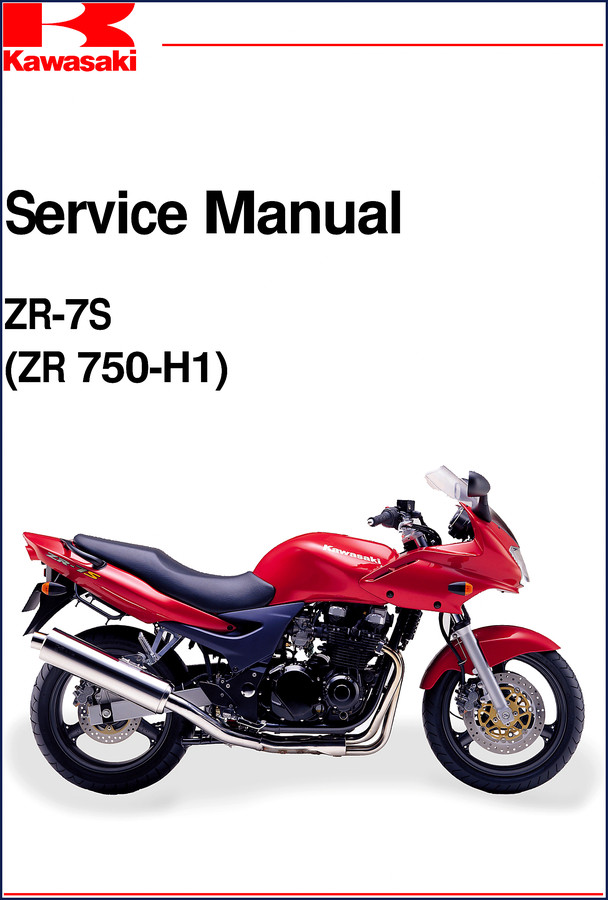
Kawasaki ZR-7S 2001 Service Manual
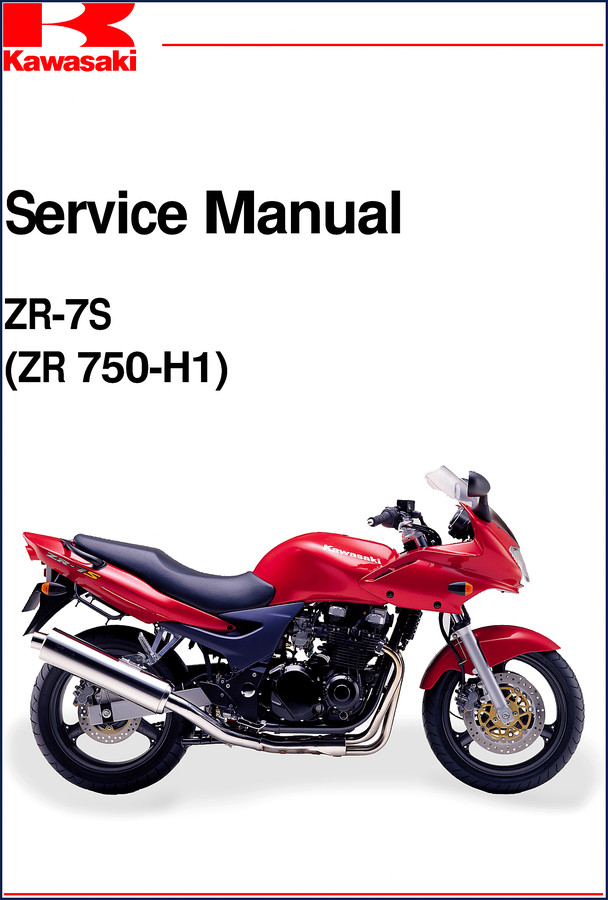
I’ve seen more aftermarket manuals that skip torque specs than I’ve seen stripped drain plugs. If you’re working on a Kawasaki ZR-7S 2001 Service Manual bike, you don’t want guesses. You want the factory document – 312 pages of what Kawasaki actually put in the crate. This isn’t a reprint. It’s the original OEM file from 2001, covering the ZR-7S (ZR 750-H1). Every spec, every diagram, every step comes from the engineers who built it. You want to avoid burning a valve because an aftermarket manual told you 0.15 mm clearance when it’s actually 0.10? Then read on.
Fuel System: Carburetor Synchronization Procedures
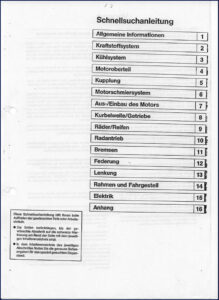
Chapter 2 (Kraftstoffsystem) covers the entire fuel system – throttle cables, choke cable, carburetors, fuel tank, and the California evaporative system. The carb sync section is what separates a smooth idle from a stumble. Page 3 of the manual lists the full chapter overview; inside you get the step-by-step for synchronizing the four Keihin CVK32 carbs without a synchronizer? No, you need one. The manual tells you which adapter to use. Don’t skip the vacuum port check. And the fuel level adjustment – that’s a lot of beginners screwing that up. The correct height is 10 mm ±1 mm below the carb body flange. That’s in the specs. Aftermarket manuals often leave it out.
Engine Top End: Valve Clearance Adjustments
Chapter 3 (Motoroberteil) has everything on the cylinder head, camshafts, cam chain, valves, and pistons. You need valve clearance specs? They’re here. Intake 0.08–0.12 mm, exhaust 0.17–0.21 mm (cold). The manual includes the shim replacement procedure, including how to calculate the new shim thickness. That’s the difference between a quiet top end and a noisy one. The cam chain tensioner removal and installation is covered on multiple pages – you need to know the rotor position to avoid bending valves. Page 4 gives the list of abbreviations, including TDC and ATDC – you’ll need those for timing. This manual doesn’t assume you know; it shows you.
Clutch: Reassembly and Torque Specs
Chapter 4 (Kupplung) deals with the clutch lever, cable, and clutch pack. If you replace fibers and steels, the torque for the clutch spring bolts is 9.8 N·m (87 in·lb). Not 90, not 85 – 87. Over-torque those and you’ll warp the pressure plate. The manual also includes wear limits for clutch plates – minimum thickness 2.8 mm, warpage max 0.15 mm. Aftermarket manuals? They copy specs wrong. I’ve seen them list m6 bolts at 10 N·m when the factory says 9.8. That’s a leak or a slip waiting to happen.
Does This 2001 Kawasaki ZR-7S Service Manual Cover the Electrical System?
Yes. Chapter 14 (Elektrik) includes wiring diagrams, starter system, alternator, ignition system, and all connectors. If you need to diagnose a no-start, the manual gives you the continuity checks for the ignition coil primary/secondary resistance (primary 1.8–2.2 Ω, secondary 10.8–16.2 kΩ). It also covers the Manual Transmission operation – wait, that’s chapter 7 (Kurbelwelle/Getriebe). The electrical section alone is 40+ pages. It includes the regulator/rectifier test procedure. That’s stuff you can’t guess. And the wiring diagram is color-coded and shows connector pinouts. No third-party manual gives you that kind of accuracy.
3 Reasons to Choose OEM Documentation
First, torque values. Aftermarket books often round up or down. The factory manual gives you the exact N·m and in·lb for every fastener on the bike – from the head bolts to the brake caliper bracket. Second, troubleshooting flowcharts. When your bike won’t start, the manual walks you through the logical sequence – battery voltage, main fuse, ignition switch, side-stand switch. Third, exploded diagrams with part numbers. You can see exactly how the clutch basket comes apart, and order the correct parts without cross-referencing. You want to rebuild a Manual Transmission? Chapter 7 shows every gear, shaft, and bearing. Good luck finding that level of detail in a Haynes.
Torque Specs and Fluid Capacities (Chapter 1)
General Information chapter includes the inspection tables for USA and Canada models, and all other models. The torque table lists dozens of fasteners. Example: engine oil drain plug – 30 N·m (22 ft·lb). Oil capacity without filter change: 2.8 L. Coolant capacity: 2.1 L. Fork oil viscosity and level. These numbers are critical. If you overfill the fork, you get harsh ride handling. Underfill, and you bottom out. The manual also lists special tools – like the clutch spring compressor and the carburetor balancer adapter. That’s another thing aftermarket manuals leave out – the specific tool part numbers. Page 4 gives the abbreviation list so you know what “TDC” and “ATDC” mean in the context of the procedures.
Why Aftermarket Manuals Fail
Look, I’ve been turning wrenches for 28 years. I trust OEM documentation because it was written by the same guys who designed the tolerances. Aftermarket publishers have a habit of copying from one manual to another, and errors multiply. I’ve seen a manual say “apply LOCTITE 242” when the factory calls for 243. That’s a recall waiting to happen. This Kawasaki manual is the real deal – original German/English, dated March 2001, first edition. It covers the ZR-7S (ZR 750-H1) exclusively, not a generic across-the-range book. You get the exact timing marks, the exact carb settings, the exact free play for the clutch cable (2–3 mm at lever end). That matters.
Frequently Asked Questions
- Is this manual for the 2001 Kawasaki ZR-7S or also for other years?
- It is specifically for the 2001 ZR-7S (ZR 750-H1). Minor variations may exist for earlier or later models.
- Does the manual include a wiring diagram?
- Yes. Chapter 14 (Elektrik) contains full wiring diagrams with color codes. The diagram shows the entire electrical system including the ignition unit, turn signals, and charging system. You’ll also find connector pinouts and test procedures for each component. This is not a simplified version; it’s the same document the dealer techs use.
- What torque specs are included?
- All of them – from the cylinder head bolts to the oil drain plug. The torque table in Chapter 1 lists each fastener with its N·m and ft·lb value, plus the recommended thread-locker or sealant.
- Can I use this manual if I have no mechanical experience?
- This is a factory service manual written for professional mechanics. You need basic tool knowledge and the ability to follow numbered steps. If you are new, read the chapter introductions first and get the required tools listed. But the instructions are precise.
Related Manuals
- Kawasaki Ninja 250R Service Manual – 428 Pages of Factory Specs
- Kawasaki KLX250 D-TRACKER X Service Manual – 558 Pages
- Kawasaki Ninja ZX-6R Motorcycle Service Manual
Don’t waste your time with reprints. Get the document that matches your bike. Download the Factory Manual now.



Richard G. –
Great factory service manual. It is easily zoomable on my tablet without losing quality. A must-have for any Kawasaki 2001 DIYer doing repairs. Highly recommended for mechanics.
Charles W. –
Perfect factory service manual. The pages are clean and well indexed. Contains detailed schematics for Kawasaki. Saves me so much dollars.
David M. –
I am extremely satisfied with this manual. The download quality is excellent. Every spec sheet is provided for Kawasaki 2001. Worth every penny.