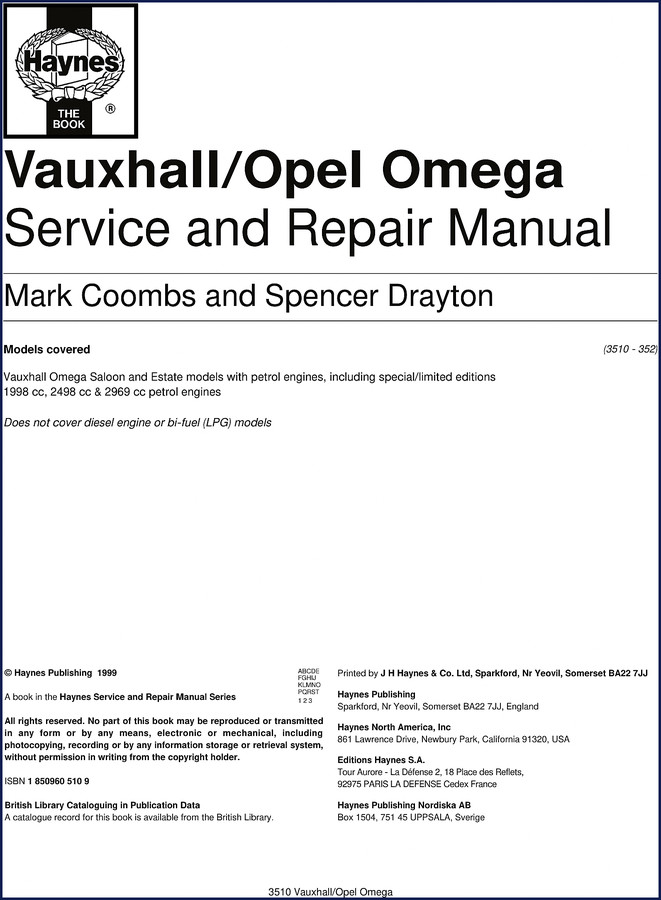
If you’re working on a Vauxhall Omega and you don’t have this Vauxhall Omega 1999 Repair Manual in your hands, you’re gambling with someone else’s car. I’ve been at this 28 years. I’ve seen good mechanics turn a simple water pump job into a head gasket failure because they pulled a random torque spec off a forum. This manual was written by people who took the car apart, measured everything, and wrote down what they found. It’s the difference between a job that holds and a job that comes back on a flatbed.
Living With Your Omega: Weekly Checks and Roadside Repairs
This manual doesn’t just jump into engine teardown. It starts with the stuff you need to do every week: checking engine oil level (page 0•11), brake fluid level (page 0•12), coolant, power steering, tires. It even has a section on identifying leaks and jump starting. If you’re a new owner, don’t skip these pages. The Safety First! section on page 0•5 is mandatory reading. I’ve seen a guy drop a car off a jack because he didn’t read the jacking points section. This manual shows you exactly where to lift the Omega.
Engine Overhaul Coverage – 2.0 SOHC, DOHC, and the 2.5/3.0 V6
Three different Engine families covered: the 2.0 litre SOHC (page 2A•1), the 2.0 litre DOHC (page 2B•1), and the 2.5 and 3.0 litre V6 (page 2C•1). The general overhaul procedures start on page 2D•1. If you’re pulling the head, the torque sequence is there. The timing belt tension specs are there. I’ve done chain jobs on the 2.5 V6 using this manual – the cam holding tools are listed, and they even tell you which bolts are single-use. Aftermarket manuals don’t tell you that. They assume all bolts are reusable. Not with this car.
Brake System Diagnostics and Factory Procedure
The Brake system section starts on page 9•1. You’ll find the bleeding sequence for the ABS system, pad replacement steps, and disc thickness specs. The manual includes the torque values for the caliper bolts and bleed nipple. I’ve encountered plenty of Omegas with spongy pedal after a pad slap – nine times out of ten, the owner didn’t use the correct bleeding order. This manual lists it. Don’t skip it.
Where Do You Find the Correct Torque Specs?
Torque specs are scattered throughout the manual where relevant. For the cylinder head, look in the engine overhaul section for your specific engine. For brake calipers, page 9•1. For wheel nuts, the weekly checks section. This isn’t a single table – it’s embedded in the procedure because context matters. The manual also includes general repair procedures in the reference section (REF•4) that cover thread repair and bolt grades. That stuff saves you a tow.
256 Pages of What Matters
This manual runs 256 pages from cover to cover. It’s a full service and repair manual, not a quick reference. It covers everything from the fuel and exhaust systems (4A•1) to the body electrical system (12•1) with wiring diagrams starting at 12•23. The emission control systems are on page 4B•1. The reference section includes dimensions and weights, conversion factors, and even MOT test checks. This is a Haynes manual, not a Vauxhall factory manual, but Haynes tears down a car and documents every step. They’ve been doing it since the 60s. The procedures are vetted. Compare that to some aftermarket PDF that someone scanned from a third-generation copy – you get blurry text and missing pages. This is a clean, original print from 1999.
Guessing costs money.
For a broader perspective on how repair manuals are developed, see the Automotive Industry Overview. If you need more theory on manual transmission operation, Manual Transmission on Wikipedia is a good reference.
Related Manuals
- Vauxhall Vectra 1999-2002 Repair Manual
- Vauxhall/Opel Corsa Owners Workshop Manual 2006-2010
- Haynes MAX Power Vauxhall Nova Modification Guide
Download the Factory Manual and stop guessing.

Reviews
There are no reviews yet.