Daihatsu F300 Service Manual – Factory Emission Control Data
Most aftermarket emission control manuals are garbage. They show generic diagrams that don’t match anything under your hood and skip the critical vacuum routing that makes these systems work. If you own a Daihatsu F300 with a HD-C or HD-E engine, you need factory-sourced data. That is what you get here.
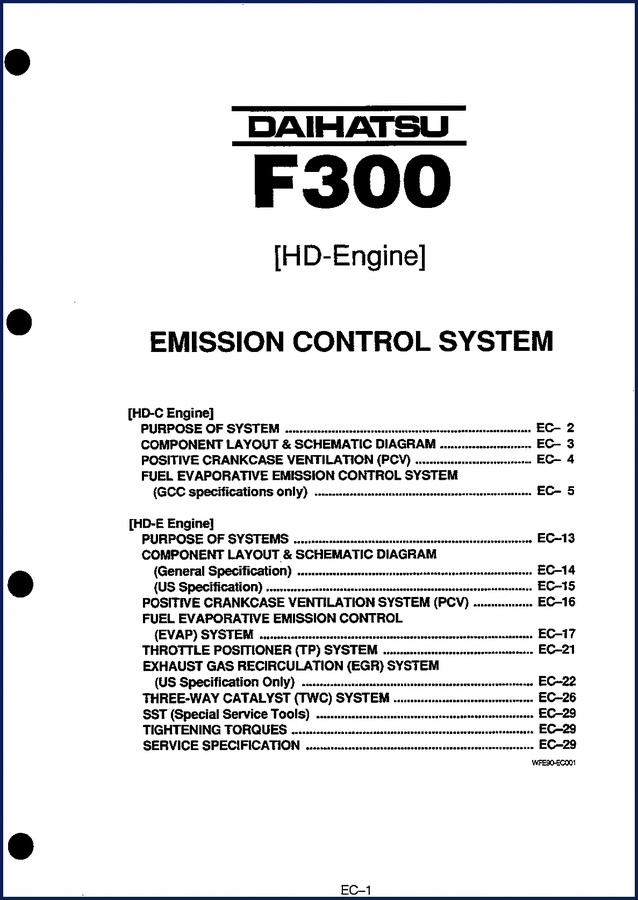
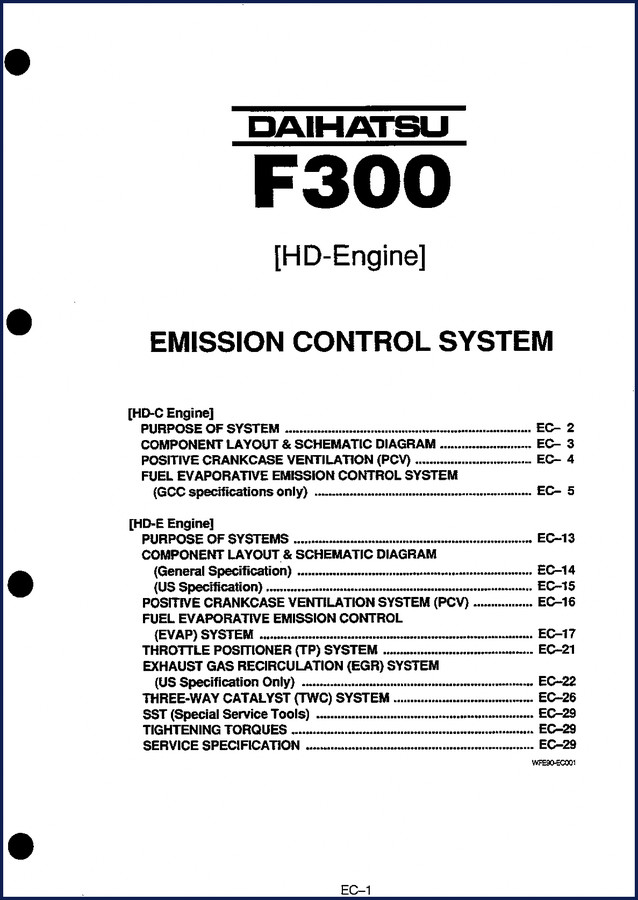
Daihatsu F300 Service Manual runs 29 pages and covers both engine variants end-to-end. Not a reprint of some third-party rewrite. This is the actual OEM publication, scanned from the original factory print. Every spec comes from Daihatsu engineering, not from someone guessing what the bolt should take.
Emission Control Systems: What the Manual Covers
This manual splits the coverage by engine. The HD-C engine gets the purpose of each system laid out on page EC-2: PCV, Spark Delay, Choke Breaker, Throttle Positioner, and Fuel Evaporative Emission Control (EVAP) for GCC specs. Each abbreviation is defined with its specific role in reducing HC, CO, and NOx. You get the schematic diagram on EC-3 showing the vacuum motor, BVSV, TVSV, and charcoal canister routing. The HD-E engine section starts at EC-13 and adds US specification components, including the Three-Way Catalyst (TWC) system, EGR, and a separate Throttle Positioner (TP) system. Both sections include the Positive Crankcase Ventilation (PCV) system with test procedures. No vague descriptions—just the component layout and what each valve does.
PCV and EVAP Systems: Factory Diagnostics
Every emission control system relies on small vacuum signals and specific valve operation temperatures. The PCV section walks you through checking the valve operation and hose routing for both engines. The EVAP section covers the charcoal canister, gas filter, and purge line inspection for GCC and US specifications. If you are dealing with a fuel smell or rough idle, these pages tell you exactly which component to test. The schematic diagrams include labels for every vacuum line and thermal valve. No guessing which port connects where. Daihatsu F300 Service Manual gives you the actual factory layout, not a cartoon.
Torque Specs and Special Service Tools
Tightening torques live on page EC-29. That is where you find the numbers for every fastener mentioned in the emission system. The SST (Special Service Tools) list includes the tool numbers and part names needed to perform the tests correctly. If you try to use a generic torque value on a thermal vacuum switching valve bracket or an EGR mounting bolt, you risk snapping the casting or creating a vacuum leak. Factory torques prevent that. The service specification table on the same page lists the allowable limits for vacuum readings, valve resistance, and other measurements. You need those to decide whether a part is within spec or needs replacement. Skip the generic data. Use the actual OEM limits.
Does the F300 Service Manual Include the HD-E Engine?
Yes. The HD-E section starts at EC-13 and runs through EC-29. It covers the PCV system (EC-16), EVAP system (EC-17), Throttle Positioner system (EC-21), EGR system for US spec (EC-22), and Three-Way Catalyst system (EC-26). The component layout includes separate schematics for general specification and US specification, so you get the right vacuum routing for your vehicle. If you are trying to pass an emissions test or track down an EVAP code, this section tells you which solenoid, valve, or line to inspect. The manual does not cover drivetrain or body components—it focuses entirely on the emission control system as designed by Daihatsu for the F300 chassis.
Torque matters.
Get the Right Tightening Torques from the Factory
Page EC-29 lists every torque value needed for the emission control system. If you are used to guessing bolt tightness or using a generic chart, stop. This manual gives you the exact ft-lb and in-lb values for all mounting bolts, sensor fasteners, and pipe connections. The SST section also tells you which special tools you need for testing the TVSV, BVSV, and vacuum motors. Beginners who skip this page end up with stripped threads or vacuum leaks. Professionals use it to confirm their torque wrench settings before cinching down a part. That is the difference between a repair that lasts and one that comes back next week with a check engine light.
If you are also working on the drivetrain, the Daihatsu F300 Engine Service Manual provides additional engine-specific data. For a deeper dive into the HD-C engine configuration, check the DAIHATSU F300 HD-C Service Manual. The DAIHATSU F300 Service Manual is your primary resource here. For basic principles of manual transmissions, refer to Manual Transmission documentation. You can look up standard transmission maintenance at Manual Transmission.
- Does this manual include wiring diagrams?
- It includes component layout and schematic diagrams (see page EC-3 for HD-C and EC-14/15 for HD-E).
- What is the difference between the HD-C and HD-E engine sections?
- The manual covers both engines separately. For HD-C, the system includes PCV, SD, C/B, TP, and EVAP (GCC only). For HD-E, it adds EVAP for US spec, TP system, EGR (US only), and TWC system. The HD-E section also includes a throttle positioner system and exhaust gas recirculation with specific test procedures. The tightening torques and service specs on page EC-29 apply to both, but component layouts differ.
Stop wasting time on vague instructions. Download the Factory Manual and get the right data on your first guess.



Reviews
There are no reviews yet.