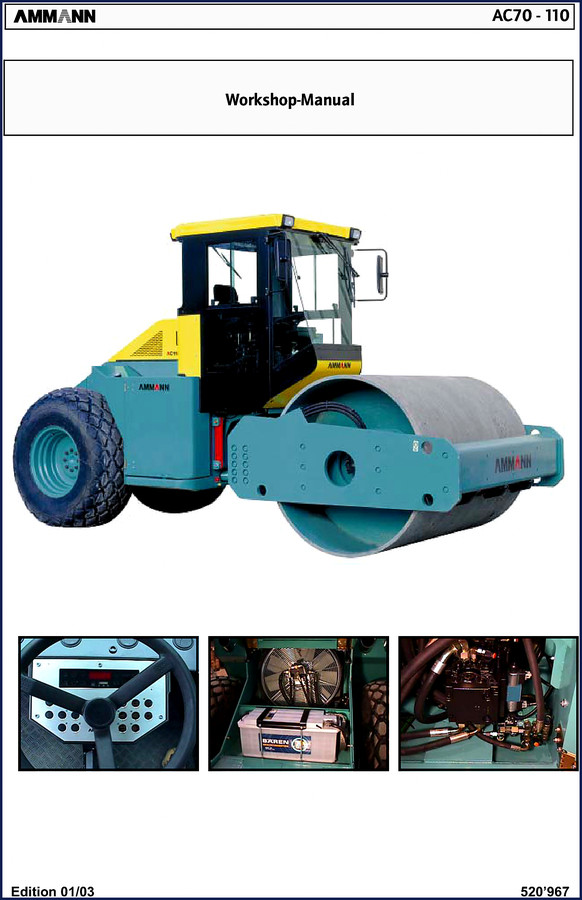
Ammann AC70, AC110 Workshop Manual
If you are maintaining an Ammann AC70 or AC110 roller, you already know that guessing on hydraulic pressures or wiring pinouts gets expensive fast. This is the factory Workshop Manual – not a third-party summary, not a reprint of a reprint. It is the same 96-page document Ammann sent to dealer techs. You get the actual pressure test sequences, the original electrical diagrams, and the torque specs that keep components from leaking or failing.
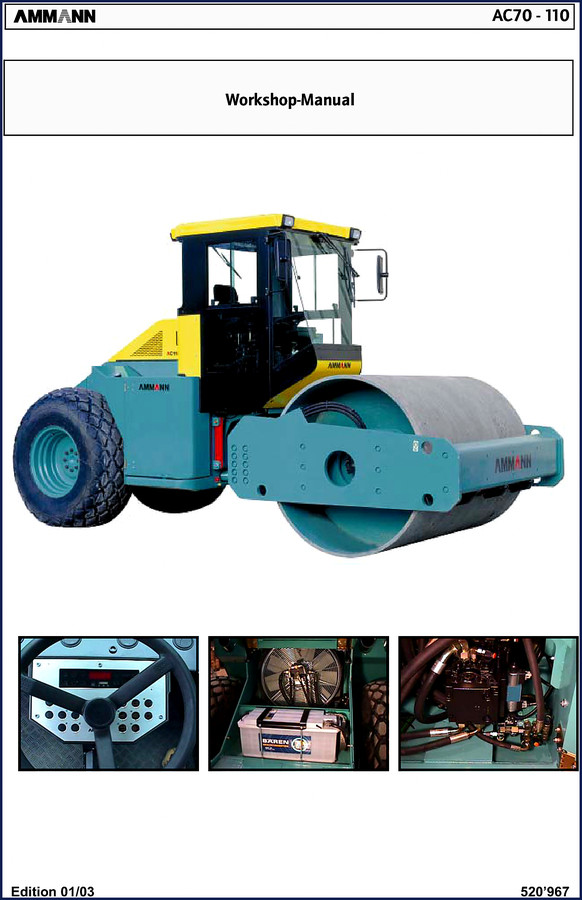
What the 96 Pages Cover
The manual opens with general layout and instrument panel displays (N-version and HD-version). You get the exact brake release procedure for towing – critical when the machine is dead on site. Then it splits into dedicated sections for the AC70 and AC110 hydraulic systems. Each includes component locations, hydraulic diagrams, and a step-by-step pressure check procedure. All values in the hydraulic adjustment section are stated at a specified oil temperature – that is the kind of detail that prevents you from chasing a phantom leak.
Hydraulic Pressure Checks: AC70 vs AC110
Pages 18 through 21 cover the AC70 pressure checks. Pages after that cover the AC110. The manual lists “Alle angegebenen Werte gelten bei:” meaning all stated values are valid under defined conditions – oil temperature, engine RPM, and viscosity. You need that data to set the charge pressure correctly. The hydraulic diagrams are schematics, not cartoons – they show port numbers and test points. Do not rely on a generic hydraulic diagram for a different roller model. This one matches the AC70-2 and AC110-2 series.
Electrical Diagrams Without Crossed Wires
The “Electric” section gives full wiring diagrams for both models, plus legends for every connector and wire color. Working on a machine that uses CAN bus and older relay logic? The manual separates the AC70 and AC110 electrical diagrams clearly. Error message tables list control and warning lamps: battery charging, low engine oil pressure, high coolant temperature, low brake/supply pressure, clogged air filter. Understanding a manual transmission helps with gear-driven hydraulic pumps, but this manual handles the electrical side. For deeper background on gear ratios, see the Manual Transmission article.
Brake System and Towing Procedures
Releasing the parking brake on a dead roller is not something you want to figure out on the fly. Page 5 covers speed control, travel selection, and parking brake release. The “Towing the single drum roller” section explains how to set the towing block, build hydraulic pressure to release the brake, and then switch the brake valve back to working position after towing. Skipping that step damages the brake piston. The manual includes front and rear towing eye positions.
Maintenance Schedules and Fluid Specs
The maintenance chart covers daily, 500-hour, 1000-hour, and annual intervals. Cummins engine maintenance is separated from roller drum service. You get the hydraulic oil change procedure, suction filter replacement, pressure filter replacement, fuel filter venting, and roller drum oil change. The operating fluids table lists approved oils and capacities. If you need to service a different Ammann roller, check the Ammann AV1-2 & AV2-2 Rollers Workshop Manual 2006″>Ammann AV1-2 & AV2-2 Rollers Workshop Manual 2006 or the Ammann AP 240 H Pneumatic Tyred Roller Workshop Manual 2015″>Ammann AP 240 H Pneumatic Tyred Roller Workshop Manual 2015. For larger rollers, the Ammann ASC 110 & ASC 130 ACE II Workshop Manual”>Ammann ASC 110 & ASC 130 ACE II Workshop Manual covers similar hydraulic and brake systems.
Understanding a Manual Transmission is useful when troubleshooting the travel drive gearbox on these rollers, though the manual provides its own gear oil change procedure.
Who Needs This Manual
You are an equipment owner, a fleet mechanic, or a shop that handles compaction equipment. The manual is written for someone who can read a hydraulic schematic and turn a wrench. Beginners will need to learn basic terms, but the procedures are stepwise. You will not find “turn the knob clockwise until it feels right.” Every pressure adjustment gives a value with a tolerance. Every fuse replacement gives the amp rating. That is the difference between factory documentation and an aftermarket knockoff.
Source Validity: Factory Ammann Print
This is the original Ammann workshop manual, edition 01/03, with part number 520’967. The PDF is scanned from the printed book. No aftermarket publisher translated it or removed pages. If you have ever been burned by a “universal” wiring diagram that did not match the machine’s harness, you will appreciate the legends and connector callouts. The manual covers AC70-2 and AC110-2 models from serial number 0001 onward.
- Does this manual cover the AC70-2 and AC110-2 models?
- Yes, the hydraulic and electrical sections are split between the two models. The TOC lists “Hydraulic AC70-2 0001-” and “Hydraulic AC110-2 0001-” separately.
- What kind of hydraulic pressure data is included?
- The manual gives test conditions (oil temperature, engine speed) and pressure values for each circuit. The AC70 section runs from page 13 to 21, with adjustment procedures repeated for clarity. The AC110 section starts at page 22. You get pump pressures, charge pressures, and brake release pressures. All values are stated in bar and can be converted to psi. The manual also shows where to install pressure gauges. Without this data, you are just cranking adjustments blind.
If you work on Ammann rollers and need the actual factory specs instead of guesswork, Download the Factory Manual today. It will sit on your tablet or in your binder, ready when the machine throws a code or the brake refuses to release.
William H. –
This is just what I was looking for. The text is searchable and easy to navigate. Contains detailed bolt torque specs for Ammann. Saves me so much time.