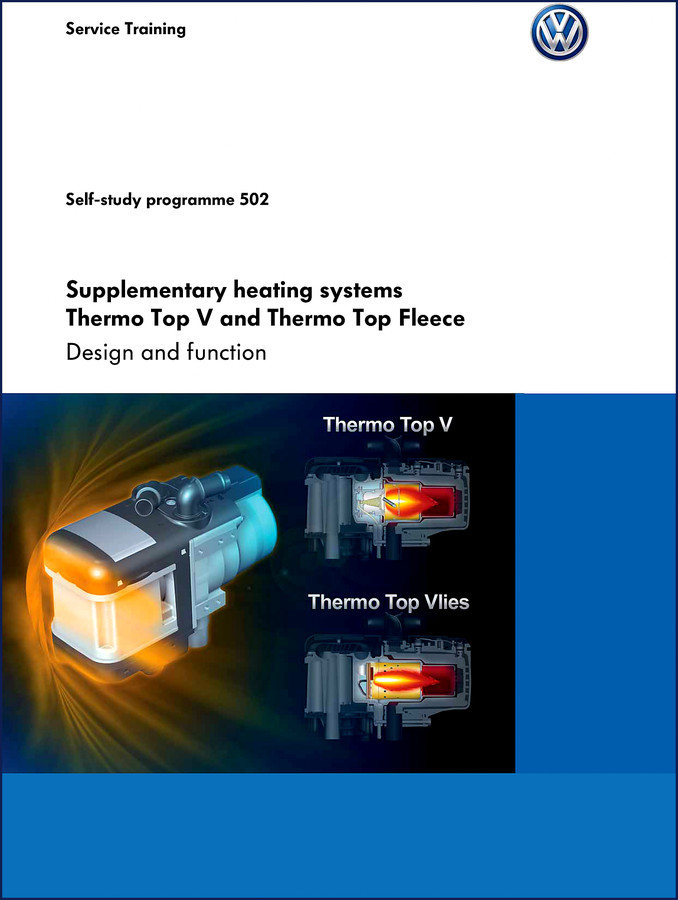
Webasto Thermo Top V, Thermo Top Fleece Training Manual
If you’ve ever had a Webasto heater leave a customer cold because you guessed at the combustion air blower sequence or wired the coolant pump backward, you know the feeling. Aftermarket diagrams with missing pinouts and generic flow charts waste billable hours. This 56-page Webasto Thermo Top V, Thermo Top Fleece Training Manual is the real thing — factory training material from the people who built the units. It won’t give you a step-by-step removal procedure, but it will tell you exactly how the control logic works, where the fuel dosing pump sits in the system, and why the temperature sensor G18 behaves differently on the Fleece model. That knowledge stops you from throwing parts at a problem.
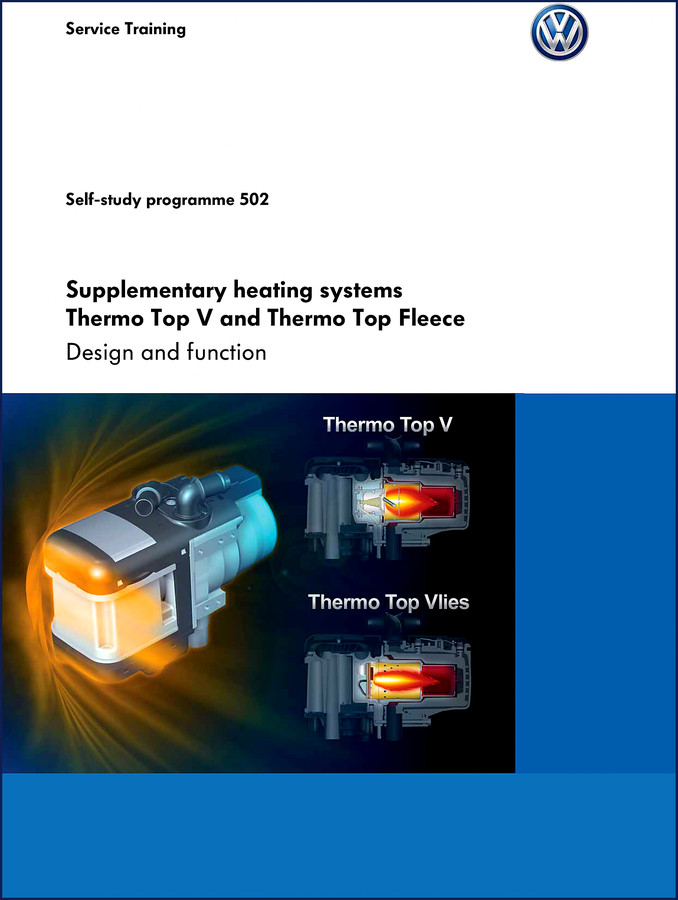
Thermo Top V – Component Overview
Chapter 3 breaks down the Thermo Top V into its physical pieces: combustion air blower V6, heat exchanger with burner insert, and the control board. The manual calls out the functional overview on page 12, showing how the glow plug, flame sensor, and coolant pump interact during the start cycle. If you’re chasing a unit that fires then dies after 30 seconds, start with the combustion air blower. The manual explains the intake path and the pressure drop that can fool the control unit. I’ve seen guys replace the whole burner head because they didn’t understand that a kinked intake hose triggers the same fault code as a failed glow plug.
Thermo Top Fleece – What Changes
Same basic platform, different combustion insert. The Fleece model uses a “combustion insert” instead of the standard burner insert. That changes the air-fuel mixing and the glow plug timing. Page 24 shows the overview of components for the Fleece variant. The fuel supply system chapter (page 37) applies to both models, but the nozzle orientation differs. If you swap a Thermo Top V into a vehicle that originally had a Fleece, the exhaust gas temperature sensor may trigger overheat shutdown because the flame cone angle is off. The manual doesn’t spell out retrofits, but knowing the hardware difference saves a diagnostic loop.
Fuel Supply System – Common Failure Points
The supplementary heating system gets its fuel from the vehicle’s main tank via a dosing pump. The manual covers the fuel supply system in a dedicated section — tank withdrawal height, line routing, and the pump’s pulse rate. I’ve had three calls this month alone from guys whose Webasto ran rough because they used rubber fuel line instead of the factory-recommended nylon tubing. The manual won’t list a part number for the line, but it explains the pressure requirements. That’s enough to know you can’t sub in a generic hose. Webasto Air Top 2000 D & B Service Manual – OEM Shop Data”>Related manual for air heaters follows the same philosophy — don’t guess, get the factory data.
Coolant Circuit Integration
Most installation failures happen here. The supplementary heater sits in the coolant loop between the engine and the cabin heat exchanger. The manual maps the coolant circuit on page 40, showing the flow direction and the location of the non-return valve. If you plumb the heater backward, the water pump stalls and the unit overheats within two minutes. The manual doesn’t provide a torque spec for the hose clamps, but it does explain why the coolant must flow in a specific path: to preheat the engine block, not just the cabin. Hyundai Kia Transaxle Training Manual”>Similar factory training applies to thermal management on those vehicles — it’s about understanding the system, not memorizing a sequence.
Heating System Management – Control Unit J364
The brains of the operation. The manual details switch-on and switch-off conditions, the role of temperature sensor G18 and overheating sensor G189, and the network communication. A common DIY mistake: connecting the heater directly to battery power without the LIN bus signal from the vehicle’s J364 controller. The heater runs a self-test, detects no communication, and shuts down. Page 42 shows the system overview and the network architecture. Gottwald HMK 260E Training Course Manual 2003″>Heavy equipment training uses similar logic — you need to understand the control loop before you touch the wiring.
Test Your Knowledge – Why This Matters
The manual ends with a “Test your knowledge” section on page 54. It’s not a joke. Working through those questions before you crack open a unit will keep you from chasing ghosts. For instance: “What happens if the combustion air blower fails during the start phase?” Answer: the control unit aborts the start attempt and locks out for 30 seconds. Knowing that stops you from replacing the fuel pump when the real problem is a seized blower bearing.
This isn’t a repair manual. It’s a training manual — 56 pages of design and function. If you need torque specs for the heat exchanger bolts or a wiring diagram for a specific vehicle, you’ll need the workshop literature listed in the introduction. But if you want to understand how a Webasto Thermo Top V or Thermo Top Fleece actually works, this is the document you put on your tablet before you touch the customer’s car. Automotive Industry Overview”>Industry standards for heater training are sparse; this is the real deal. Manual Transmission”>Similar OEM training covers drivetrain — same principle, different system.
- Does this manual cover the Thermo Top Evo or other Webasto models?
- No. This is specific to Thermo Top V and Thermo Top Fleece only.
- Can I use this to diagnose a no-heat condition on a Volkswagen with a Webasto unit?
- Yes — provided the vehicle has one of these two heaters. The manual explains the switch-on conditions (engine running, coolant temperature below threshold, timer or remote signal) and the control unit logic. It will not give you a step-by-step diagnostic flow chart, but it will tell you what the system expects to see from the sensors. If you read the fuel supply and coolant circuit sections, you’ll understand whether the problem is fuel delivery, coolant flow, or a control unit that isn’t receiving the proper inputs. Combine this with the vehicle-specific electrical wiring diagram, and you can narrow down a no-heat issue in under an hour.
You need the factory line of thinking. Stop relying on forum posts and Chilton diagrams. Download the Factory Manual from AutoRepairManuals and keep it on the bench. The 56 pages of Webasto design theory will save you more time than any aftermarket DVD ever could.
Richard G. –
This is exactly what I required. The scan is high-quality and well indexed. Contains detailed schematics for Webasto. Highly recommended for mechanics.