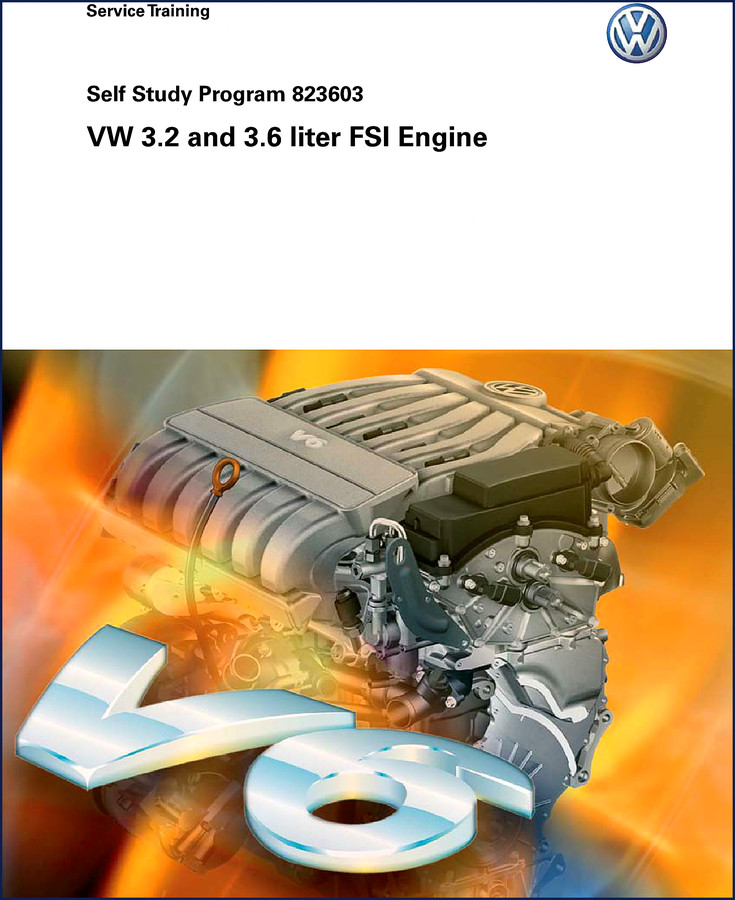
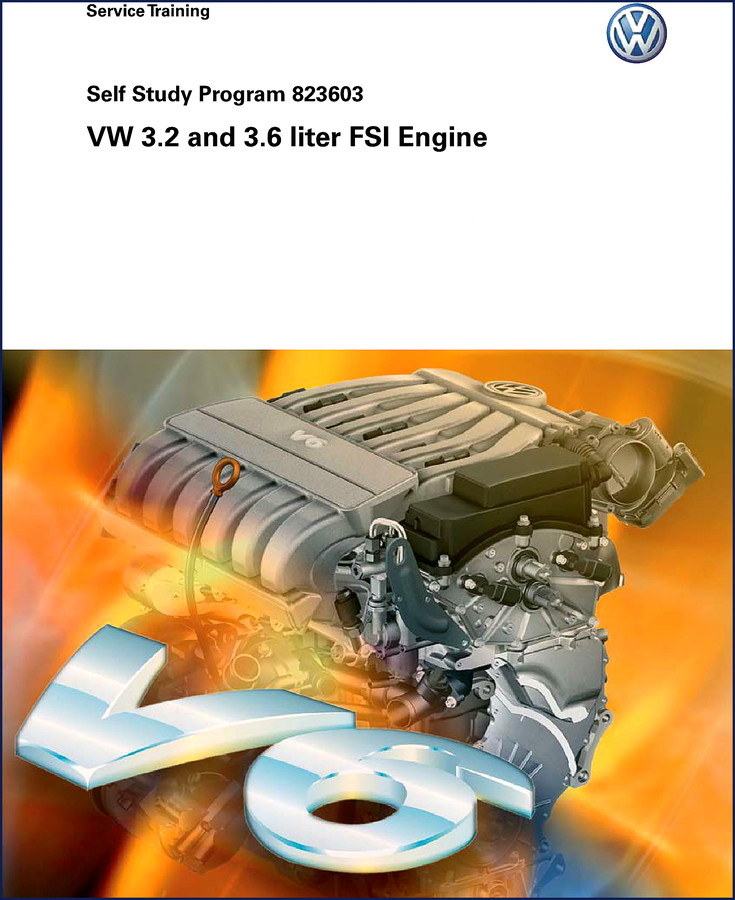
Volkswagen 3.2, 3.6 2006 Training Manual – Factory Engine Design & Function
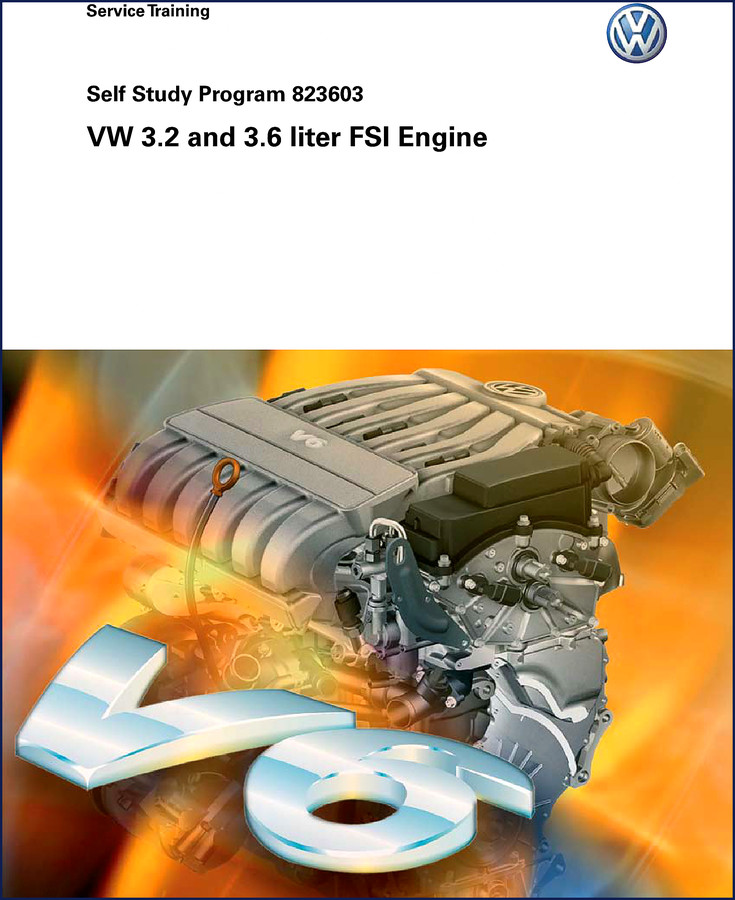 If you’re working on any VW VR6–based 3.2L or 3.6L FSI engine, you need to understand how these engines think. This is the actual 2006 Self-Study Program from Volkswagen – course number 823603. It’s not a repair manual, and they tell you that on page 3. What it is: a 72-page deep dive into the design, mechanics, and management of the VW 3.2 and 3.6 liter FSI engines. I have torqued head bolts on these engines. I know the difference between guessing and knowing. This manual gives you the knowing part – how the variable intake manifold works, what the fuel system logic is doing, why the V-angle is reduced. You want to diagnose a misfire or an intake runner fault? Start here, not with a generic scan tool video.
Engine Mechanics – Page 15
Page 15 kicks off the mechanical section. Crankshaft, connecting rods, piston cooling jets, timing chain layout. The VR family uses a narrow 10.6-degree V-angle, and the 3.6L has a longer stroke than the 3.2L. If you are rebuilding one of these, you need the factory design specs – bolt stretch limits, bearing clearance ranges, chain tensioner preload values. That information lives in this manual. It also explains the variable intake manifold tuning and the two-stage oil pump. Don’t reach for aftermarket data on this – the OEM training manual has the diagrams the factory uses to teach their own techs.
Engine Management – What the 40-Page Section Covers
Starting at page 40, this section breaks down the Motronic MED 9.5.1 system. Fuel injection strategy, knock control, throttle adaptation, camshaft adjustment. It shows you the sensor input/output matrix and how the ECU calculates injection timing under stratified and homogeneous modes. If you are chasing a fuel trim issue or a no-start on a 3.6L, understanding the high-pressure fuel pump control and pressure sensor logic from this manual will save you hours of scope time. It also includes the wiring for the secondary air injection and EVAP system. The diagrams on page 59 are worth the price alone.
Get the Fuel System Fundamentals from Basics
Pages 4 through 14 cover the basics: fuel quality requirements, knock sensor sensitivity, and the FSI combustion process. This is where you find out why the 3.2L uses a different piston crown than the 3.6L. The manual explains the stratified charge and homogeneous charge modes. If you are a beginner, start here. If you are a pro, you will still pick up details about the pressure regulating valve and returnless fuel system that most aftermarket diagrams get wrong. I’ve seen aftermarket manuals that show the fuel line routing backwards. This one shows it like the assembly line builds it.
3 Reasons to Stick with OEM Documentation
First: the torque sequences in aftermarket books are often copied from earlier revisions. Volkswagen Academy printed this in 2006, and it reflects the production specs at that time. Second: the operating diagrams on page 59 show the exact fuel and air flow paths under different loads. Third: the knowledge assessment on page 67 tests your understanding of the VR engine’s unique features. You cannot get that from an aftermarket guide. This training manual is the OEM source for the VR6 FSI design – not a generic rewrite. Check the Automotive Industry Overview for context on why factory documentation matters for professional repairs.
How to Use the Operating Diagrams
Pages 59 through 64 contain full color system schematics. These are not wiring diagrams in the traditional sense – they show fuel pressure, air flow, and electrical signal paths during start, idle, acceleration, and deceleration. If you are diagnosing a stumble on a 3.2L, pull up the diagram for part-load enrichment. The manual shows you what the ECU expects to see from the MAF, oxygen sensors, and fuel pressure sensor. Having that baseline saves you from chasing ghosts. Use this alongside the Manual Transmission section if your car is a stick – but note this manual focuses on the engine, not the gearbox.
FAQ
- Is this a repair manual with torque specs and step-by-step rebuild instructions?
- No. Page 3 states clearly: “This Self-Study Program is not a Repair Manual.” It will not give you head bolt torque values or timing chain replacement steps. It educates you on the engine’s design and function so you understand the theory behind the repairs. Use it as a supplement to the factory repair manual (which we also carry).
- Can I diagnose a specific fault code (e.g., P0087) using this manual?
- Not directly. The manual does not list diagnostic trouble codes. However, the engine management section (pages 40–58) explains the fuel pressure control system, injector firing order, and knock control. If you understand the system logic from this training manual, you will pinpoint which sensor or actuator is causing the code faster than by guessing. The operating diagrams on page 59 are particularly helpful for fuel system diagnosis.
If you work on VW VR6 FSI engines, this training manual belongs on your tablet or print binder. It is the factory’s own explanation of the 3.2L and 3.6L – not a third-party approximation. Related manuals you might need: VW 3.2 and 3.6 liter FSI Engine Self Study Program (this one), Volkswagen 2.3-ltr. V5 Training Manual – OEM Factory Specs, and Volkswagen Passat 2005 Training Manual – Technical Overview. Download the Factory Manual today and get the OEM design data that makes diagnostics stick.
William H. –
Five stars! Immediate link after checkout. Every spec sheet is included for Volkswagen VW. I will definitely buy again.
gearhead88 –
Great OEM spec sheet. It is easily zoomable on my iPad without losing quality. A must-have for any Volkswagen VW owner doing repairs. Saved my repair job! Thank you.