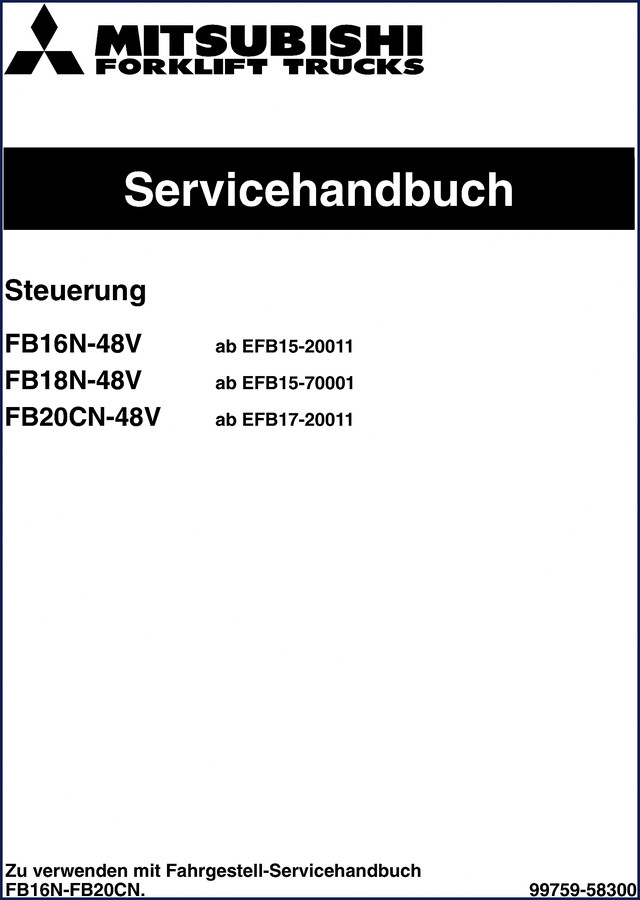
Mitsubishi FB16N, FB18N, FB20CN Service Manual
If you’re working on a Mitsubishi electric forklift and the mast starts drifting or the controller throws a code, you don’t have time to guess. I’ve been under hoods for 28 years, and the difference between a factory print and a third-party PDF shows up when the bolt is halfway stripped. This Mitsubishi FB16N, FB18N, FB20CN Service Manual is what you need on the bench — straight from the engineering department, not some scan of a copy that lost its margin notes.
The manual covers three models: FB16N (48V, from serial EFB15-20011), FB18N (48V, from EFB15-70001), and FB20CN (48V, from EFB17-20011). It’s designed to be used alongside the control unit maintenance manual. 282 pages of factory procedure, not a summary.
Safety Warnings on Page 5 – Not Optional
Page 5 lays out the safety symbols you’ll see through the whole book. The warning triangle for serious injury or death, the caution for machine damage, and the note for reduced service life. It also tells you to lower the forks or block them before any work, and to use steps and handrails when mounting. I’ve seen a tech skip the blocking step once. The floor doesn’t listen to excuses. The manual spells this out because Mitsubishi expects you to read it before you touch a wrench.
Exploded Views and Disassembly Sequence
Page 4 shows an example exploded drawing with a callout list — parts like “Abdeckung, Bolzen, Unterlegscheibe” (cover, bolt, washer) followed by a disassembly order and a tip for pulling the output shaft. Each section follows that pattern: picture, part list, sequence, then suggestions. That’s how you avoid forcing a cover off that’s still clipped on the back side. The manual gives you standard values and service limits in millimeters — like piston-to-cylinder clearance 0.020 to 0.105 mm with a limit of 0.15 mm. You need that number before you decide whether to hone or replace.
What You Get with 282 Pages of Factory Data
This is not a highlights reel. The table of contents groups instructions by system — chassis, mast, options — so you can jump straight to the section you need. There’s a preface on page 3 that tells you the manual applies to 1.6, 1.8, and 2.0 ton capacity trucks with the serial numbers listed. Publication number 99759-57300. Every page is a factory release, not a reprint. The specs match what you’d see if you called Mitsubishi tech support — assuming you could get them on the phone.
Who Needs This Manual?
If you own a small fleet of these forklifts or you’re the one technician in a warehouse who has to keep them running, this is your reference. The DIY crowd will appreciate the step‑by‑step disassembly order because it keeps you from pulling parts in the wrong sequence. Beginners should read the safety warnings on page 5 twice before any electrical work — 48V systems can arc hard if you short a terminal. Professional mechanics will rely on the clearance specs and torque values (though the manual uses metric; you’ll need your conversion chart). Shop owners benefit from a single source of truth for your techs — less downtime arguing over what the spec should be.
Why OEM Beats Aftermarket Every Time
Aftermarket manuals cost less up front, but they cost you in hidden mistakes: wrong shim tolerances, missing torque sequences, electrical diagrams that skip a fuse. This is a factory Mitsubishi release — same binder that plant engineers used. The OCR excerpt shows the original German text with safety symbols and the Mitsubishi logo on every page. When I see a publication number like 99759‑57300, I know I’m holding an official document. Save yourself the headache of buying a generic guide that leaves out the mast tilt cylinder rebuild steps.
Frequently Asked Questions
- Which models and years does this manual cover?
- It covers Mitsubishi FB16N, FB18N, and FB20CN 48V forklifts starting from serial numbers EFB15-20011 (FB16N), EFB15-70001 (FB18N), and EFB17-20011 (FB20CN). The exact year of publication isn’t listed, but the serial range indicates a specific production cut‑in. Cross‑reference your truck’s serial plate before ordering.
- Are torque specs given in the manual?
- Yes, the manual includes torque values for critical fasteners. The specs are in Nm, so have a conversion chart handy for ft‑lb. Page cites within each procedure.
Look at the work you have waiting in the bay — mast drift, controller faults, hydraulic leaks. A factory spec eliminates the guesswork. Mitsubishi FB16N FB18N FB20CN Service Manual is the same manual used by dealer techs. If you need related documents, check the Mitsubishi Dodge Stealth R/T Turbo 3000GT VR4 GTO Service Manual for passenger car diagnostics or the Mitsubishi Eclipse Spyder 1996 Service Manual – Factory Specs & Wiring for a different chassis. For a broader perspective on industry repair standards, see the Automotive Industry Overview and Automotive Industry Overview.
Download the Factory Manual and put it on the tablet next to your tool cart. 282 pages, no filler.
diy_master –
Five stars! The download quality is excellent. It guided me to repair my Mitsubishi FB16N transmission. Worth every penny.
William H. –
I am so happy with this purchase. The pages are clean and easy to navigate. It guided me to fix my Mitsubishi FB16N electrical connector. Saves me a lot of dollars.