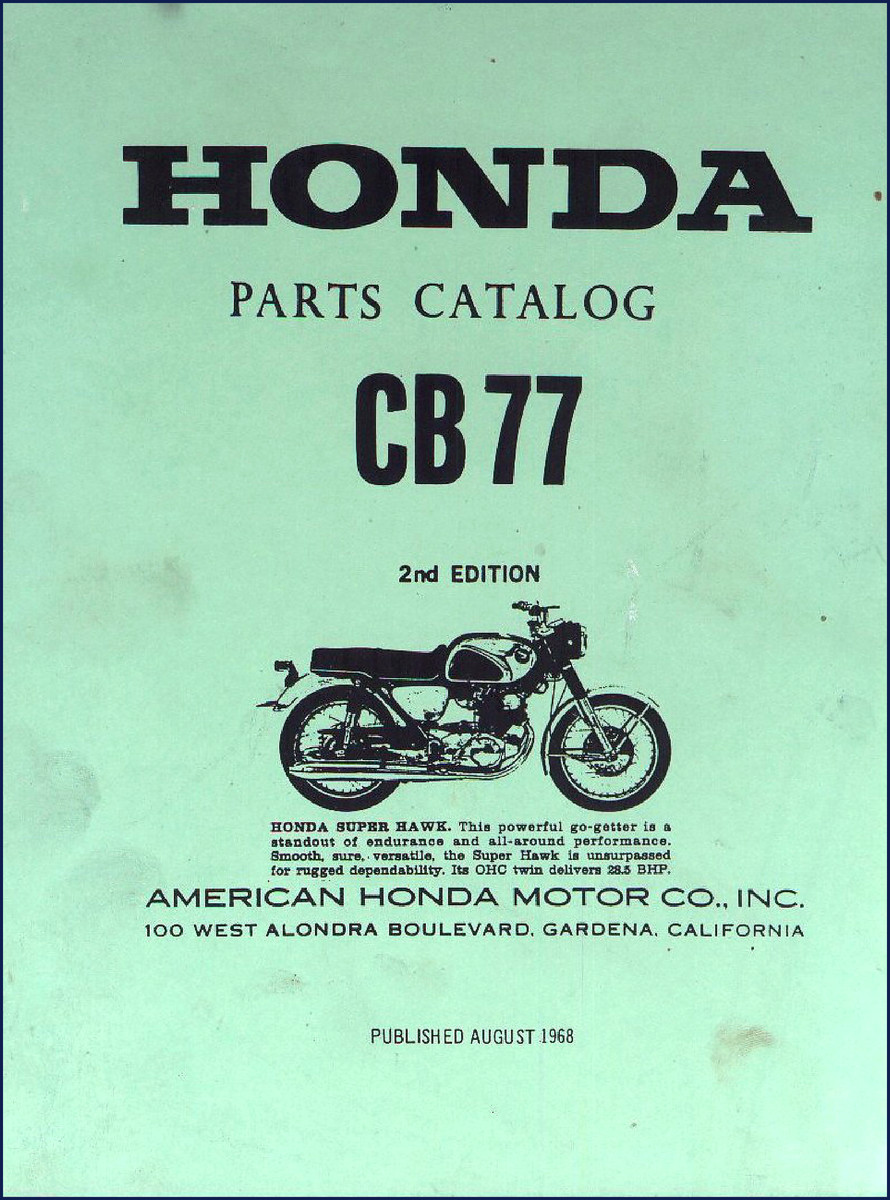
Honda CB 77 1968 Parts Catalog
If you’re digging into a Honda CB 77 1968 Parts Catalog, you need the factory parts breakdown. I’ve been turning wrenches since these Super Hawks were new, and I’ve seen too many guys order the wrong piston or gasket because they guessed from a grainy photo. This is the real deal – 116 pages, printed August 1968, straight from American Honda. It gives you the part numbers, the exploded views, and the thread pitch changes that will keep you from stripping a bolt. No aftermarket reprints, no fuzzy scans.
Engine Group: What the Exploded Views Cover
The Engine Group section breaks down every major assembly: Cylinder, Crankshaft, Camshaft, Valve and cam chain, upper and lower crankcase, clutch, left crankcase cover, Transmission, gear change, kick starter, oil pump, magneto, starting motor, contact breaker, and both right and left carburetors. Each part gets an exploded diagram with a Honda part number and the H/C code. You want to know which circlip goes on the crank? It’s in this section. No cross-referencing to a vague drawing.
3 Sections That Save You Guesswork
First, the parts number system explanation on page 3 – that page alone is worth the price. Second, the ISO thread change table: Honda modified the hex sizes and thread pitches for 3mm, 4mm, 5mm, and 12mm bolts. If you just grab a 10mm wrench for a 6mm bolt in this vintage, you’ll round the head. The catalog tells you the new wrench sizes (5.5mm, 7mm, etc.). Third, the gasket set list at the back – common tools and special tools needed for assembly. Three sections, no filler.
Parts Numbers and the ISO Thread Change
Flip to page 3 and you’ll see the Honda part number system broken down: function number, component number, product number, classification number, color code. That’s how you decode a number like 16100223030A. Then right there is the ISO conversion table for bolts. The catalog explicitly warns: “Care must be taken to use the correct pitch to avoid stripping.” I’ve seen stripped threads on restored bikes because someone used an old JIS 0.9mm pitch on a 5mm bolt that now needs 0.8mm. This catalog gives you the data – use it.
Does This Catalog Cover the Frame and Fuel System?
Yes. The Frame Group includes handle bar, front fork, steering stem, front fender, Fuel tank, frame body, air cleaner case, dual seat, main stand, exhaust pipe, muffler, rear fork, rear fender, rear cushion, front and rear wheels, headlight, speedometer, dimmer switch, wire harness, battery, tail light. That’s every bolt and bracket for the rolling chassis. If you need the rubber grommet for the fuel tank petcock, it’s in the Fuel Tank subsection – part number and Honda code listed. You won’t be hunting through a generic “fuel system” chapter that leaves out dimensions.
Source Authenticity: Why OEM Beats Aftermarket
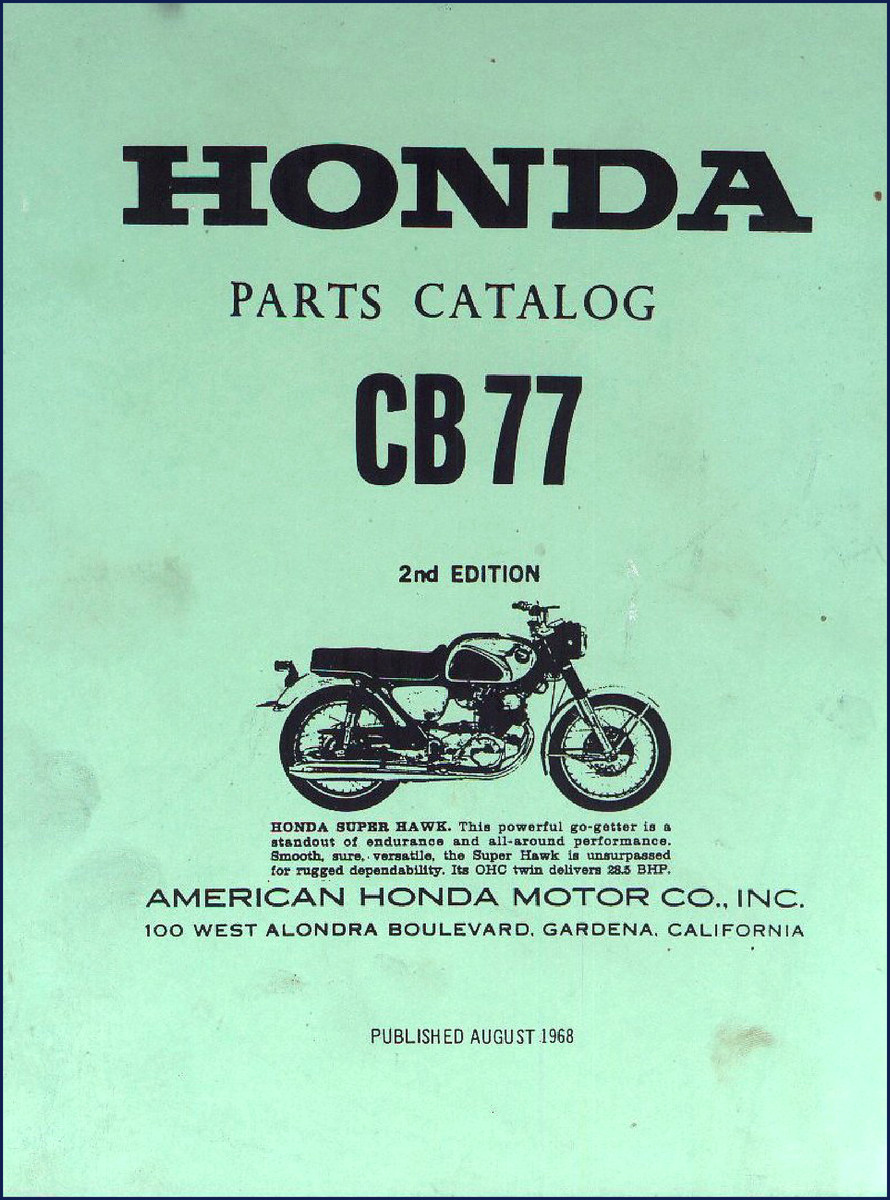
Aftermarket parts catalogs often redraw the diagrams and lose the bolt torque markings or thread pitch notes. This is an original Honda print – second edition, 1968. The OCR excerpt shows the actual page 1: “HONDA PARTS CATALOG CB 77 2nd EDITION.” The drawings are crisp, the part numbers are the ones dealers used. When you order a camshaft for a 1968 CB 77, you want the exact part number, not a supersession guess. That’s what this delivers. Also check related factory manuals like the Honda VFR750F 1994 Parts Catalog – OEM Factory Parts Breakdown or the Honda VFR400R VFR400Z 1989 Parts Catalog – OEM Factory Manual for similar level of detail. For scooters, the Honda PCX150, WW150EX 2014 Parts Catalog – OEM Factory Manual follows the same format. For an overview of the industry standards, read the Automotive Industry Overview and for battery specs see Automotive Battery.
FAQ
- How do I find the correct part number for the clutch?
- Check the Clutch section under Engine Group on page 3.
- What about frame parts like the fuel tank?
- The Frame Group starts after the Engine Group and includes Fuel Tank, Frame Body, and every bracket. Each part has an exploded diagram with the Honda part number and Honda Code (H/C) to the left. If your fuel tank has a paint code, the catalog lists the color-code suffix (e.g., “A” for the 1968 Candy Red). Aftermarket catalogs often skip the color suffix, which means you order a tank that says “CB77” but doesn’t match the factory stripe or emblem holes. This OEM catalog gets it right because it was built from the same engineering drawings used to assemble the bike. Use the H/C when ordering from American Honda – that code is still valid for NOS parts in many cases.
You’ve got the bike in pieces on the bench. The cylinder head is off, and you’re staring at the cam chain tensioner. Without this catalog, you’ll be guessing which spring or spacer goes where. With it, you pull up the Camshaft, Valve, Cam Chain page, match the exploded view to your parts, and write down the part numbers. That’s the difference between a Saturday rebuild and a month-long headache. Download the Factory Manual and get the parts list that Honda mechanics used.

Reviews
There are no reviews yet.