
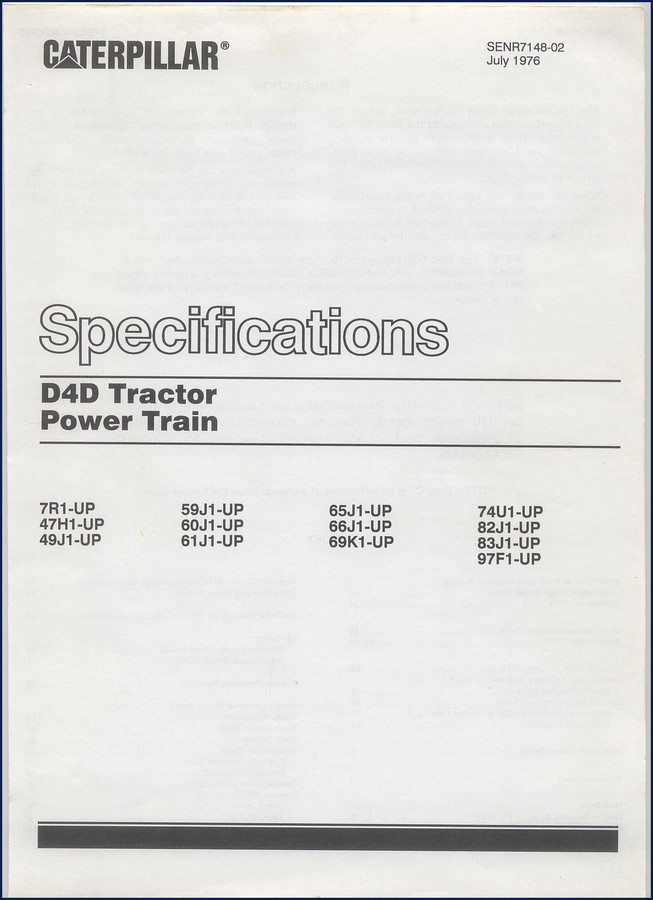
I have seen too many guys waste a Saturday chasing a spec that some aftermarket PDF got wrong. That is why I keep a copy of the original 1976 Caterpillar D4D 1976 Service Manual on the shelf. This is the real deal – 24 pages of factory-printed power train specs from July 1976, straight out of Peoria. Not a scan, not a reprint. Every torque value, every clearance, every oil pump pressure comes from Caterpillar’s own engineering department. You are not guessing.
Final Drive Sprocket Bearing Adjustment – Page 17
Page 17 walks you through the sprocket bearing adjustment procedure. You will need a dial indicator and a feeler gauge. Specs are given in thousandths of an inch. The manual tells you the exact preload range for the tapered roller bearings and how to check end play. Miss this step and you will cook a bearing inside a hundred hours. I have seen it happen.
Hydraulic Controls for the Power Shift Transmission
Section on page 12 covers the hydraulic controls for the power shift transmission. It lists the pressure regulator setting, the clutch engagement sequence, and the required tooling to test without tearing into the valve body. If your D4D lurches or slips, start here. The factory gives you the test port locations and the pressures in psi. Aftermarket manuals will guess the pressure – this one does not.
Torque Converter and Bevel Gear Specs – Page 7
Page 7 is where you find the torque converter stall speed test procedure and the bevel gear backlash specification. The bevel pinion and ring gear setup matters. You get the depth and shim selection process from the same section. The manual tells you to use a dial indicator with a magnetic base – part number not listed, but you should have one. The backlash range is 0.006 to 0.012 inch. Do not guess.
Why Factory Specs Beat Aftermarket PDFs
Aftermarket documentation rarely includes the “use again” and “permissible” tolerances that Caterpillar printed in this manual. The chart on page 2 spells it out: if a part measures within the permissible range, you can run it. If not, replace it. That decision gets expensive if you use a generic torque chart from some online forum. This manual also has the original general tightening torque table for bolts, nuts, and taperlock studs – tested with Caterpillar hardware, not SAE grade junk.
Rollover Protective Structure – Page 22
Page 22 covers the rollover protective structure (ROPS) installation and hardware torque. This is not optional. The frame bolts must be torqued to factory spec or the structure does not meet the design limits. I have watched guys back off because they thought “tight enough” meant done. That is how people get hurt. The manual gives you the exact ft-lb value for each fastener.
Who Needs This Manual?
If you own a D4D tractor with serial numbers 7R1-UP, 47H1-UP, 49J1-UP, 59J1-UP, 60J1-UP, 61J1-UP, 65J1-UP, 66J1-UP, 69K1-UP, 74U1-UP, 82J1-UP, 83J1-UP, or 97F1-UP, then this manual matches your machine. The power train section covers both direct drive and power shift transmissions. You get the flywheel clutch linkage adjustment (page 9), the transfer gear shimming (page 10), and the oil pump specs for both transmission types (page 11). The track roller frame alignment – both hydraulic and mechanical adjustment – is on page 18. The front idler and recoil spring adjustment on page 21. Everything you need to keep that undercarriage square.
Page 17. That is where you find the sprocket bearing adjustment. The rest of the manual fills in the gaps. No filler. No generic diagrams. Just the factory procedure.
- Does this manual cover the track adjustment?
- Yes, page 19 covers track adjustment with the correct sag measurement.
- Why should I trust these torque values over a generic chart?
- Caterpillar engineers tested these bolts with their own hardware and designed the “use again” and “permissible” tolerances specifically for D4D components. A generic SAE chart does not account for the clamping loads required on the bevel gear housing or the steering clutch case. This manual gives you the exact ft-lb values for each fastener location, including the taperlock studs in the final drive. That level of detail eliminates the risk of stripping threads or causing a leak because a bolt was under-torqued. I have seen a steering clutch housing fail because a tech used a generic chart and the bolts loosened under vibration. The factory spec is there for a reason.
Related manuals you might need: Caterpillar D4D Service Manual – Factory Power Train Specs, Caterpillar C175, 3600, C8.7, C12.9 2016 Service Manual – Factory Tool Catalog, Caterpillar 3500B 2002 Service Manual – Factory Specs. For general transmission theory, see the Manual Transmission article on Wikipedia.
Stop chasing bad data and start using the original. Download the Factory Manual from AutoRepairManuals and put it on your bench next to the torque wrench. That is the only way to be sure the job is done right.



Charles W. –
Highly recommended! Quick download after checkout. A must-have for any Caterpillar 1976 DIYer doing maintenance. Saves me a lot of time.
James L. –
I am so happy with this purchase. The PDF is high resolution. It helped me to troubleshoot my Caterpillar 1976 electrical connector. Saved my repair job! Thank you.