
BMW 325i 1988 Troubleshooting Manual
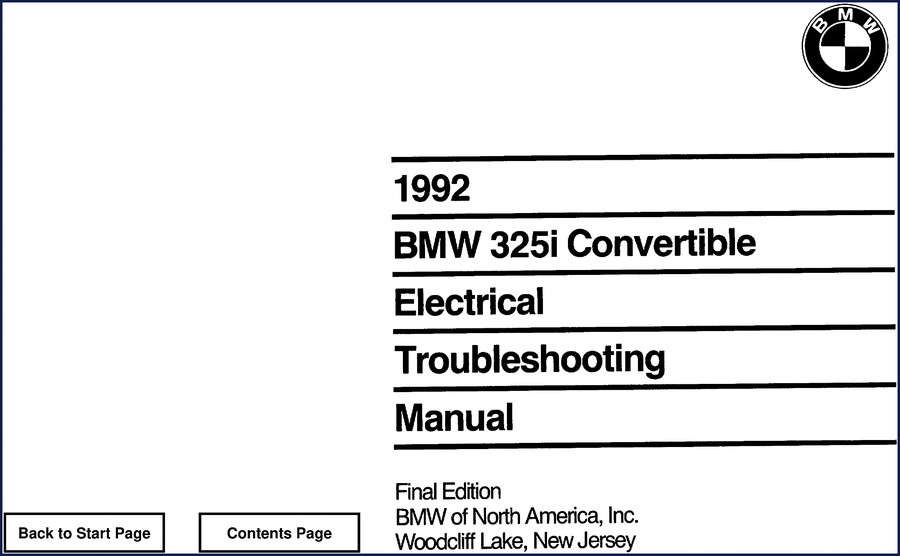
If you are staring at a dead 1988 BMW 325i with no spark and no idea where the power stops, you need this manual. I have been an ASE Master Technician for 28 years, running a 6-bay shop in San Antonio. I have seen more electrical fires caused by guessing than I care to count. This BMW 325i 1988 Troubleshooting Manual is the only document I trust for factory wiring diagrams on these E30 convertibles. It is 135 pages of original OEM data, not some aftermarket reprint that skips the critical splice locations.
You will find the Index on page 4. It lists every circuit alphabetically – from Active Check Control to Wiper/Washer. Need the ABS system? Look under Antilock Braking System, section 3450. The manual includes a How to Use This Manual section on page 3 that explains the symbols. Do not skip it. I have seen guys blow a fuse because they misread a ground symbol.
What the 1988 BMW 325i Troubleshooting Manual Covers
Look at the table of contents. This book covers Power Distribution (0670), Charge System (1230), Start (1240), Injection Electronics (1360), Brake Warning System (3435), and the Antilock Braking System (ABS) (3450). It goes into Body Electrical (6100), including power mirrors, central locking, power windows, seats, and the entire lighting system. The Heating and Air Conditioning section (6410) includes compressor controls and auxiliary fan wiring. For the audio guys, there is Radio/Antenna (6500) and Cruise Control (6571). Every circuit has its own section with component location views (7000), splice location views (8000), and connector views (8500) specific to the 2.5i engine.
ABS Diagnostics: Factory Procedure
For the Antilock Braking System, the manual gives you the exact wiring from the ABS control unit to each wheel sensor. Section 3450 shows the circuit path. I have used this to trace an intermittent ABS light on a customer car – the problem was a corroded splice at location S104. The manual told me exactly where to look. Aftermarket manuals I have seen lump the ABS into one generic diagram. This one breaks it down by pin. You get the connector views in section 8500 that show terminal numbers.
3 Reasons to Choose OEM Documentation
First, the torque specs and wire gauge information come from BMW of North America, not a third-party compiler. Second, the circuit numbers match the actual car – no translation errors. Third, the troubleshooting logic in the Systematic Troubleshooting chapter teaches you to isolate faults without shotgun replacing parts. I have watched a DIYer save $400 in unnecessary parts by following the step sequence in this manual.
Check the Brake Warning System First
If the brake warning light is on, do not start replacing switches. Section 3435 covers the Brake Warning System in detail. It includes the circuit from the brake fluid level switch to the instrument cluster. The manual also cross-references the Component Location Chart (9000) so you can find the physical parts under the dash or in the engine bay. I always tell my guys: start with the simplest circuit – the brake warning system often shares a ground with other electronics.
Systematic Troubleshooting: The Right Way to Trace a Fault
The manual has a dedicated section called Systematic Troubleshooting. It walks you through a logical sequence: identify the symptom, select the appropriate circuit, locate the components, and test using the specified procedures. This is where the manual shines. It tells you what voltage to expect at each test point. For example, the Charge System (1230) gives you the alternator output test procedure. No vague “check for power” – it tells you which pin on the connector to probe and what reading you should get. Use a digital multimeter, not a test light, for these checks.
For the Injection Electronics (1360), the manual includes wiring for the Motronic control unit. If you have a no-start condition, you can trace the power supply from the main relay through to the ECU. The connector views (8500) for the 2.5i engine show the exact pin layout. This is critical because swapping connectors can damage the ECU.
Related manuals you might need: BMW 3 Series 1999-2005 Service Manual for newer models, BMW 3 Series 1992-1998 Service Manual for the E36 generation, and BMW 318i 318is 325i 325is 1993 Electrical Troubleshooting Manual if you work on a later E30 variant. For general automotive electrical knowledge, check the Automotive Industry Overview and Manual Transmission sections on Wikipedia for background on standardized wiring practices.
Frequently Asked Questions
- How many pages is the manual?
- 135 pages, factory-printed.
- Does it include wiring for the ABS system?
- Yes. Section 3450 covers the Antilock Braking System with full circuit diagrams and component locations. The index on page 4 points you right to it.
- Is this a reprint or a digital copy?
- It is a digital scan of the original 1988 BMW factory manual, not a third-party rewrite. The part number on page 2 is PN 88 89 1 000 273 – same as the dealer version. I have seen aftermarket manuals that claim to cover the E30 chassis but leave out critical splice locations or fuse data. This one gives you the exact wire colors, connector views starting at section 8500, and component location views in section 7000. If you are diagnosing a no-crank condition or a brake warning light that stays on, you need the real thing. That is what this is.
- What does the ‘Systematic Troubleshooting’ section teach?
- It teaches a methodical approach – start with the symptom, use the symbols on page 3, then follow the circuit path. No guesswork.
I have used this manual on more than a dozen E30s. The 135 pages cover everything from the central locking system to the auxiliary fan. If you work on a 1988 BMW 325i Convertible, you need the factory data – not a generic diagram that might have been drawn in someone’s basement. Download the Factory Manual now and keep it on your tablet or print it out for the workbench. You will save yourself at least a day of chasing ghosts.
Reviews
There are no reviews yet.