
1991 Operators Manual for International 1462–3900 FC
I’ve been turning wrenches in San Antonio for 28 years, and I’ve seen more than a few guys try to run these old Internationals without cracking the book. Then they wonder why the transmission grinds, the brakes fade, or the engine overheats. This 1991 Operators Manual is what you need on the seat next to you—not buried in the glovebox under receipts. It’s 108 pages of straight talk from Navistar, and it covers the 1462, 1652, 3600, 3700, 3800, and 3900 FC chassis. You don’t guess with these trucks. You follow the factory instructions.

1991 Operators Manual: The Warnings on Page 1
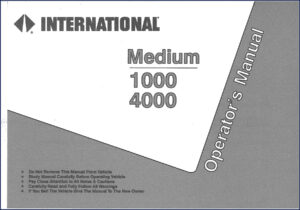
Page 1 of this operator’s manual gets straight to the point: “Do Not Remove This Manual From Vehicle.” That’s not a suggestion. If you sell the truck, the manual goes with it. The warnings on that page remind you to study the book before operating, pay attention to all notes and cautions, and adhere to every warning. I’ve had guys ignore these and end up with a burned-up clutch because they didn’t read the cold-start procedure. This is your safety insurance. The manual stays in the cab.
Maintenance Section – What to Service and When
Page 2 explains that the maintenance section advises what to service and when. That means you get a schedule for oil changes, filter replacements, brake inspections, and more. For a 1991 International with a DT/DTA-360 or 466, you need to know the intervals—not guess. This manual spells it out. I’ve seen DIYers skip the chassis lube and then wonder why the kingpins squeal. Don’t be that guy. Run the schedule from the book.
What Does the Lubrication Section Cover?
The lubrication section tells you when items require attention. Grease fittings, universal joints, steering linkage—everything has a place and a frequency. If you are working on a 3900 FC, you need to know the correct grease type and how many pumps. The manual gives you that data. I use it every time I hit the lube rack. It saves me from over-greasing and blowing seals. If you want to understand the Manual Transmission in these trucks, the lubrication section also covers the transmission lube intervals and capacity.
Unit Refill Capacities – Engine Oil, Coolant, Transmission
One of the most useful parts of this manual is the refill capacity section. It lists exact amounts for engine oil, coolant, transmission fluid, differentials, and hydraulic systems. For the International 7.3L engine, for example, you get the oil capacity in quarts. No guessing. If you are rebuilding or servicing, you reference the specifications section at the back. I’ve had guys dump in 5 gallons of coolant when the system only holds 4.2—then they wonder why it pukes out the overflow. The capacities are all in here.
Specification Section – Tolerances and Adjustments
The specification section covers tire pressures, valve clearances, belt tensions, and other adjustables. This is not a service manual—it’s an operator’s manual—but it gives you the baseline numbers you need for daily operation and minor adjustments. For instance, you’ll find the recommended fuel injection timing range for the DTA-466. That’s critical for proper starting and power. If you need deeper repair data, the manual even includes order forms for official service manuals and sections. That’s how you get the full factory procedures.
I keep a copy of this manual in the cab of every International that comes through my shop. It’s not a reprint or a third-party summary—it’s the original Navistar publication. You need the VIN and component codes from page 3 to order parts correctly. The manual shows you where to find the engine serial number (left front corner of the crankcase for the 7.3L, pad on the left side for the DT/DTA). If you ignore that, you’ll end up with wrong gaskets and wasted time. The Manual Transmission code is also on the line setting ticket—the manual explains that on page A-1.
That’s the level of detail in this 108-page book. It’s not a novel. It’s a working document.
Original Factory Print – Not Aftermarket
I’ve seen aftermarket operators manuals that leave out half the warnings or print the wrong capacities. This one is the real deal. It’s an International (Navistar) publication from 1991, with a copyright notice on page 2 that says “Printed in the United States of America.” The scan is clean, the text is readable, and the warnings are bolded. When you buy from AutoRepairManuals, you get the largest collection of OEM shop manuals in North America. That matters when your customer’s rig is down and you need the factory spec—not a guess.
Related manuals you might need: Hitachi ZAXIS225US-3 2007 Operators Manual | OEM Factory Specs, Libra SK40 Operators Manual – Factory Specs, and Lister-petter TS, TR, TX 2000 Operators Manual | OEM Factory Specs.
- Does this manual include engine torque specifications?
- No. This is an operators manual, not a service manual. It covers operation, maintenance, lubrication, and capacities. For torque specs, you need the corresponding service manual.
- Will this manual work for a 1988 International 3600?
- It was published in 1991, so it covers the models listed: 1462, 1652, 3600, 3700, 3800, and 3900 FC. For a 1988, some specs may differ. Cross-check the VIN and component codes with the manual’s data.
- How many pages is it?
- 108 pages.
- I need wiring diagrams. Are they in this manual?
- No wiring diagrams. This operator’s manual focuses on daily operation, safety, and routine maintenance. For electrical schematics, order the factory service manual using the form at the back of this book.
If you own or work on any of these International trucks, you need the factory instructions. Don’t rely on memory or a faded photocopy. Download the Factory Manual from AutoRepairManuals and keep it in the cab. Your truck—and your wallet—will thank you.
Thomas B. –
Excellent factory service manual. It is easily zoomable on my iPad without losing quality. Contains precise bolt torque specs for vehicle. Saved my repair job! Thanks.