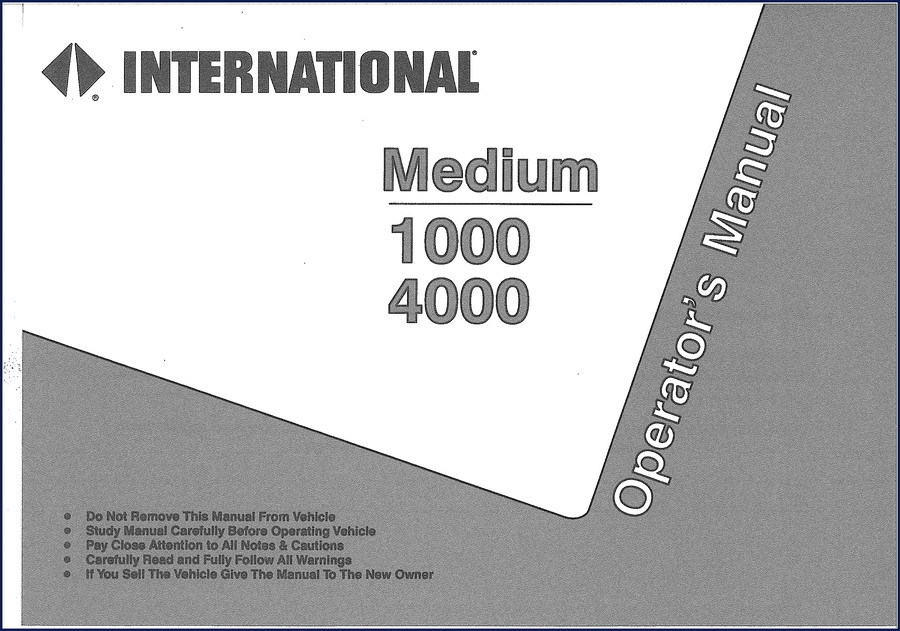
1995 Operators Manual – International Medium 1000-4000 Series
If you’re running an International Medium 1000 or 4000, and you don’t have the factory operators manual in the cab, you’re asking for trouble. I’ve pulled enough wrenches to know that guessing on shift patterns or fluid capacities ends with a tow truck bill. This is the real deal – 246 pages of what Navistar printed for the 1995 model year. It covers the VIN location (page 3), the pre-start inspection, and every warning you need before you even turn the key. Don’t trust a photocopy from a third party; get the OEM version that belongs in the truck. I’ve seen aftermarket ‘condensed’ versions that skip the entire Vehicle Inspection Guide – that’s where you catch a loose drag link before it kills someone. This manual starts with that guide on page 4, and it doesn’t skip anything.
1995 Operators Manual – What You Get
This document is the Navistar-issued 1995 Operators Manual for the International Medium 1000-4000 line. That means it was printed in 1994 for the 1995 model year, and it carries all the original warnings, cautions, and notes from the factory. The table of contents is laid out in sections from V through F – Vehicle Inspection Guide, To The Owner, Operation, Maintenance, Lubrication, Unit Refill Capacities, and Fuse & Bulb Charts. You get the oil change intervals, the fuel filter part numbers, the clutch adjustment procedure – all straight from the engineers who built the truck.
Vehicle Inspection Guide – Start Here
Section V is the first page you read after you park the truck. It’s a pre-trip checklist. Walk around, check tires, lights, fluid levels, belts, and leaks. The manual tells you exactly what to look for and what to do if something’s off. I’ve had guys skip this section and blow a brake chamber on the highway. Don’t be that guy. The guide also includes a form to record each inspection – keep it in the cab and you’ll never miss a week.
What’s in the Operation Section?
Section B covers starting, stopping, driving, and towing. It explains the controls, the gauge layout, and the proper way to operate a manual transmission – yes, it’s a Manual Transmission vehicle, and this manual gives you the shift pattern and clutch break-in procedure. It also covers the PTO operation, the parking brake system, and what to do if you overheat. There’s a separate subsection on winter operation and cold-weather starting aids. Pay attention to the warning labels – they’re there for a reason.
Maintenance and Lubrication: Factory Torque and Fluid Specs
Section C is the heart of the manual. It lists every maintenance interval from daily to 150,000 miles. Oil changes, fuel filter swaps, coolant flushes – all with the exact specs. The lubrication section (D) gives you the grease points, the chassis lube schedule, and the recommended lubricants by weight. Unit Refill Capacities (section E) is the page you’ll flip to when you drain the axle and need to know how much 80W-90 to put back. Don’t guess; use the factory numbers. Aftermarket manuals often round up or down – that’s how you get a seal blowout.
246 Pages of OEM Procedure
Every page is a scan from an original Navistar print. You get the wiring diagrams in the Fuse & Bulb Charts section, plus the component identification numbers for the engine, transmission, front and rear axles, and transfer case. The manual even lists the regional sales offices and the customer relations hotline. This is the document that came with the truck when it was new. 246 pages, no abridgment, no editorializing. Just the facts as the factory wrote them.
Fuse & Bulb Charts – Why Aftermarket Copies Fail
Section F is often the most abused part of a vintage manual – users spill coffee on it, tear it, or lose it. This copy is clean and legible. The fuse charts list each circuit and the amp rating. The bulb charts tell you the socket size and wattage. I’ve seen cheap reprints print the wrong amp ratings because they didn’t update the PDF. This one is a direct scan of the 1995 original. If you’re chasing an electrical gremlin, you need the correct chart, not a guess.
Frequently Asked Questions
- Is this manual the same as a service manual?
- No. This is the operators manual – it covers daily operation, maintenance, and basic troubleshooting, not engine or transmission overhaul. For that you need the service manual.
- Does it cover the 4000 series trucks?
- Yes, and also the 1000 series.
- Can I use this for a 1996 model?
- The manual is for 1995 model year. Later models may have changes. However, the basic operation and maintenance procedures are largely similar. But specifications like fluid capacities, fuse ratings, and some component details could differ. Always cross-reference your VIN and component codes. For example, the engine serial number location (page 3) is the same across many years, but the transmission gearing may have been revised. If you have a 1996, this manual still covers 90% of the info, but double-check any critical specs against the vehicle’s actual decals.
- Where do I find the VIN location?
- Page 3. For the 2000, 4000, 8000, and 9000 series, it’s stamped on a plate on the left door rear post.
Skip it and you’re taking a gamble.
You need this in your glovebox or tool box. Download the Factory Manual now and keep the original instructions in your truck.
Related Manuals
- Hitachi ZAXIS225US-3 2007 Operators Manual | OEM Factory Specs
- Libra SK40 Operators Manual – Factory Specs
- Lister-petter TS, TR, TX 2000 Operators Manual | OEM Factory Specs
For further reading on heavy truck standards, see this Manual Transmission article.
Reviews
There are no reviews yet.