1999-2000 Honda CBR600F4 Service Manual
If you’ve ever cracked open a reprint manual and found a torque spec that’s off by 5 ft-lb, you know the frustration. I’ve seen cylinder heads warped, crankcases cracked, and suspension bolts that let go on the highway because some aftermarket house printed numbers that looked close enough. On a Honda CBR600F4 1999 Service Manual, close enough can cost you an engine. Honda built these bikes with precision tolerances. Section 8 of this OEM manual – the Cylinder Head/Valve chapter – gives you the exact head bolt torque sequence and angle. Page 73 for the charge pressure? No. You need the real factory data from the 361-page document that Honda’s own techs used.
Engine and Drive Train: What the 361 Pages Cover
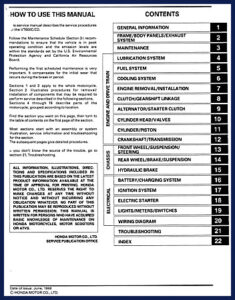
Most people crack the manual when something breaks. But the real value is knowing the tolerances before you pull a wrench. This 1999 Honda CBR600F4 Service Manual covers the entire engine removal and installation sequence (Section 7), the lubrication system (Section 4), and the fuel system (Section 5). You get specifications for the cooling system (Section 6) – including thermostat opening temperature and coolant capacity in imperial units. Section 11 details the crankcase and transmission disassembly. Section 12 covers the crankshaft, piston, and cylinder. If you are splitting the cases, you need the bearing clearance specs from this manual – not a generic guide.
Cylinder Head/Valve Job: Factory Procedure
Doing a top-end rebuild? Section 8 shows you the cylinder head removal, valve clearance adjustment, and the exact shim selection chart. Honda uses a shim-under-bucket design. The manual tells you how to measure clearance at the camshaft lobes and select the correct shim thickness. I have seen DIYers snap valve stems because they used the wrong tool or skipped the sequence. The manual includes a troubleshooting table in Section 22 that diagnoses compression loss, hard starting, and valve noise.
Cooling System Specs and Torque Values
Overheating a CBR600F4 is not forgiving. The cooling system chapter (Section 6) gives you the radiator cap pressure test spec, thermostat opening temperature, and water pump inspection procedure. The torque values for the radiator mounting bolts and water pump housing are listed in imperial units. Page references in the manual are clear – for the coolant drain plug torque, look up the specification table. Do not guess. A loose plug can dump coolant on hot exhaust, and that is a fire you do not want.
Does This Manual Cover the Fuel System?
Yes. Section 5 covers the fuel system: carburetor disassembly, float height adjustment, pilot screw setting, and throttle cable routing. The CBR600F4 uses a 38mm flat-slide carburetor with accelerator pump. The manual includes the factory air screw turns (usually 1-5/8 out, but confirm with your year – the 1999 spec is in the chart). You also get vacuum synchronization procedures. If you are balancing carbs without the factory vacuum gauge readings, you are flying blind.
3 Reasons to Choose OEM Over Aftermarket
First, the wiring diagrams in Section 20 are factory-correct. Aftermarket diagrams often omit the starter safety circuit or the sidestand interlock. Second, the torque specifications in this manual come from Honda’s engineering department – not from a third party that typed numbers from a bad scan. Third, the troubleshooting flowcharts in Section 22 are specific to the CBR600F4 ignition system, charging system, and electric starter. A generic manual will send you down a dead end.
Read the Wiring Diagram Before You Solder
Section 20 includes full wiring diagrams with color codes. The battery/charging system (Section 16) and ignition system (Section 17) rely on these diagrams. If you are chasing an electrical gremlin – like a no-spark condition – the manual tells you to check the pulse generator resistance, ignition coil primary/secondary resistance, and the ignition control module output. Do not replace parts without testing. The manual gives you the test values. Use a digital multimeter, not a test light.
Before you order a generic aftermarket manual or trust a forum post, remember that Automotive Industry Overview shows that OEM documentation is the gold standard for safety. The Manual Transmission section (Section 11 of this manual) covers gear ratios, shift drum removal, and fork inspection – all critical for a transmission rebuild. If you own a Honda and want it to stay together, this is the tool you need.
If you want related manuals for other bikes, check the Honda VT600C 1998 Service Manual – Factory OEM Repair Guide or the Honda VFR800/A 2002 Service Manual – OEM Factory Repair Guide. For car guys, the 1994 Honda Civic Service Manual OEM Factory Specs is another solid factory document.
Frequently Asked Questions
- What year models does this manual cover?
- 1999 and 2000 Honda CBR600F4 models.
- Can I use this for the CBR600F4i?
- No. The F4i has fuel injection and different ignition systems. This manual covers only carbureted CBR600F4 models. Using it for an F4i will give you wrong wiring diagrams, fuel system procedures, and ECU diagnostics. Buy the F4i OEM manual instead.
- The manual mentions “molybdenum oil solution” – what is that?
- It is a 1:1 mix of engine oil and molybdenum grease used on certain engine bearings and thrust washers during assembly. The manual expects you to prepare it yourself. Do not use assembly lube as a substitute unless it specifically contains molybdenum disulfide with more than 3% content. Check the specification on page 3 of the manual.
- How do I download the manual after purchase?
- You get a direct download link in your account. The file is a searchable PDF, 361 pages, with bookmarks for each section. No waiting, no shipping.
Download the Factory Manual now and get the correct procedures, torque values, and wiring diagrams for your 1999-2000 Honda CBR600F4. No reprints, no aftermarket guesswork – just the OEM service manual from Honda.


John D. –
Great OEM spec sheet. It is easily zoomable on my laptop without blur. Contains precise wiring diagrams for Honda. Saved my weekend project! Thanks.