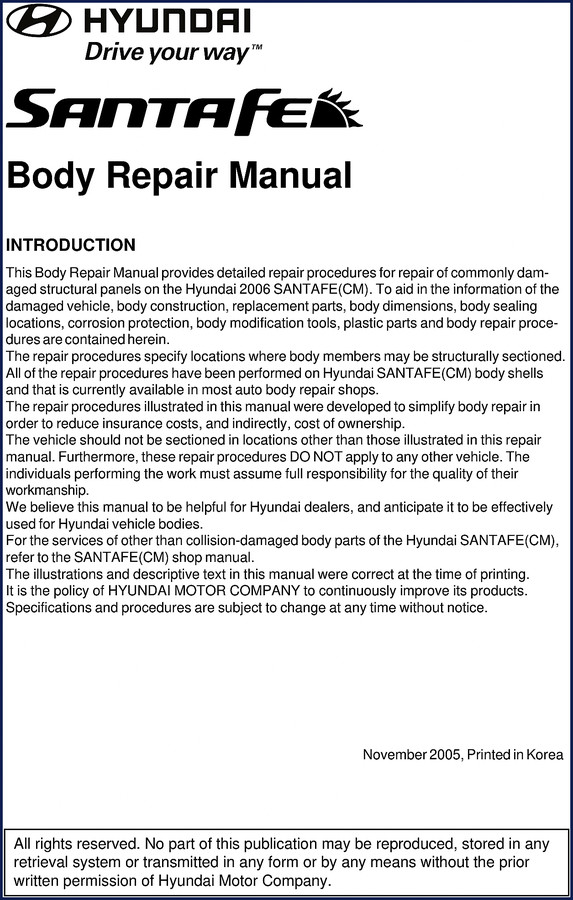
Hyundai SANTAFE 2005 Repair Manual – Factory Body Repair Specs
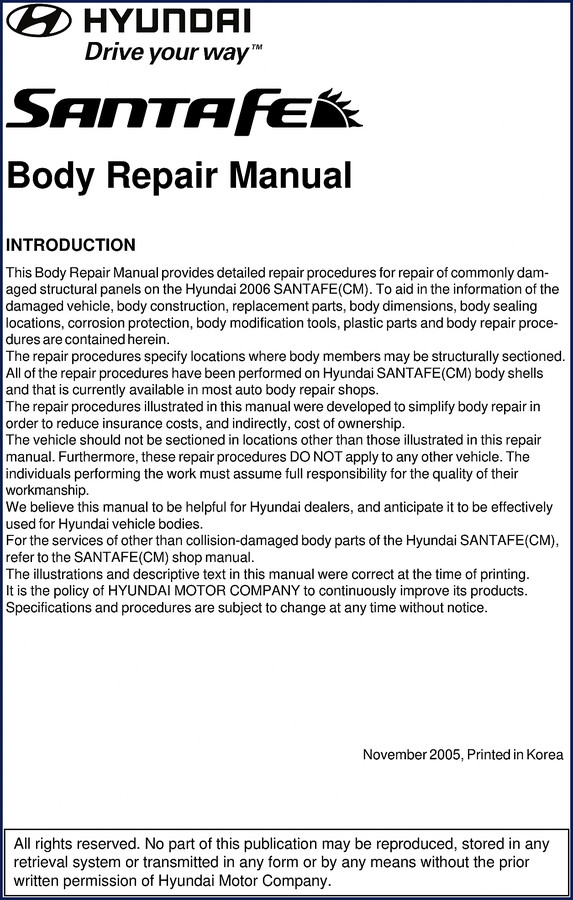
I’ve pulled enough aftermarket manuals apart to know the difference between a guess and a factory print. When a rookie hands you a torque figure that doesn’t come from the manufacturer, you end up with stripped threads or a car that leaks oil faster than it burns gas. This Hyundai SANTAFE 2005 Repair Manual is the real deal – 121 pages of OEM procedures straight from Hyundai Motor Company. It covers the 2005 (and 2006 CM body) SANTAFE. If you’re a DIY owner or a tech working flat rate, the last thing you need is a generic diagram that tells you to “apply sealant” without specifying the bead size. This manual gives you the exact locations for welding, the correct high-strength steel panels, and the SRS air-bag precautions you must follow before cutting into a pillar.
SRS Air-Bag: What the Manual Says About Safety (GI-3)
Before you touch any structural panel, the manual opens with General Information – specifically the SRS Air-Bag section on page GI-3. That’s three pages of warnings that will keep you alive. You’ll find the exact disarming procedure, the locations of impact sensors, and the zones where you cannot weld or apply heat without deploying the bag. I’ve seen guys arc weld near a steering column without disabling the system. That’s a lawsuit waiting to happen. This manual tells you exactly what to disconnect and how long to wait for the capacitor to discharge. Don’t skip it.
Body Construction and Zinc-Galvanized Panels (BC-4)
The Body Construction section runs from BC-2 through BC-23. It breaks down every panel: front body, quarter panel, side body, rear body, roof, floor panels. You get the material callouts – which parts are zinc-galvanized steel and which are high-strength steel. That matters when you’re repairing a side sill or pillar. If you weld a high-strength panel with the wrong parameter, you create a brittle zone that cracks. Page BC-6 lists those panels. The manual also covers the exact location of each panel and whether it’s bolted or welded. That saves you from cutting a part that should be unbolted.
3 Sections Dedicated to Body Panel Repair Procedure
The Body Panel Repair Procedure chapter (BP-2 through BP-38) is the section you’ll wear out first. It covers fender apron inner front panel, front side member partial, front pillar, center pillar, side sill partial, quarter panel, and back panel with rear side member. Each procedure shows the allowable sectioning points – places where the manufacturer says it is safe to cut and join. The manual specifies whether to use MIG, spot welding, or plug welding. It includes diagrams of how to reinforce the joint. If you’ve ever repaired a center pillar without the factory sectioning diagram, you know it’s a gamble. This manual removes the guesswork.
Hyundai SANTAFE 2005 Repair Manual: Body Dimensions and Measurement Methods (BD-2)
Body Dimensions chapter (BD-2 to BD-15) gives you the reference points for measuring front body, side body, interior, rear body, and under body. The measurement method on BD-2 explains how to use a tram gauge or electronic measuring system with the vehicle’s datum plane. You get projected dimensions and actual dimensions. This is the difference between a straight car and one that pulls to the right. The manual doesn’t leave you guessing – it lists the exact distance from one locating hole to another, in millimeters. Use these dimensions to verify your pull before welding. The 2005 SANTAFE unibody is sensitive; a half-inch shift in the front side member throws off all the fender gaps.
Corrosion Protection: Cavity Wax Injection and Under Body Coat (CP-11)
You can weld a panel perfectly, but if you skip the corrosion protection, you’ll be redoing it in two years. The manual dedicates a full chapter to Corrosion Protection (CP-2 to CP-14). It covers zinc-galvanized steel, zinc-phosphate coating, electrodeposition primer, and the exact locations for cavity wax injection. Page CP-11 shows where to inject wax in the side sills and pillars. The under body anti-corrosion agent on CP-14 lists the recommended product type and application thickness. If you’re restoring a SANTAFE, this chapter alone is worth the price of the manual. The factory knows how to keep salt belt cars from rotting – this is that knowledge.
I’ve worked in San Antonio for 25 years. Even here, corrosion protection matters on a vehicle that came from a northern state. The Body Sealing Location chapter (BS-2 to BS-8) shows every seam that needs sealer: floor, upper and side body, under body. The factory uses a specific sealer cross-section and location. Use the manual, not your memory.
Source Authenticity: OEM vs Aftermarket
This is not a reprint or a third-party compilation. The product you download is the exact PDF that Hyundai Motor Company released in November 2005. It includes the original Korean manufacture marks, the “Printed in Korea” notice, and the copyright language. Every dimension, every torque spec, every welding symbol is factory-authorized. Aftermarket manuals often copy the diagrams but change the torque values to fit a generic range. I’ve seen a manual claim a 10mm bolt gets 30 ft-lbs when the factory spec is 18 ft-lbs. That rips the threads out of the unibody. Trust the OEM data. For a broader understanding of how the automotive industry handles body repair documentation, you can check the Automotive Industry Overview. And if you’re also working on manual transmissions, the Manual Transmission article provides good background on tooling.
The table of contents confirms every section I’ve referenced: General Guidelines and Precautions (GI-2), Electron Parts (GI-4), Welding (GI-5), Body Modification Tools (BT-2 through BT-8) with specific tool lists for cut and disassembly, assembly, welding machines, buffing and grinding, and handheld tools. The manual even covers polypropylene bumper repairability (PP-2). That’s the kind of depth you want when a customer backs into a pole and you need to fix the bumper cover without replacing the whole assembly.
Bottom line: if you own a 2005 Hyundai SANTAFE or work on them, this 121-page factory manual belongs on your bench. You get the SRS safety data, body dimensions, panel repair procedures, sealing locations, corrosion protection strategy, and tool specifications. Download the Factory Manual and stop relying on internet forum guesses.
- Does the manual include SRS air-bag precautions?
- Yes, page GI-3 covers the disarming procedure and affected components.
- What specific body panel repair procedures are listed?
- The Body Panel Repair Procedure chapter covers fender apron inner front panel, front side member (partial), front pillar, center pillar, side sill (partial), quarter panel, and back panel with rear side member. Each procedure includes sectioning points, weld types, and reinforcement diagrams. The manual also specifies which panels are zinc-galvanized or high-strength steel, so you use the correct repair technique. For example, the front side member repair (BP-7) shows exactly where to cut and how to overlap the joint for structural integrity.
- Is this a factory OEM manual or a reprint?
- This is the original 2005 Hyundai Motor Company PDF, not a third-party reprint. The file includes manufacturer logos, part numbers, and the official publication notice.
- How many pages and what year is the publication?
- 121 pages, published November 2005, covering the 2005–2006 SANTAFE (CM) body.
Reviews
There are no reviews yet.