Bosch NG 6 Technical Manual – Factory Hydraulic Specs for the 22-Page OEM Document
If you’ve ever tried to tune a proportional valve using a photocopied aftermarket schematic, you know the pain. The coil resistance is wrong, the pressure ratings are rounded off, and you end up with a spool that sticks at the wrong current. That’s why you need the actual Bosch NG 6 Technical Manual – 22 pages of factory-sourced data that Bosch themselves used on the assembly line. Forget the third-party PDFs that reprint blurry tables. This is the real deal: the same document that Bosch stamped with their part numbers and pressure limits.
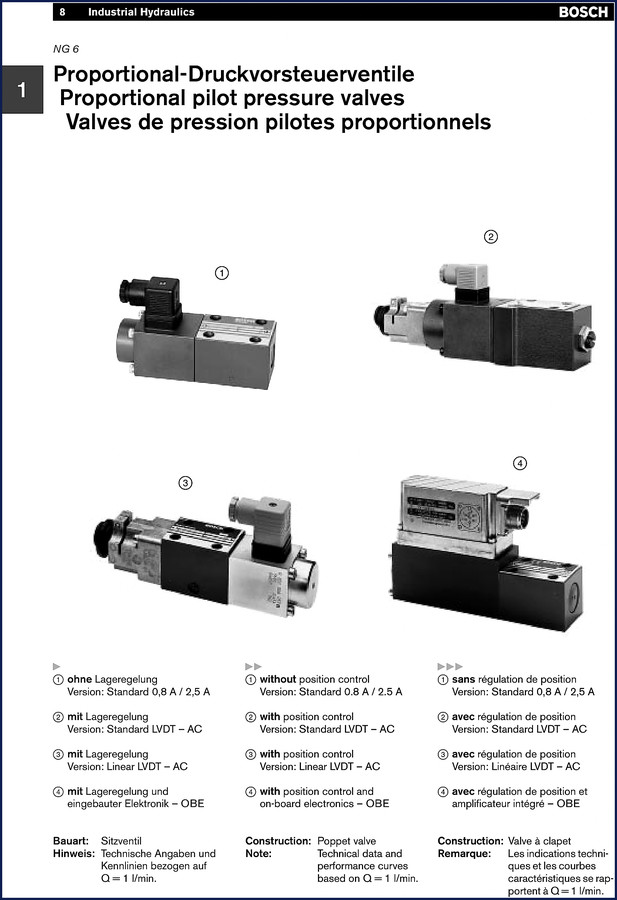
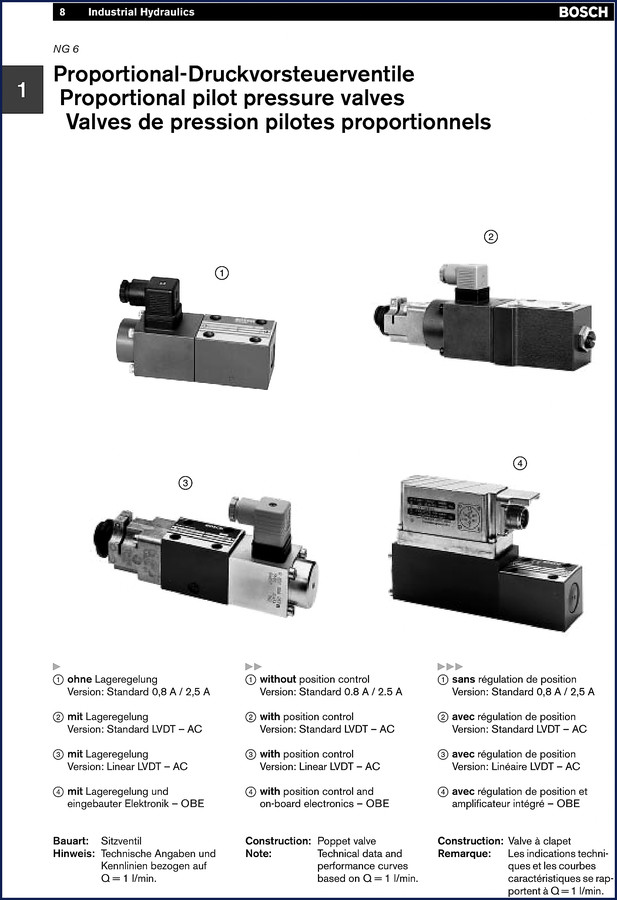
Proportional Pilot Pressure Valves: What You Get on Page 1
On page 1 of the manual, you get the full ordering range for the NG 6 proportional pilot pressure valves. The table lists every variant: without position control (0.8 A / 2.5 A), with LVDT position control, and with lag – each with its own part number and max pressure in bar. Need a valve that handles 315 bar at 1 l/min? It’s there. The manual also gives you the coil resistance (RL = 20 Ω or 3 Ω depending on the version) and the mounting bolt spec – M5 x 30 DIN 912–10.9. Tool list? You’ll need a torque wrench that can hit the right ft-lb for those bolts; the manual doesn’t give the torque value directly, but the bolt grade tells you where to set it. Don’t guess – use a fastener spec chart.
Pressure Relief Valves and the Ordering Range
The pressure relief valve section (page 3) covers the pilot stage with Qnom = 1 l/min. You get the same part-number breakdown: 1-P, 2-P, 3-P, and so on, with pressure ratings from 50 to 315 bar. Each variant lists the amplifier type needed – AS 0.8 – V, AS 2.5 – V, 1 M 0.8 – RGC1, etc. If you’re retrofitting an old system, this table tells you exactly which amplifier card to order. The manual also includes the plug connector pinout for the OBE (onboard electronics) – a 7-pole plug that matches the LVDT feedback. Wire it wrong and you’ll fry the coil. Safety warning: always verify the coil resistance with a multimeter before applying power.
Does This Manual Cover the Wiring and Amplifier Types?
Yes. The manual dedicates a full page to amplifier technology – what Bosch calls “Verstärkertechnik.” You’ll see the alphanumeric codes: AS 0.8 – V (voltage input), AS 2.5 – mA (current input), and the RGC1 and RGC3 variants with ramp functions. If you’re tuning a proportional valve for a press or a conveyor, the ramp settings prevent pressure spikes. The manual doesn’t hand-hold you through every wiring scenario, but it gives you the pinout and the electrical specs so you can build your own control circuit. Treat this like a wiring diagram – trace each connection before you power up.
3 Key Specs You Need Before Tuning the NG 6
First, the flow rate: the manual lists Qnom values from 0.8 to 3.7 l/min depending on the valve type. Second, the maximum pressure: 315 bar for the heavy-duty versions. Third, the ambient temperature range: –20 to +50 °C. If you’re working in a hot Texas shop in August, you’re pushing the upper limit. Make sure the fluid viscosity matches the OEM recommendation – the manual references hydraulic oil as the medium, but doesn’t give a specific grade. That’s where you cross-reference with the machine’s service manual. And don’t forget the mounting torque on those M5 bolts – use a thread locker if the manual says so (it doesn’t, but I always do on hydraulic manifolds).
Understand the NG 6 Hydraulic Connections
The manual shows the port pattern: NG 6 (ISO 4401) plate mounting. That means the valve fits any standard NG 6 manifold. The symbol drawings on each page tell you whether the valve is normally closed, normally open, or proportional. For a DIY guy swapping a stuck valve, the ordering table on page 2 is your cheat sheet. Match the part number to your existing valve – don’t rely on the paint color. And if you’re replacing a coil, the manual lists the correct coil resistance (e.g., 20 Ω for the 0.8 A version). Measure your old coil with an ohmmeter; if it’s open, you’ve found your problem. Safety: always depressurize the system before removing a valve. The manual doesn’t say it, but I’ve seen what 3000 psi does to a hand.
Related Manuals
- Bosch NG6, NG10 Technical Manual – 204 Pages of Factory Hydraulic Specs
- Bosch KTS 550 2004 Technical Manual – Factory Specs
- Bosch 147, 156, 159, 166, 2400 2011 Technical Manual | Shop Specs
If you need a broader reference on valve spool operation, check out the Manual Transmission article on Wikipedia for a mechanical analogy. For additional reading on hydraulic control fundamentals, the Manual Transmission page (again) covers basic sliding-gear principles that apply to spool valves.
- Is this manual available in English?
- Yes, the manual is trilingual: German, English, and French. All tables and key terms appear in all three languages.
- What specific hydraulic valves are covered?
- The manual covers proportional pilot pressure valves and pressure relief valves in the NG 6 size range. It lists over 30 part numbers with accompanying flow rates (0.8–3.7 l/min), max pressures (50–315 bar), and amplifier types (AS, 1 M, PV, PDL). It also includes the 7-pole connector pinout for the OBE and the mounting bolt specification (M5 x 30, grade 10.9). For detailed ordering info, see pages 2–3.
Don’t waste billable hours chasing bad data. If you’re working on a Bosch NG 6 hydraulic system, get the actual factory documentation with confirmed specs. Download the Factory Manual from AutoRepairManuals today.
gearhead88 –
Great OEM spec sheet. It is very easy to read on my tablet without losing quality. Contains precise wiring diagrams for Bosch. I will recommend this shop to others.