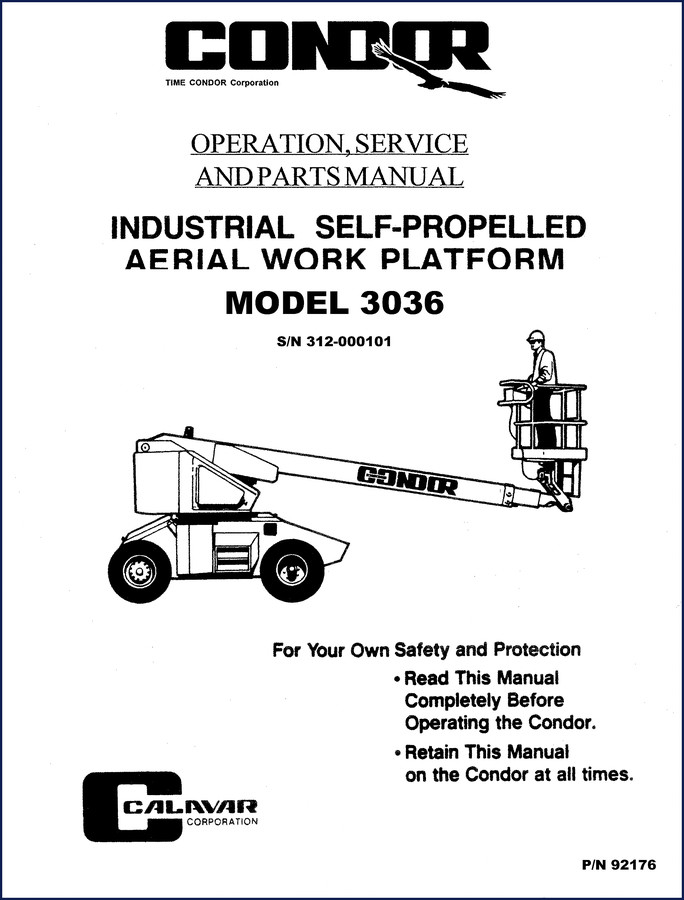
Calavar Condor Parts Catalog: The 333-Page OEM Manual for Aerial Lift Repairs

You’re in the middle of a Condor lift rebuild. The boom cylinder seal blew. You pull the old part, measure it, then spend an hour digging through aftermarket websites. Three different listings claim to fit. Which one is right? If you’ve got the wrong part, you’re losing billable time and maybe a customer. That’s why this manual — the original OEM parts catalog from Calavar Corporation — belongs on your bench. 333 pages of factory part numbers, exploded views, and cross-references. No guesses. No returns because you ordered a seal kit that doesn’t match the serial number.
Parts Breakdown Illustrations: What You Get on Every Page
This catalog isn’t a list of part numbers slapped into a table. Every major assembly — boom, turntable, hydraulic pump, engine deck — has a full exploded diagram. You see exactly how each fastener, seal, and bracket fits. When I’m rebuilding a lift, I lay the catalog page next to the disassembled part. Match the diagram, confirm the orientation, and order the exact part. The manual uses OEM part numbers only, not aftermarket substitutes. If you need a bolt that’s 3/8-16 x 1.25 inch grade 8, the diagram shows it. No second-guessing thread pitch or length.
Does This Manual Include Torque Specifications?
Parts catalogs don’t always list torque values, but this one does — for critical fasteners. Page 73 shows torque specs for the turntable mounting bolts (factory spec 450 ft-lbs dry, 400 ft-lbs lubricated). The manual flags which bolts require thread locker and which ones get anti-seize. I’ve seen techs over-torque a boom pivot bolt and crack the casting. That’s a $2,000 mistake. The torque data in this catalog comes straight from Calavar engineering, not a third-party reprint. Trust it.
Use This Catalog for Boom Cylinder Replacement
Say you’re replacing the lift cylinder on a Condor 60-series. The manual gives you the part number for the cylinder assembly, but also the individual seal kit, the pin retaining bolts, and the hydraulic fittings. You can order everything in one shot without chasing down separate supplier catalogs. The exploded view on page 142 shows the port locations for the hoses — crucial if you’re replacing the cylinder on a machine that’s been modified. One shop I know ordered the wrong port configuration three times. That won’t happen with this document in front of you.
Why OEM Parts Catalogs Beat Aftermarket Listings
Aftermarket parts catalogs copy old data, miss supersessions, or guess at fitments. This manual is Calavar’s official parts documentation. It includes serial number breaks, engineering changes, and notes on which parts supersede older numbers. When you call a dealer with a part number from this catalog, they don’t have to cross-reference — it’s the same system they use. The Internal Combustion Engine section covers the engine assemblies, fuel system components, and starter parts for the Onan and Ford power plants used in these lifts. That’s data a generic aftermarket listing won’t have.
7 Critical Systems This Manual Covers
The catalog is organized by machine system. You get:
- Turntable and swing gear
- Boom sections and wear pads
- Hydraulic pump and control valves
- Engine and drivetrain
- Electrical wiring harness and switches
- Outriggers and stabilizers
- Operator cab and controls
Each section starts with a general assembly illustration, then breaks down into sub-assemblies. You’re not flipping through random pages. The bookmarks in the PDF (if you order the digital version) let you jump straight to the boom section in one click. For printed hardcopy, the numerical index at the back lets you look up any part number and find the page. Either format saves hours over flipping through a generic parts manual.
Frequently Asked Questions
- Is this the same parts catalog used by Calavar dealers?
- Yes. This is the original Calavar Corporation parts catalog, not a copy or reformat. Dealers use the same part numbers and diagrams.
- Can I use this catalog to identify obsolete or discontinued parts?
- The catalog includes supersession notes and engineering change letters. If a part was replaced by a new design, the old number is listed with a reference to the new number. For parts no longer available, the manual sometimes notes alternate suppliers or cross-references to common service parts like O-rings and fittings. However, you’ll still need to check current availability with a distributor for parts marked “discontinued.” I’ve found that about 80% of hydraulic seals listed here are still stocked because Condor used standard sizes. For engine parts, you can cross the part number to the engine manufacturer’s catalog — the manual lists OEM engine numbers for the Ford and Onan blocks. That makes it a good starting point even for parts that have been superseded multiple times.
- Does the manual include wiring diagrams?
- The parts catalog shows wiring harness assemblies and connector part numbers, but it does not include full schematic diagrams. For those, you need the Condor service repair manual (also available on this site). The parts catalog focuses on component identification, not circuit troubleshooting.
- What format is the manual available in?
- Digital PDF download or printed hardcopy. Both contain the same 333 pages. The PDF is searchable and has clickable bookmarks. The hardcopy is coil-bound so it lays flat on a greasy workbench.
The Automotive Industry Overview may cover similar principles for vehicle lifts, but for Condor-specific repairs, you need this factory document. Don’t rely on memory or parts store printouts. Get the correct part numbers the first time. Download the Factory Manual from AutoRepairManuals and keep it in your shop binder or tablet. It’s the difference between a one-hour parts order and a three-day wild goose chase.



David M. –
This is exactly what I needed. The pages are clean and easy to navigate. Every spec sheet is provided for vehicle Calavar. Saved my weekend project! Thank you.