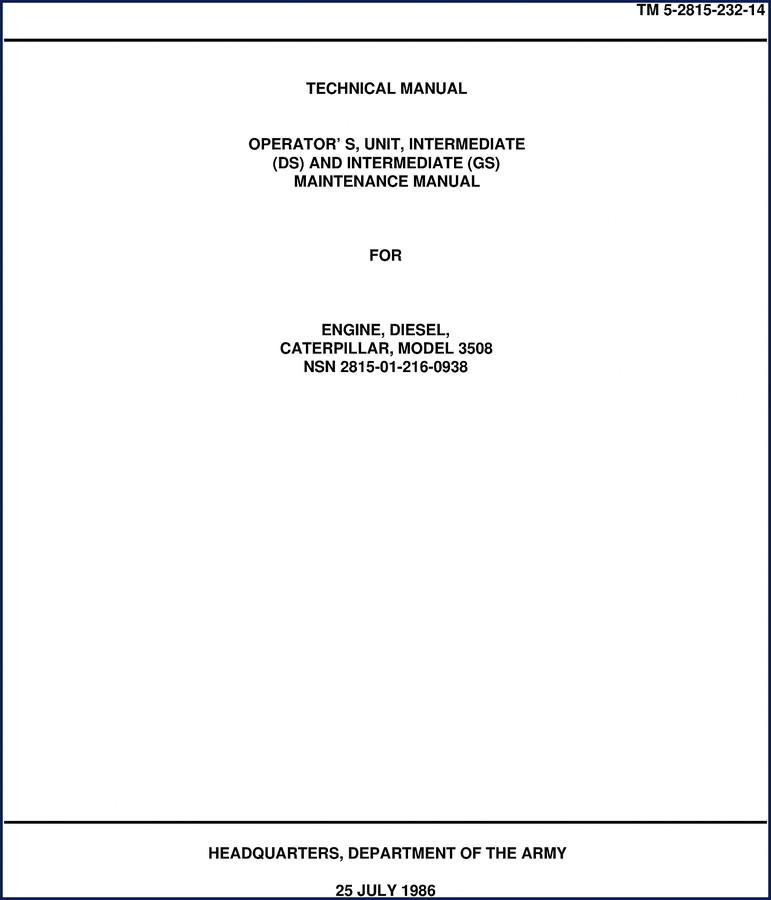
Caterpillar 3508 1986 Technical Manual
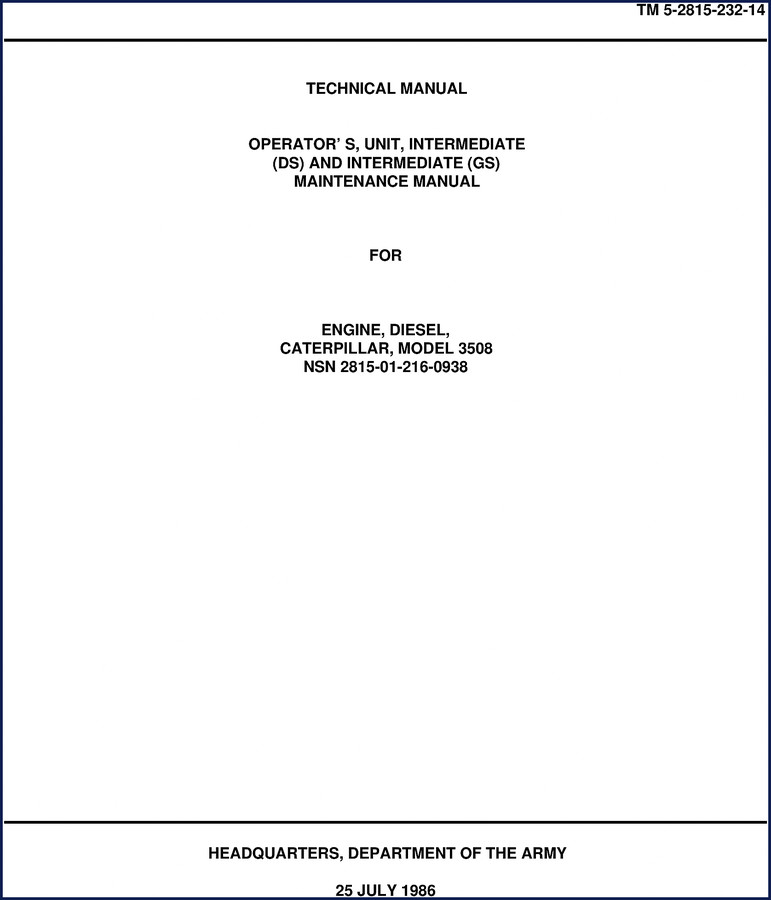
When you’re elbow-deep in a Caterpillar 3508 1986 Technical Manual job, guessing torque specs or skipping a step can turn a routine overhaul into a scrap metal run. This engine isn’t a lawnmower. It’s a 1,200-horsepower industrial diesel that demands the numbers Caterpillar wrote. That manual you’re looking at? It’s 661 pages of what the factory floor used — not a third-party rewrite, not a condensed summary. It’s the original US Army Technical Manual TM 5-2815-232-14, dated 25 July 1986.
Caterpillar 3508 1986 Technical Manual: What You Get
This isn’t a parts catalog. It’s a full maintenance and repair guide covering operator, unit, intermediate (DS) and intermediate (GS) tasks. The first page identifies the engine NSN 2815-01-216-0938. Page 3 leads with an important safety notice: improper repairs can cause injury or death. That’s not lawyer fluff; that’s a direct warning from Caterpillar to read and understand all precautions before turning a wrench. You get the same warning labels and hazard symbols the Army required.
Safety Warnings You Cannot Skip
The safety section on page 3 spells out basic precautions and where hazards exist. It tells you that operations causing mechanical damage are marked with CAUTION or NOTICE. Caterpillar also states that the warnings in this manual aren’t all-inclusive — if you use a tool or method they didn’t recommend, you own the risk. That’s why you stick to the factory procedure. The manual includes charts and figures for every major system, from fuel timing to cylinder head torque.
What Torque Values Are in This Manual?
Every critical fastener has a spec in lb-ft. The manual doesn’t leave you guessing. For example, cylinder head bolts, main bearing caps, connecting rods — all listed with the correct tightening sequence and angle where required. You get the exact values from the Caterpillar engineering release, not a generic internet forum number. If the spec calls for 150 lb-ft plus 90 degrees, that’s what you do. The manual also covers fluid capacities, pressures, and adjustment tolerances for injectors and valves.
Charts and Figures: How to Read Them
The PDF bookmarks break down into WARNING, CHARTS (parts A through D for two separate sections), and FIGURES (1 through 10). Each figure corresponds to a specific assembly or test procedure. For instance, Figure 1 is likely the engine front view; Figure 6 might show the fuel system routing. The charts contain the numerical data you need for diagnostics — charge pressure, oil pressure, temperature ranges. Page 73? That’s where you find charge pressure specs if your engine won’t build boost. Cross-reference the charts with the figures, and you have the full picture.
Get the Right Tools and Parts Before Starting
Each procedure lists required tools. Some are common — wrenches, torque wrench, feeler gauge. Others are Caterpillar special tools like the fuel timing pin. The manual gives you the tool number so you can source the correct one or find a dimensional substitute. Don’t start a job assuming you can improvise; the manual tells you exactly what fits. For related engines, check out Caterpillar 3508, EMCP II, EMCP III, 3508B EUI 1998 Installation Manual or Caterpillar 3508, 3512, 3516 2009 Operators Manual – OEM Specs. For piston and liner specs on similar Caterpillar models, Caterpillar 3116, 3044C, 3114, 3408 Technical Manual | Piston Specs is worth a look. If you’re working on a vehicle with a standard gearbox, Manual Transmission fundamentals apply, but this engine manual covers the engine side only.
FAQ
- Does this manual cover the 3508 after a serial number break?
- Yes, it covers the common configurations up to 1986 production.
- Is this the same manual a Caterpillar dealer would use?
- This is an exact reproduction of the original Technical Manual used by Army maintenance units. It contains the same torque specs, adjustment procedures, and safety warnings as the Caterpillar SENR2995 service manual. Dealers may have updated bulletins for later revisions, but the base procedures for the 1986 model are identical. If you’re working on a military-spec 3508, this is the authorized document.
- Can I use this for the 3508B?
- No, this is for the 3508 only.
- What kind of tools do I need to start a repair?
- The manual lists required tools in each procedure. For example, to perform the cylinder head bolt torquing, you need a torque wrench capable of reading in lb-ft, a 12-point socket, and a feeler gauge for valve adjustment. Some tasks reference special tools like the fuel timing pin. The manual specifies tool numbers where needed. If you don’t have the exact Caterpillar tool, you can often substitute with a generic equivalent, but the manual tells you the correct dimensions and tolerances so you can make an informed substitution. Always verify with the chart data before starting.
This engine will run another 10,000 hours if you stay within factory limits. Download the Factory Manual and work from the same data the engineers wrote. No guesswork, just specs that hold.




workshop_guy –
I am so happy with this manual. It is very easy to read on my phone without blur. A must-have for any Caterpillar 3508 DIYer doing maintenance. I will recommend this shop to others.