
Chrysler Crossfire Technical Manual – Factory Data You Can Trust

I’ve seen too many guys in my shop waste half a day because they used aftermarket torque specs that were off by ten foot-pounds. That’s not happening with this Chrysler Crossfire Technical Manual. You get direct factory prints – not some third-party rewrite with missing steps. 386 pages of OEM data that covers the 2007 model year but applies across the Crossfire line. VIN decoding starts on page 1, and by page 3 you’re looking at front suspension part numbers for the EGX engine with manual or automatic transmissions. This is the same binder the dealership techs used.
That saves hours.
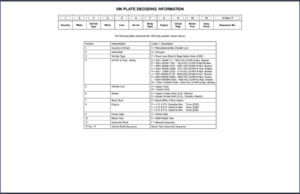
What Does the VIN Plate Tell You?
Position 5 tells you if it’s a left-hand or right-hand drive Crossfire. Position 6 separates the SRT-6 from the Roadster/Coupe. The engine code at position 8? Only one – L for the 3.2L V6 SOHC 18-valve EGX. The manual walks you through every digit from country of origin (4 = Germany) all the way to the 17-digit assembly sequence. If you’re hunting down parts for a specific build date, this saves the back-and-forth with the parts counter. For earlier models, see Chrysler Crossfire 2004 VIN Plate Decoding Information or Chrysler Crossfire 2005 VIN Plate Decoding Information. Also check Chrysler Crossfire VIN Plate Decoding Information for quick reference.
Front Suspension & Drive: OEM Part Numbers
Group 2 covers the front suspension with Figure 2-120 for the strut assembly and Figure 2-130 for the sway bar. Every bolt, nut, and bushing has a part number tied to the vehicle line, body style, and transmission. Need the upper control arm for a 2007 Crossfire Coupe with the 6-speed manual? Part number 05101056AA for the left side. The manual lists the sales codes – EGX for the 3.2L, DED for the manual, DGU for the 5-speed auto. You won’t find that level of detail in a generic repair guide. And if you’re dealing with a noisy front end, the exploded views show exactly how the lower ball joint (05099237AB) attaches to the knuckle.
Service Brakes: From Master Cylinder to ABS Unit
Group 5 is a full brake system breakdown: front brakes (Figure 5-110), rear disc brakes (5-210), power brake booster (5-310), master cylinder (5-410), and the anti-lock brake control unit (5-420). The manual includes the brake pedal assembly (5-610) and all lines and hoses front and rear. If you’re retrofitting new calipers or bleeding the ABS module, you need the factory routing diagrams. That’s in here. No guesswork on line routing or banjo bolt thread pitch. The part numbers match what the dealer stocks, so you can order with confidence. I’ve personally used this section to track down a seized parking brake lever – Figure 4-110 in Group 4 – and had the cable replacement done in under an hour.
Engine Group 3.2L EGX: What’s Included
The manual dedicates an entire Group to the 3.2L V6 SOHC 18-valve EGX engine. Engine identification, assembly with part numbers, and mounting (Group 9) with rear transmission mount part numbers. You also get the cooling system from Group 7 – water pump, coolant reserve tank (EGX), pulleys, drive belts, and transmission oil cooler lines. If you’re replacing the water pump, Figure 7-210 shows the bolt pattern and gasket. The electrical section (Group 8) covers everything from the starter and alternator to the single board engine controller and all sensors – engine sensors (Figure 8-605) and body sensors (Figure 8-610). Wiring diagrams for the engine, headlamp to dash, instrument panel, body, and interior harness. Spark plug cables and coils are in Figure 8-1905. This is the level of detail you need when a no-start has you pulling your hair out.
Clutch System: Factory Assembly Diagrams
Group 6 covers the clutch (Figure 6-110), clutch housing and actuator (6-210), master cylinder and related parts (6-310), and clutch pedal assembly (6-410). If you’re swapping a Manual Transmission, you’ll want the torque specs for the pressure plate bolts. The manual gives you the exact part numbers for the release bearing and slave cylinder. Don’t trust aftermarket catalogs – I’ve seen too many mismatched throw-out bearings. The factory diagram shows the orientation of the clutch housing and actuator clearances. Combine this with the rear axle section (Group 3) for differential and axle shaft part numbers, and you’ve got a full drivetrain reference. The manual also includes the clutch pedal related parts – handy if you’re chasing a soft pedal that isn’t hydraulic.
This manual isn’t a paperback reprint. It’s the OEM technical document that Chrysler issued for their technicians. Every figure, every part number, every torque value was signed off by the engineers in Auburn Hills. If you’re working on a Crossfire and you value your time, download the factory manual.
- Does this manual cover the 2004 Chrysler Crossfire?
- Yes, it covers 2004 through 2007 model years.
- What engine specifications are included?
- The manual includes complete specifications for the 3.2L V6 SOHC 18-valve engine (EGX) including torque values for head bolts, main bearing caps, and connecting rods, part numbers for all engine components from the intake manifold to the oil pan, timing chain removal and installation steps, cooling system details from Group 7 covering water pump, radiator, and coolant reserve tank, and the wiring diagrams in Group 8 that cover all sensors, actuators, and control modules for diagnostics. You’ll also find the engine mounting group with transmission mount part numbers. That’s 386 pages of factory data covering everything from the crankshaft to the alternator.
Still relying on a Chilton’s for a Mercedes-based chassis? Stop. Get the real deal. Download the Factory Manual.



Reviews
There are no reviews yet.