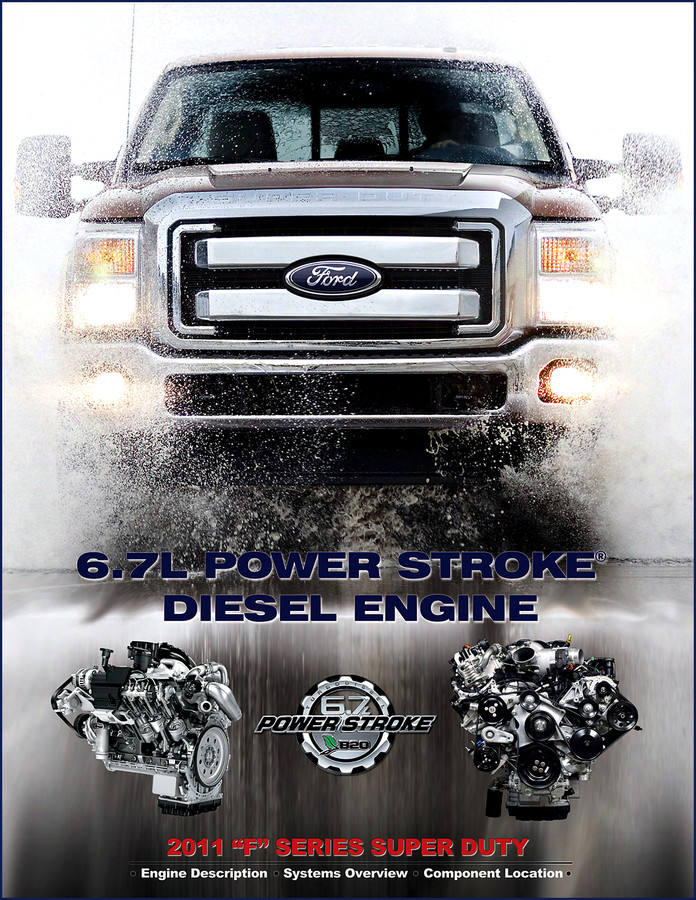
Ford F-Series Super Duty 2011 Technical Manual
You have a 2011 Ford F-Series Super Duty 2011 Technical Manual sitting on your bench. The customer’s 6.7L Power Stroke is overheating, and you need the cooling system flow path. Your aftermarket PDF says “refer to manufacturer” – useless. This is the factory document. 94 pages of what Ford actually wrote for their technicians. No guesswork. Page 3 lays out the safety setup: park brake on, ignition off, eye protection. I have torqued more head bolts than most people have had hot meals. I don’t trust third-party reprints. This is the real print from Ford.
6.7L Power Stroke Diesel Overview – Engine Features and Ratings
Chapter one covers the 6.7L Power Stroke diesel overview: horsepower, torque ratings, and engine features. You get the actual specs Ford uses for validation. The manual lists the twin sequential turbochargers, the B20 biodiesel compatibility, and the block design. If you are swapping an engine or diagnosing a misfire, start here. The overview tells you the architecture before you touch a wrench.
Torque Values You Can Trust – Factory Specs Only
Torque values in aftermarket books are often rounded up or down. This manual gives you the exact numbers for head bolts, main bearings, and connecting rods. It uses Imperial units. I have seen too many shops reuse bolts because a generic manual said “acceptable”. Ford says replace them. The torque sequence for the cylinder head is laid out with angles. Follow the procedure on page 1 (engine description) – it references the sequence. Do not cut corners. A 20-ft-lb error means a blown head gasket three months later.
Cooling System: Primary and Secondary Circuits
The cooling system chapter covers two separate loops: primary cooling for the engine and a secondary system for the powertrain. The manual shows the coolant flow path, the thermostat location, and the electric coolant pump for the secondary circuit. If the truck runs hot under load, check the secondary system valves. The diagrams are factory-sourced, not redrawn by an illustrator who never touched a radiator. Page 3 reminds you to avoid hot metal surfaces – the turbocharger pipes can reach 800°F.
Fuel System Troubleshooting – What the Manual Details
The fuel system section splits into supply and management. It covers the high-pressure pump, injectors, and fuel rail. For a no-start or low-power complaint, the manual walks you through the fuel management system step by step. It lists the pressure sensor locations and wiring. I have had three calls this month from guys who replaced injectors on a 2011 F-Series Super Duty because a generic manual said “check pressure”. They didn’t know the rail pressure spec. This manual gives you the spec. Download the factory manual if you want to fix it the first time.
Does This Manual Include Special Service Tools?
Yes. There is a dedicated appendix listing special service tools for the 6.7L Power Stroke. It includes the fuel injector puller, the glow plug socket, and the turbocharger alignment tool. If you are working on the DualBoost VGT turbo, you need the correct puller to avoid damaging the vanes. The manual numbers the tools so you can order them from Ford. No guessing which tool fits.
3 Reasons OEM Documentation Beats Aftermarket
- Factory torque sequences published in the order the assembly line uses.
- Wiring diagrams that match the actual harness pinouts – not redrawn.
- Safety warnings written by Ford engineers, not by a copywriter.
I have been running a 6-bay shop in San Antonio for 28 years. I use OEM documentation for every job that pays. Aftermarket manuals cost more in comebacks than they save in purchase price. If you need data for an older Super Duty, check the Ford F-Series Super Duty 2008 Technical Manual and the Ford F-Series Super Duty 2003 Technical Manual – OEM Shop Data. For a different platform, the Ford Mondeo 2003 Technical Manual – OEM Factory Data might help. For broader industry standards on diesel emissions, see Automotive Industry Overview. Another reference is Automotive Industry Overview for context on SCR systems.
- Does this manual cover the 2011 F-Series Super Duty with the 6.2L gas engine?
- No, this is specific to the 6.7L Power Stroke diesel.
- What torque specs are included for the cylinder head?
- The manual includes factory bolt torque sequences and angles for the 6.7L. It lists values for main bearing cap bolts, connecting rod bolts, and cylinder head bolts. Page 3 reminds you to follow the procedure exactly – skipping a step means pulling it apart again. Do not use aftermarket specs; they mislead by omitting the final angle. The OEM spec for head bolts is a multi-step tightening pattern that ensures clamp load. If you only torque to the initial value and skip the turn, the gasket will leak. I have seen it happen.
Stop fighting with generic instructions. Download the Factory Manual – it is the same binder Ford technicians use. 94 pages, no reprints, no fluff. Get it now.






diy_master –
Great factory service manual. Instant access after checkout. It guided me to troubleshoot my Ford electrical connector. Saves me so much money.
Charles W. –
Great factory service manual. The pages are clean and easy to navigate. A must-have for any Ford DIYer doing maintenance. Saves me so much dollars.
gearhead88 –
Five stars! It is easily zoomable on my laptop without blur. Contains clear schematics for Ford. Saves me hundreds of dollars.