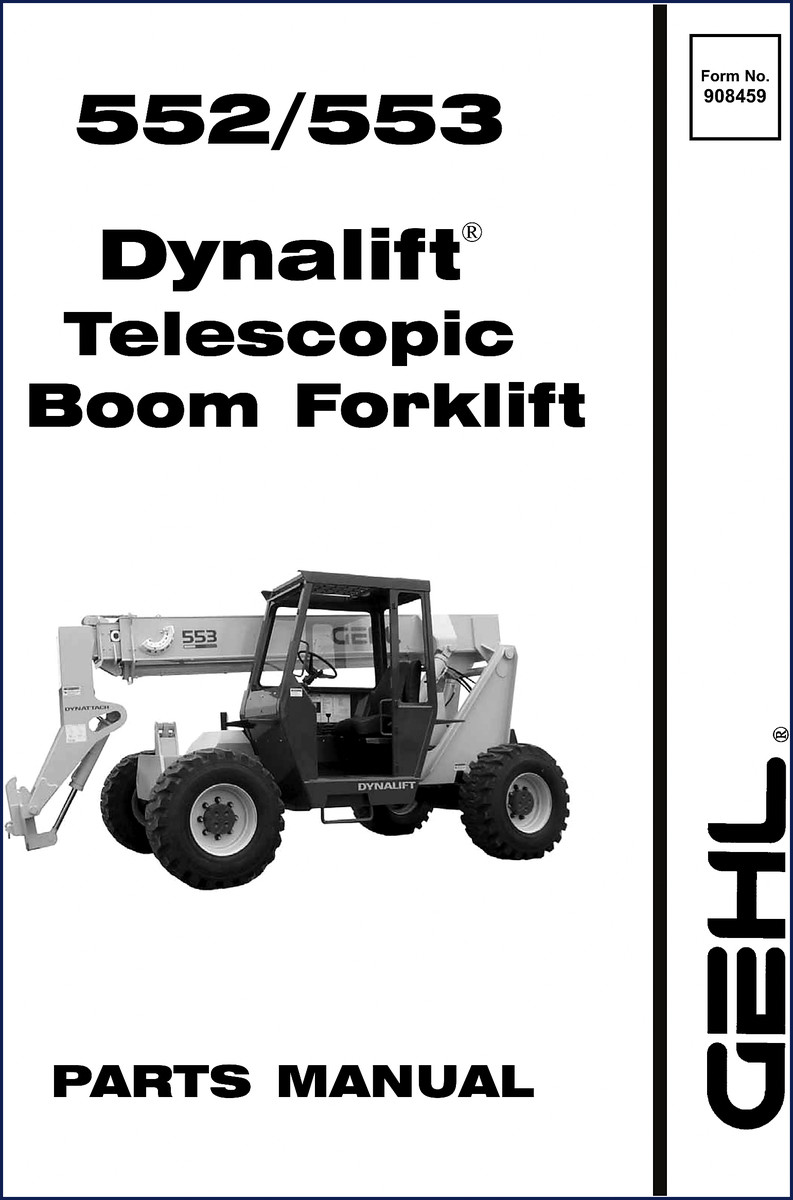
GEHL 552, 553 Parts Catalog – Factory OEM Specs for Dynalift Forklifts
If you’re pulling parts for a Gehl 552 or 553 telescopic boom forklift, you need the factory GEHL 552, 553 Parts Catalog. Not a third-party reprint. Not a PDF of unknown origin. You need the actual 180-page document that Gehl shipped with the machine. I’ve seen guys order a brake caliper off a blurry screenshot and end up with the wrong thread pitch. That’s a week of downtime.
This is Form Number 908459, printed in the USA by Gehl Company. The 180 pages cover model 552 and 553 Dynalift telescopic boom forklifts from the serial number decoding on page 2 through all component groups – engine, electrical, hydraulic, drivetrain, steering, frame, and attachments – to the torque specifications on the inside back cover (page 180). The table of contents shows page locations for each group, and the numerical index lets you look up any part number alphabetically. Each exploded diagram includes a parts list with indented hardware: cap screws, nuts, washers, and special fasteners are listed below the main component. That arrangement means you don’t hunt for hardware in a separate section – it’s right there with the drawing. The introduction also clarifies that right and left are determined from the operator’s seat facing forward, so you orient parts correctly.
WARNING: Aftermarket parts catalogs often mislabel hydraulic fittings or skip fastener grades. This manual lists all cap screws as Grade 5, cadmium or zinc plated, with hex nuts to match. Torque values for standard attaching hardware are on page 180. If you’re torquing a cap screw on a Gehl boom pivot, you want those numbers – not a generic chart from the internet.

Torque Specifications: Why Factory Numbers Matter
Torque values are right on the inside back cover – standard attaching hardware cap screws and nuts. The manual says all cap screws are Grade 5 unless otherwise specified. That’s critical when you’re reassembling the boom structure or the engine mounting. If you use a different grade, you change the clamp load. I’ve seen a boom come loose because someone used a Grade 2 bolt with Grade 5 torque. Don’t be that guy.
What Is the Numerical Index and How Do You Use It?
Use the Numerical Index to locate any part number in the catalog. It lists every number in ascending order and tells you which page the exploded view is on. Cross-reference that page, find the part in the diagram, and verify the quantity and description. This is faster than flipping through sections blind.
Decoding Serial Numbers on 552 and 553
On page 2 you’ll find the serial number breakdown. The format includes model, unit number, engine, month, and year (U=03, V=04, W=05). Why does that matter? Because Gehl made running changes. A 553 built in 2004 might have a different hydraulic filter bracket than a 2005 unit. Without the serial number, you risk ordering parts that don’t fit. Always include the full serial when ordering.
Don’t trust aftermarket parts catalogs.
7 Systems Covered – Exploded Views and Part Numbers
Organized by 7 major systems, the table of contents groups components into engine, electrical, hydraulic, drivetrain, steering, frame, and attachments. Each group has multiple pages with exploded line drawings and a parts list. The list indents hardware below the parent component, so you know exactly which bolt goes where. For example, a hydraulic cylinder assembly shows the barrel, rod, seals, and all attaching clevis pins and cotter pins. The hardware is listed but not always illustrated – that’s noted in the introduction on page 2. When you order a part, the catalog tells you the part number, description, and quantity required.
Why OEM Documentation Beats Aftermarket
Aftermarket catalogs often combine multiple models into one generic drawing, or they use superseded part numbers without telling you. This manual is the original Gehl publication – Form 908459. It includes updates up to the printing date (AP0603 on page 3). Every part number is the one Gehl used at the factory. If you need a replacement wheel set, the catalog calls out tire size information to help you buy locally (Gehl policy prohibits selling tires direct). That’s the kind of detail you don’t get from a third-party scan.
Frequently Asked Questions
- Does this manual include repair procedures or just parts?
- This is a parts catalog. It lists part numbers and exploded views, not step-by-step repairs.
- Can I use this catalog to find torque specs?
- Yes. Standard attaching hardware torque values are on page 180. But for specific component torque (like cylinder rod ends), you need the service manual.
- How do I find the correct part for my machine?
- Use the serial number stamped on the frame inside the operator’s station. The table of contents lists each component group and its page number. The numerical index sorts every part number in the catalog ascending, so you can find where a specific part appears. Then verify the part number against the exploded diagram to confirm location and quantity. If you order without the serial number, you risk getting the wrong part – Gehl made running changes that affect filter brackets, hydraulic lines, and engine mounts. Always specify model, serial number, full part number, and description. The manual’s introduction on page 2 explains the serial number format and where to find it.
- Is this an official Gehl publication?
- Yes. Form number 908459, printed in the USA by Gehl.
If you work on other Gehl machines, check out GEHL SL4640, SL4840, SL5640, SL6640 2005 Parts Catalog and GEHL SL7610, SL7710, SL7810 2005 Parts Catalog – OEM Factory Specs. Also GEHL RS6-34 2013 Parts Catalog – Factory OEM Manual. For background on the diesel engines used, see this Wikipedia article on diesel engines or this Wikipedia article on diesel engines.
Download the Factory Manual. Get the OEM parts catalog for your Gehl 552 or 553. You’ll save hours of chasing wrong part numbers and avoid the headache of returned parts. This is the same document the dealer uses. Stop guessing. Get the actual factory data.
Reviews
There are no reviews yet.