General Motors 4L40-E, 5L40-E 2002 Service Manual – The Only Factory Document You Should Use
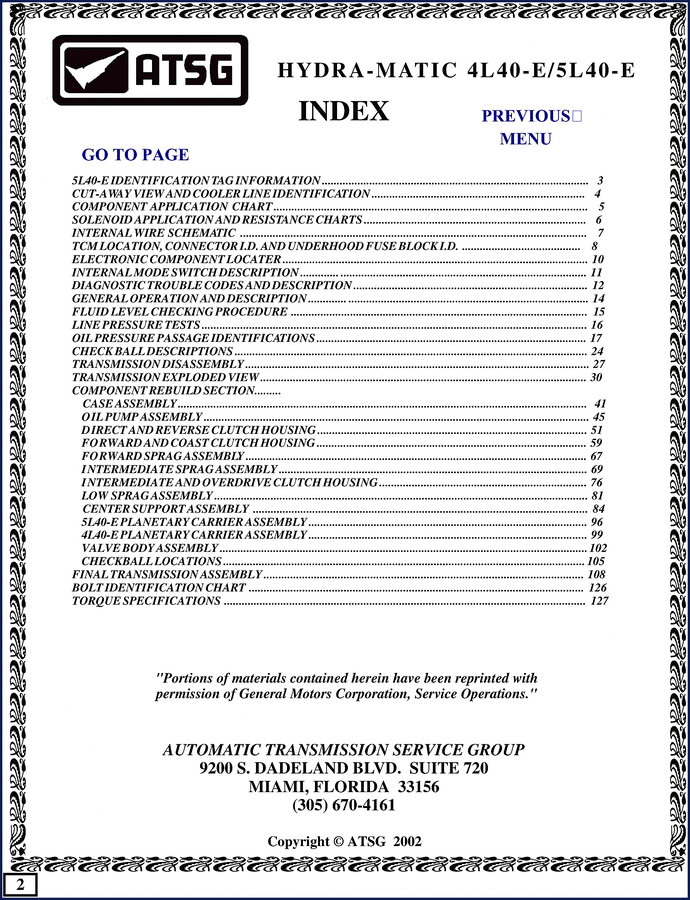
If you’ve ever rebuilt a transmission using a generic manual that skipped half the clutch clearances, you know the feeling of watching it fail on the test drive. That’s why this General Motors 4L40-E, 5L40-E 2002 Service Manual exists. It’s a 128-page factory-sourced document that tells you exactly what GM wanted in the shop. I’ve been turning wrenches for 28 years, and I won’t touch one of these Hydra-Matics without it. The cutaway view and cooler line identification on page 4 save you an hour of tracing lines on the bench.
5L40-E Identification Tag Information – Don’t Guess the Model
Manual opens with tag ID on page 3. You need to know if you’re working on a 4L40-E or a 5L40-E before you order a single part. The tag tells you the build date, model code, and serial number. Get this wrong and the center support assembly won’t match. I’ve seen that mistake cost a shop a full day of rework. Aftermarket manuals often skip this because they assume you already know. GM didn’t.
Line Pressure Tests: Page 16 Gives You the Numbers
Page 16 is where you’ll find line pressure test procedures and specs. No guesswork – GM tells you the exact pressure range at idle and stall. Without that, you’re just hoping the pump and valve body are healthy. The oil pressure passage identifications starting on page 17 show you which circuits feed which clutch. Follow that with the check ball descriptions on page 24 and you can pinpoint a leak without tearing the whole case apart.
Page 16 is for pressure tests.
Transmission Disassembly and Rebuild – 27 Steps to a Clean Case
Transmission disassembly starts on page 27 with the exploded view on page 30. Every clutch housing, sprag assembly, and planetary carrier gets its own section. For example, the direct and reverse clutch housing rebuild starts on page 59, forward and coast on page 67, intermediate sprag on page 76. The valve body assembly section (page 105) includes checkball locations on page 108. If you drop a checkball during reassembly, good luck finding its home without that diagram. I keep a copy laminated on my bench.
Aftermarket manuals love to combine all the sprag assemblies into one vague paragraph. This manual treats each one separately with photos and clearance specs. The low sprag assembly (page 84) and center support assembly (page 96) each have their own dedicated rebuild procedure. That’s the difference between a job that holds and a comeback next week.
Torque Specifications: Why You Need the Bolt Identification Chart on Page 127
Torque specs are scattered throughout, but the bolt identification chart on page 127 is your safety net. Each bolt is labeled with its location, thread size, and torque value in ft-lbs. I’ve seen guys use the same torque on a valve body bolt and a bellhousing bolt – one snaps, the other leaks. GM lists the torque for the oil pump assembly (page 51), the case assembly (page 45), and the final transmission assembly (page 126). Cross-reference with the chart and you won’t strip anything.
Does This Manual Cover Wiring and Solenoids?
Absolutely. The internal wire schematic on page 7 shows every pin and color code. TCM location and underhood fuse block ID are on page 8. Solenoid resistance charts on page 6 give you ohms for each solenoid – apply that to the component locator on page 10 and you can diagnose an electrical fault without removing the valve body. The diagnostic trouble code list (page 12) includes descriptions that aftermarket scanners often mislabel. For a 2002 Cadillac CTS with a 5L40-E, this is the only wiring reference I trust.
For general transmission background, check the Automotive Industry Overview from Toyota’s owner resources – it helps understand how these units evolved. If you’re also working on the engine, the General Motors 3.0L Service Manual – OEM Factory Specs covers the 2.8L and 3.0L powerplants that bolt to this trans. And for hybrid systems, the General Motors Volt, Ampera 2012 Service Manual – OEM Factory Specs is a different animal but uses similar diagnostic logic. Also, the General Motors 4.3L Powertrain Service Manual – OEM Factory Specs is handy if you’re swapping in a Vortec.
Another external source worth reading is Automotive Industry Overview for a broader look at transmission development. But stick with the factory manual for the actual work.
Three Reasons to Use OEM Torque Specs
First, GM engineering validated every number on a production line – not a guy in a garage with a Harbor Freight wrench. Second, the bolt identification chart keeps you from overtightening aluminum case bolts. Third, the final transmission assembly page 126 gives you the overall end-play spec that controls clutch pack life. Ignore that and you’ll burn up the forward clutches in 10,000 miles.
- Does this manual cover the 4L40-E and 5L40-E equally?
- Yes, both transmissions are included. The 4L40-E planetary carrier assembly is on page 102, the 5L40-E carrier on page 99. The main difference is the extra overdrive ratio in the 5L40-E.
- What year models does this apply to?
- It covers 2002 model year production, but the 5L40-E was introduced in 1999. Check the identification tag – if your transmission was built after 2002, you need a later supplement.
- Are there wiring diagrams for the TCM?
- Page 8 has the TCM location, connector pinout, and underhood fuse block ID. The internal wire schematic on page 7 is the complete harness diagram. Solenoid resistance values on page 6 let you test each actuator without a scope.
- Can I rebuild the valve body with this?
- Yes – valve body assembly starts on page 105 with checkball locations on page 108. You’ll also need the line pressure test results from page 16 to confirm your repair.
Bottom line: if you’re pulling a 5L40-E or 4L40-E out of a Cadillac CTS or a BMW 3 Series, you need this manual on your scan tool cart. Download the Factory Manual from AutoRepairManuals and get the original GM data.

Robert T. –
This is just what I was looking for. The PDF quality is excellent. It assisted me to rebuild my General Motors 4L40 transmission. Saved my repair job! Thank you.
Charles W. –
This is just what I needed. It is very easy to read on my phone without blur. Contains detailed wiring diagrams for General Motors. Saved my weekend project! Thank you.