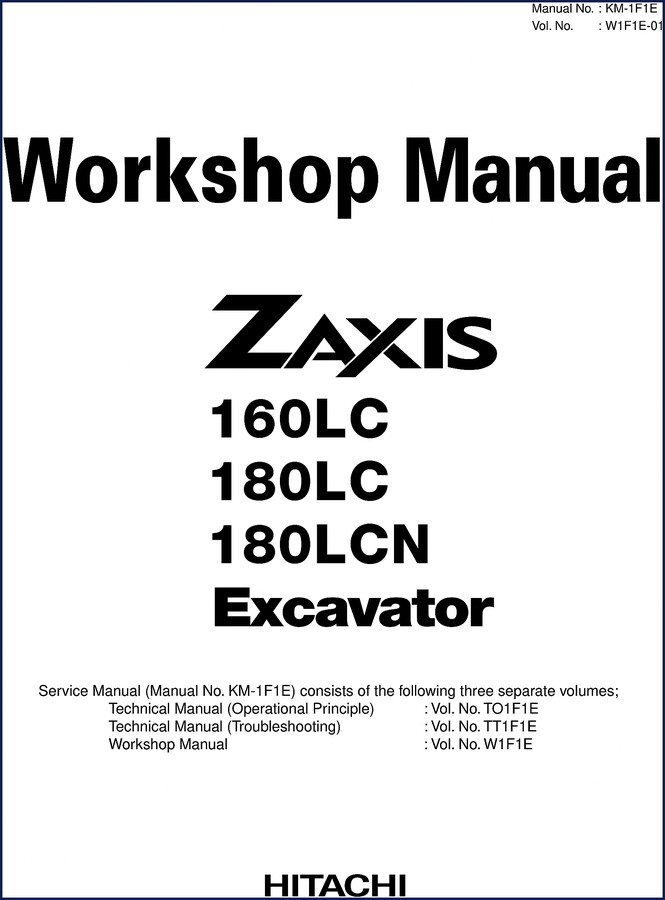
Hitachi Construction Machinery 160LC, 180LC, 180LCN Workshop Manual
If you’re turning wrenches on a ZAXIS 160LC, 180LC, or 180LCN, you already know the cost of a messed‑up torque sequence or a dropped swing drive. I’ve seen one too many guys try to guess the main relief pressure on a machine this size and end up with a hydraulic hose through the cab window. This Hitachi Construction Machinery 160LC, 180LC, 180LCN Workshop Manual is the only binder you want on your bench when the machine won’t track straight or the boom drifts down. It’s 666 pages of the same procedures Hitachi trains its factory techs on — no aftermarket shortcuts, no missing pages.
Lifting and Disassembly: Weights Matter
Page 4 of the introduction slaps you with the safety alert symbol and a reminder about component weights. You ignore that and you’re looking at a crushed foot or a bent frame. The manual lists lifting points, required sling capacities, and the exact sequence to pull the cab or the counterweight. I’ve had to quote this stuff to a guy who thought a come‑along was enough — it’s not. Every section that involves removal starts with the weight of the assembly and the minimum crane capacity. That’s not in any third‑party CD you bought off eBay.
Safety Alert Symbols and Their Meaning
The manual spells out the signal words — CAUTION, WARNING, DANGER — and where each applies. If you’ve ever worked on a machine that runs 300‑plus horsepower, you know a misread decal can cost you fingers. The Workshop Manual includes a full reproduction of every safety placard on the machine and explains when to wear hearing protection, when to lock out the starting circuit, and why you never work under a raised boom without mechanical stops. New guys skip this chapter. Don’t.
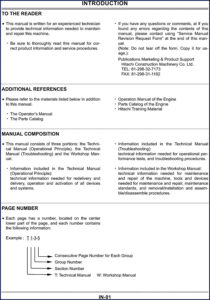
Technical Manual vs. Workshop Manual: Know the Difference
This isn’t the troubleshooting volume. That’s the Technical Manual (T1F1E). This Workshop Manual (W1F1E) is for maintenance and repair — removal, installation, disassembly, assembly, and the tools needed to do it right. For example, the swing motor overhaul: you get the bearing preload specs, the seal driver dimensions, and the torque pattern for the motor end cap. If you need the operational principle or the test procedures, grab the Hitachi ZAXIS 160LC/180LC/180LCN Technical Manual. That’s a separate volume. But this one is the one you keep on the shop floor.
Does This Manual Cover the Fuel System and Hydraulics?
Yes, but not the engine internals. The manual covers the engine mounting, cooling system, and hydraulic pump installation — but for the engine itself (say, the Isuzu 6BG1) you need the separate engine operation manual. What you do get here is the full hydraulic schematic for the main control valve, the relief valve settings, and the pilot pressure adjustments. I’ve used it to set the swing brake release pressure on a 180LCN that wouldn’t hold on a slope. It works because the numbers come from Hitachi’s engineering department, not a copy shop.
Why OEM Documentation Beats Aftermarket Reprints
I’ve burned hours chasing a ghost leak because a reprint had the wrong O‑ring cross‑section on the travel motor. This manual is an original factory PDF — not a scanned, blurred, folded copy of a copy. The torque tables on page 87 are legible, the exploded views have callout numbers that match the parts catalog, and the safety notes haven’t been stripped out to save paper. You’re paying for the assurance that the spec you’re torquing to is the spec the engineer intended. For anyone who repairs heavy equipment for a living, that’s not optional.
If you’re working on a different Hitachi model, check the Hitachi ZX210W Workshop Manual or the Hitachi Excavator 110/125US/120/135US Workshop Manual — both are OEM factory docs.
One more thing: don’t confuse the hydrostatic drive on this excavator with a car’s Manual Transmission. The principles are different, and so are the lube specs. For broader industry context, the Automotive Industry Overview won’t help you here — stick to construction equipment manuals.
- What is the difference between the Technical Manual and this Workshop Manual?
- The Technical Manual covers operational theory and troubleshooting procedures. This Workshop Manual covers maintenance, repair, removal, installation, and assembly. You need both for full coverage, but this one is the hands‑on repair volume.
- How many pages is this manual?
- 666 pages, including the safety introduction, torque data, and exploded parts illustrations. No fluff.
Stop guessing and start working with verified factory data. Click the button below to Download the Factory Manual.

Reviews
There are no reviews yet.