
Look, I’ve seen too many guys try to rebuild a carburetor with a Chilton manual and wonder why the bike runs lean. The Honda CB600FW 1998 Service Manual is the factory book – 372 pages of what Honda actually wants you to do. If you’re working on a Hornet 600, this is what you need on the bench, not some photocopied PDF from a forum.

Torque Values: The Difference Between a Leak and a Proper Seal
Page 3 tells you to follow the maintenance schedule. But the real meat is in Section 1: General Information. That’s where Honda lists every torque value from the cylinder head bolts to the oil drain plug. You don’t get that from aftermarket summaries. You get the exact foot-pounds required for every fastener on the bike. Torque isn’t optional.
On page 2 you’ll find the type code table – ED, II ED, H, II H, E, F, G, SW, U. That table tells you which emission variant you have. Ignore it and you’ll use wrong pilot screw settings. That matters.
Fuel System Work: The Carburetor Chapter
Section 5 covers the fuel system from air cleaner housing to fuel valve. If you’ve ever separated a set of carbs without the factory alignment marks, you know the pain. This manual gives you the separation, disassembly, assembly, and combination steps. It also includes pilot screw adjustment. I’ve seen techs skip the pilot screw step because an aftermarket guide said “turn until it feels right.” Honda gives you a specific number of turns out from lightly seated. That’s the difference between a bike that idles and one that surges.
For a related engine platform, the Honda VT600C 1998 Service Manual – Factory OEM Repair Guide covers a similar carburetor setup but with different jetting. If you’re moving between models, keep the factory books straight.
Maintenance Schedule: Follow It or Pay Later
Section 3 lays out the maintenance schedule: fuel line inspection, throttle operation, carburetor choke, air cleaner, spark plug, valve clearance, engine oil and filter, carburetor synchronization, idle speed, radiator coolant, cooling system, secondary air supply, drive chain, brake fluid, pad wear, brake system, clutch, side stand, suspension, nuts and bolts, wheel/tires, steering head bearings. That’s not a suggestion – it’s a list. Miss the valve clearance check at the specified interval and you’ll burn a valve. The manual tells you the clearance spec for both intake and exhaust. No guesswork.
When you need a break from motorcycles, the 1994 Honda Civic Service Manual OEM Factory Specs uses the same quality of factory data for four-wheel work.
Cylinder Head Work: Valve Clearance and Cam Timing
Section 8: Cylinder head/valves starts with a compression test procedure. Then it goes through cylinder head cover removal, camshaft removal, cylinder head removal, disassembly, inspection, valve guide replacement, valve seat inspection/refacing, and reassembly. The cam chain tensioner lifter procedure is in there. If you try to time the cams without the factory marks and torque sequence, you’ll bend a valve. I’ve seen it. The manual gives you the exact order for tightening the cam holder bolts. Don’t skip that page.
For a V4 experience, the Honda VFR800/A 2002 Service Manual – OEM Factory Repair Guide covers a more complex valve train but the same attention to factory spec.
Why the OEM Manual Beats Third-Party Reprints
I’ve had customers bring in bikes with stripped threads from using aftermarket torque charts that were off by 10 ft-lbs. The Honda CB600FW 1998 Service Manual is printed by Honda Motor Co., Ltd. in 1998. It has the original safety notice, type codes, and wiring diagrams that third-party reprints re-photograph until they’re unreadable. When I need to reference industry standards, I look at Automotive Industry Overview for calibration data. But for this bike, you want the OEM source. The manual includes 19 sections covering every system: frame, body panels, exhaust, maintenance, lubrication, fuel, cooling, engine removal, cylinder head, clutch, alternator, crankcase, crankshaft, front and rear suspension, hydraulic brake, battery/charging, ignition, electric starter, and lights/meters/switches. That is 372 pages of factory-audited content.
You can also cross-check procedures with Automotive Industry Overview for general safety standards, but the Honda book is your final authority.
Honda CB600FW 1998 Service Manual: What the Factory Includes
Every technician I mentor asks: “What makes this different from a Haynes?” The answer is in the detail. The wiring diagrams are the actual Honda drawings. The troubleshooting sections for each system (fuel system, cooling system, ignition system, etc.) are written by the engineers who designed the bike. The clutch section includes right crankcase cover removal and installation with the correct gasket sealant spec. The brake section gives you the air bleeding sequence for the linked brakes. That is the level of specificity that saves an afternoon of bleeding air you can’t find.
FAQ
- Does this manual cover the 1997 model?
- No, this is specifically the 1998 CB600FW service manual.
- Can I use this for the CB600F Hornet?
- Yes, the CB600F is the same base model. The manual covers all variations listed in the type code table on page 2. It includes specs for European direct sales, Netherlands, UK, France, Germany, Switzerland, and Australia. If you have one of those, the torque values and procedures apply. The manual includes specific code designations like ED, II ED, III ED, H, II H, E, F, G, SW, U. Each has different power restrictions, but the service procedures are identical for the engine and chassis. The only differences are in emission components and carburetor settings. So yes, it fits.
- Are torque values given in foot-pounds?
- Yes. All critical fasteners have torque specs in the General Information section and throughout the chapters.
- How is the manual organized?
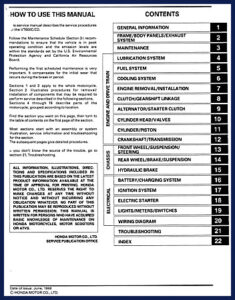
- Sections 1 and 3 apply to the whole motorcycle. Section 2 covers removal/installation of body panels. Sections 4 through 19 cover specific systems: lubrication, fuel, cooling, engine, cylinder head, clutch, alternator, crankcase, crankshaft, front and rear suspension, brakes, battery/charging, ignition, electric starter, and lights/meters/switches. Section 3 has the maintenance schedule. Section 21 is troubleshooting. The table of contents is at the front of each section. Follow page 3’s instructions on using the manual and you’ll find what you need quickly.
If you’re rebuilding a CB600FW or just doing a valve adjustment, get the factory book on your tablet or printed out. Download the Factory Manual now and stop trusting internet forum torque values.




John D. –
This is just what I was looking for. The PDF is very clear. Every torque spec is provided for Honda CB600FW. I will definitely buy again.
pro_mechanic –
I am very pleased with this transaction. It is very easy to read on my phone without losing quality. Every torque spec is provided for Honda CB600FW. Saves me hundreds of time.