Honda XR400R, XR250R 1995 Service Manual
You’ve got a XR400R or XR250R on the lift, and the aftermarket manual you grabbed says “tighten to spec” but never gives you the actual number. That’s how you strip threads on a cylinder stud or warp a head from guessing at torque. I’ve seen it a hundred times. Honda XR400R, XR250R 1995 Service Manual from AutoRepairManuals is the real deal – a direct factory reprint of the original Honda publication. No third-party rewrites, no missing pages. This is what the dealer techs used when these bikes were new. 300 pages of OEM data, all in one PDF.
Engine and Drive Train: Section 6 Coverage
Section 6 covers the engine and drive train – everything from the crankshaft to the transmission. If you’re tearing into the bottom end, you need the factory clearances and assembly sequence. The manual walks through each disassembly and reassembly step with exact torque values for the main bearing cap bolts and the transmission shaft nuts. Don’t trust generic specs on forums; these came straight from Honda R&D in 1995. The crankcase split procedure is laid out in Section 12, and the transmission (Section 13) includes gear and shift fork identification.
Does This Manual Cover the Fuel System?
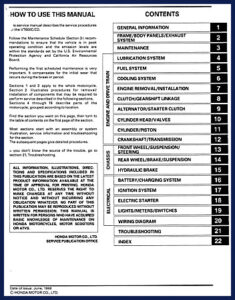
Yes, Section 5 is the Fuel System chapter. It covers the carburetor – both the XR250R and XR400R use the same Keihin PD series. You get float level adjustment, jetting specs, and the throttle cable routing diagram. The manual shows the fuel line routing with numbered hose guides to prevent kinks. This is critical after a carb rebuild; a pinched line will lean out the mixture and burn a piston. Page 3 of the manual explains how to use the service information grouping – that page tells you to go to Section 5 when you have fuel-related trouble.
3 Reasons to Trust OEM Documentation
First, the torque values. The General Information section (starting on page 1) lists every fastener torque in ft-lb. No guessing – you know the cylinder head nut sequence and value. Second, the wiring diagrams in Section 19 are original Honda schematics, not redrawn by an aftermarket publisher who might drop a ground wire. Third, the troubleshooting section (Section 20) follows the factory logic tree – it’s the same diagnostic flow the Honda techs used. Aftermarket manuals skip these details and leave you chasing ghosts.
Get the Right Torque Data from the General Information Section
Page 1 of the manual has the standard safety warnings – read them. The torque values are listed in Section 1 under Specifications (1-4 through 1-14). You’ll find values for the cylinder head bolts, the crankcase bolts, the brake caliper mounting bolts, and every suspension pivot. Use a calibrated torque wrench; don’t rely on “feel.” The suspension and chassis sections (14–16) also have specific torque specs for the front and rear axle nuts, the steering stem, and the shock mount bolts. A loose shock bolt will kill the handling and can cause a crash.
Cylinder Head/Valves: Factory Procedure
Section 8 details the cylinder head and valve service. You get the valve clearance specs (intake and exhaust), the cam chain timing marks, and the head bolt tightening sequence with torque values. The manual warns that overtightening can distort the cylinder bore – that’s why you follow the two-step pattern. Section 9 covers cylinder and piston removal, including ring end gap limits. If you’re rebuilding the top end, you need these numbers. The manual also includes the balancer alignment for the XR400R (Section 12) which is easy to get wrong and cause vibration.
Brake and Electrical Systems: What You Get
The brake system (Section 17) covers drum brakes on the rear and disc up front – pad wear limits, caliper rebuild, master cylinder overhaul. The electrical system (Section 18) goes through the stator, regulator, ignition coil, and all connectors. Section 19 wiring diagrams are color-coded by the original Honda standard. If your XR is dead or won’t start, the troubleshooting section (20) guides you through the charging system and ignition circuit. A bad ground can mimic a dead stator – the manual shows you the correct test points.
FAQ
- Does this manual cover both the XR250R and XR400R?
- Yes. It covers both models with separate specs where they differ (e.g. bore, carb jetting).
- What torque values are listed in this manual?
- All critical fastener torque values are in Section 1, from cylinder head nuts to axle nuts. The manual also includes a lubrication and seal point chart (page 1-19) and cable routing diagrams (page 1-21). For engine internals like the crankshaft and transmission, the specific sections have their own torque tables. If you’re doing a full rebuild, you’ll use at least a dozen different torque values – this manual has every one. Don’t trust aftermarket abridgments that omit the lower yoke nut torque.
If you work on other Hondas, check out the HONDA XR400R Service Manual for a standalone version, or the Honda VT600C 1998 Service Manual – Factory OEM Repair Guide and Honda VFR800/A 2002 Service Manual – OEM Factory Repair Guide on AutoRepairManuals. For general industry background on why OEM documentation matters, see this Automotive Industry Overview and the Automotive Industry Overview resource. Don’t waste time with reprinted junk. Download the Factory Manual from AutoRepairManuals and get the correct Honda specs on your screen or printed out.

pro_mechanic –
I am very pleased with this transaction. It is very easy to read on my tablet without losing quality. Contains clear schematics for Honda. Saved my weekend project! Thank you.
John D. –
Great factory service manual. The download is high resolution. It assisted me to troubleshoot my Honda XR400R transmission. Saved my repair job! Thank you.
Charles W. –
This is just what I was looking for. The document is high resolution. Every torque spec is provided for Honda XR400R. I will definitely buy again.