Hyundai D4A, D4D 2005 Service Manual
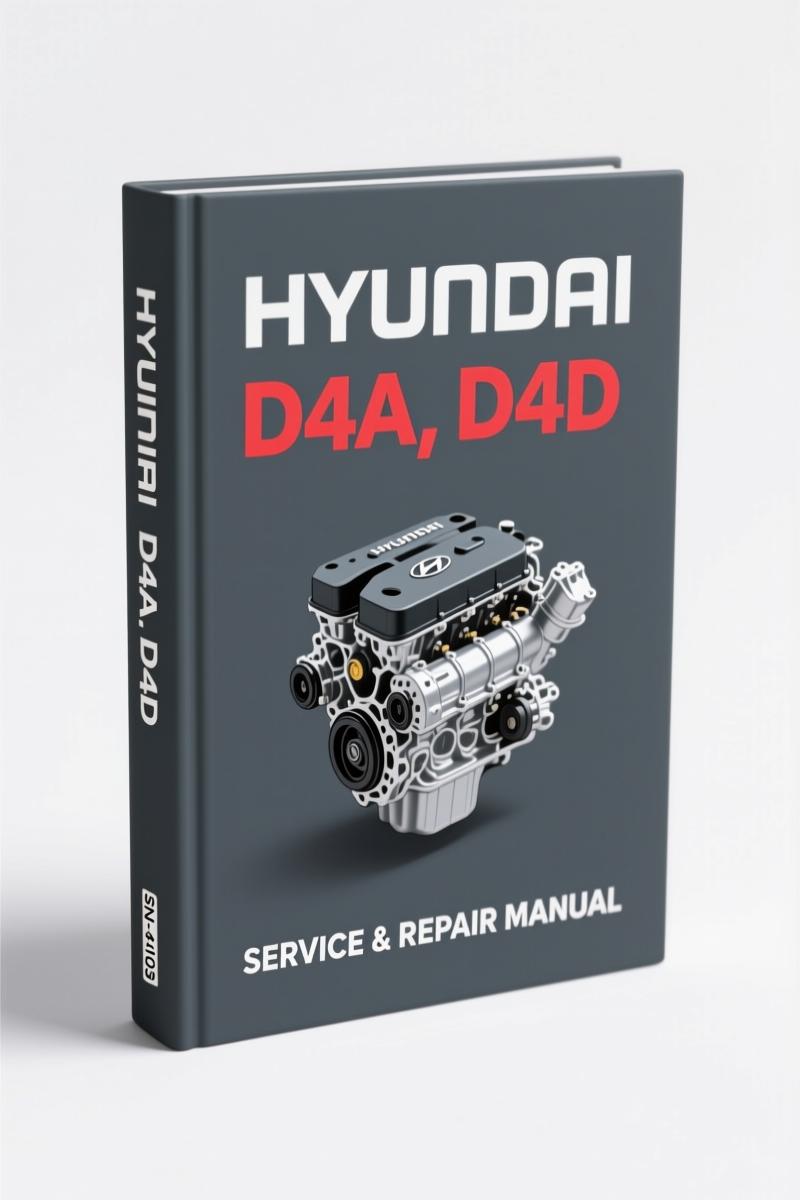
Working on a Hyundai D4A or D4D diesel engine without the factory specs is throwing money away. I’ve seen guys guess the head bolt torque and end up with a blown gasket within 50 miles. This 287-page Hyundai D4A, D4D 2005 Service Manual hands you the exact tightening torques, service standards, and troubleshooting procedures straight from Hyundai. No aftermarket interpretation. You get the real OEM documentation that factory technicians use. Whether you’re a home garage mechanic or running a shop, this manual stops the guesswork. HYUNDAI D4A D4D Series Diesel Engine Service Manual 2005 is the same manual you’re looking at.
Engine Proper: D4A/D4D Service Procedures
Every section follows the same structure: specifications, service standards, special tools list, service procedures, and troubleshooting. The Engine Proper chapter covers cylinder head reconditioning, valve clearance adjustment, and piston ring end gaps. If you’ve ever had a D4D that wouldn’t start after a rebuild, it’s usually a missed timing mark or wrong torque on the injection pump gear. This manual shows you the exact protrusion from crankcase top surface – that’s a spec you won’t find in a generic guide. Page references are grouped by system, so you jump straight to the data you need.
Does This Manual Cover the Fuel System?
Yes – the Fuel System chapter is a full group (Group 7) with its own troubleshooting tree. It covers injection nozzle testing, governor adjustment, and fuel feed pump inspection. The manual specifies standard values and limits for plunger stroke and delivery valve clearance. Without these numbers, you’re guessing at injector pop pressure. The table of standard tightening torques appears in the General section and applies across all systems – use it for every bolt that doesn’t have a specific torque callout.
3 Reasons to Choose OEM Factory Documentation
First, the torque table on page 26 (from the General group) is the same table Hyundai assembly line workers use. It’s not a third-party approximation. Second, the troubleshooting sections are written for technicians who diagnose problems systematically – they list symptoms, probable causes, and corrective actions. Third, wiring diagrams and special tool numbers (like for the injection pump timing fixture) are only available in the factory manual. Aftermarket manuals often skip these because they cost money to reproduce.
Get the Right Torque Data from the Table of Standard Tightening Torques
Look in the General section under “TABLE OF STANDARD TIGHTENING TORQUES.” This table covers bolts with no specific torque listed elsewhere – it gives values for M6, M8, M10, M12 bolts in both wet and dry conditions. If you’re bolting a manifold back on, use that table. Then cross-check with the specific torque in the Engine Proper section for critical fasteners like main bearing cap bolts. The manual also includes the terms and units explanation: front is fan side, rear is flywheel side, right and left are from flywheel view. Read that page once so you interpret the illustrations correctly.
Troubleshooting: Factory Procedure for Common Failures
Each chapter ends with a troubleshooting table. The Cooling chapter, for example, lists overheating causes – bad thermostat, radiator blockage, air in system – with the factory order of inspection. The Lubrication section covers low oil pressure and high oil consumption. These aren’t generic lists; they’re based on Hyundai’s engineering tests. One thing I appreciate: the manual calls out special tools by Hyundai part number. You can either buy them or fabricate equivalents if you know the dimensions. Hyundai Santa Fe Service Manual 2001-2002 – 353 Pages OEM Factory Specs is a different manual but shares the same OEM sourcing quality.
For comparison, if you’re working on heavy equipment, check out Hyundai 75-7 Service Manual – OEM Factory Specs for Excavator Repair. The same factory approach applies.
When I evaluate repair documentation, I always check the source. This manual comes from Hyundai’s own publication, not a third-party aggregator. The foreword states it’s for “personnel responsible for maintenance of HYUNDAI D4A, D4D series diesel engine.” There’s no reprint, no copy – it’s the original scan of the 2005 book. For background on why OEM specs matter, read this Automotive Industry Overview and Automotive Industry Overview – industry standards rely on exact factory data.
FAQ
- Does this manual include wiring diagrams for the engine electrical system?
- Yes. The Engine Electrical chapter covers starter, alternator, preheating system, and engine start system. It includes schematic diagrams and connector pinouts.
- What is the page count?
- 287 pages.
- Can I use this manual for a D4A engine in a non-Hyundai application?
- Yes. The manual covers the D4A and D4D engines themselves – not specific vehicle wiring. You’ll get the engine specs, torque values, and overhaul procedures. For vehicle-specific connections, you’d need a chassis manual. But for the long block and injection system, this is the definitive source. The troubleshooting tables apply regardless of what the engine is bolted into. I’ve used D4A data for generator sets and it matched perfectly.
- Are torque values given in imperial units?
- The manual provides tightening torque specifications in metric (N·m) and imperial (kgf·m). Easy to convert with a standard chart.
Stop relying on forum posts and aftermarket summaries. Download the Factory Manual and get the actual Hyundai service data you need to do the job right the first time.


Reviews
There are no reviews yet.