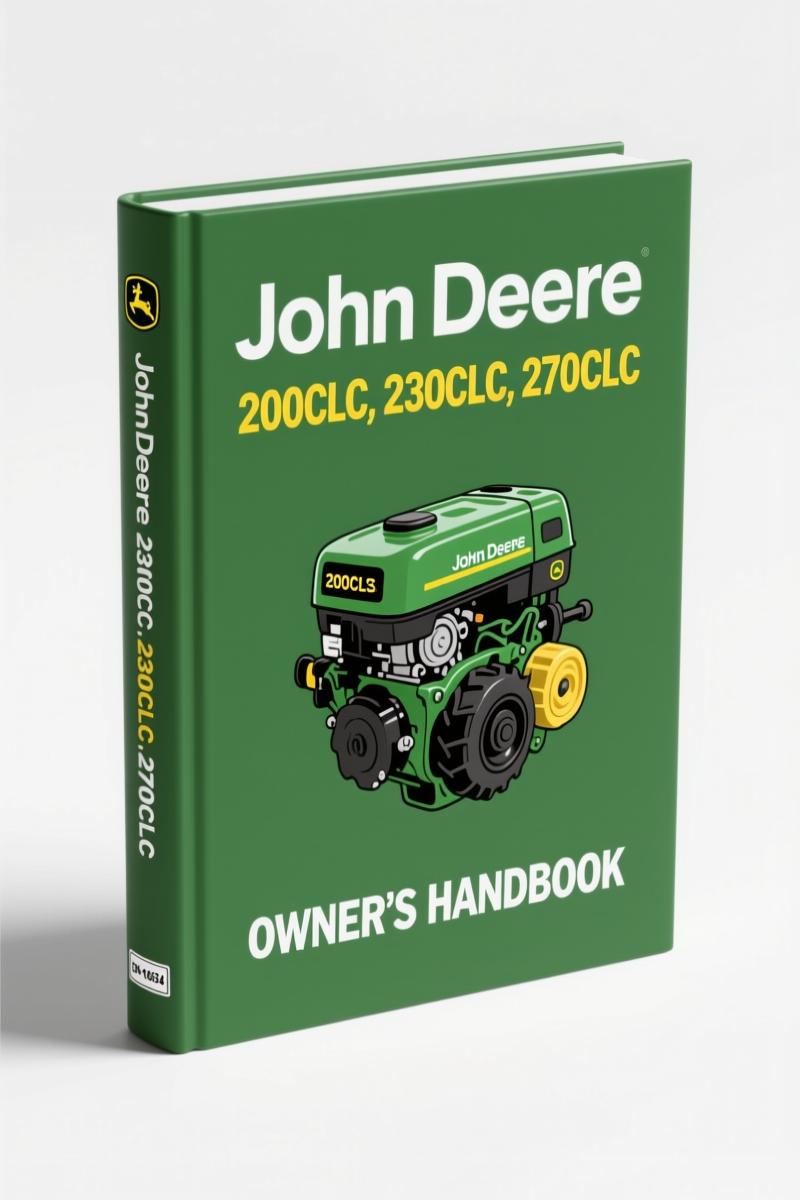
John Deere 200CLC, 230CLC, 270CLC Operators Manual – What a Tech Notices First
I’ve torqued head bolts on everything from a lawn tractor to a 300-ton crane. When a John Deere 200CLC, 230CLC, 270CLC rolls into my bay, I want the factory book – not some aftermarket PDF that guesses the hydraulic pressure. This Operators Manual is the one that stays in the cab, not on the shelf. 184 pages of John Deere’s own procedure, written for the guy who actually runs the machine. If you’re a home garage guy or a fleet owner, this is the document that tells you what the monitor panel actually means and how to avoid a $4,000 swing gear rebuild because you greased the wrong fitting. Let’s break down what you get when you download this manual.
What’s Inside: 184 Pages of Factory Procedure
This is not a condensed quick-start card. It’s the full operator’s manual covering all three models – 200CLC, 230CLC, 270CLC. The table of contents starts with safety features and general precautions, then moves into operating precautions, maintenance precautions, and safety signs. After that, you get the operator’s station: pedals, levers, monitor panel functions, front and rear switch panels, power boost switch, pilot control shut-off lever, cab heater and A/C, plus the AM/FM radio operation. Then comes operating the machine: starting engine, cold weather warm-up, using booster batteries on a 24-volt system, travel pedals, control lever pattern conversion, operating in water and mud, lifting, towing, and lifting the machine. Maintenance sections cover diesel fuel specs, engine oil, hydraulic oil, swing and propel gearbox oils, track adjuster grease, and then a full periodic maintenance schedule from every 10 hours to every 500 hours. Every specification is from the factory – not converted from metric incorrectly.
Safety Sections: Not Just Warnings, Real Procedure
Page 2 of this manual says: “READ THIS MANUAL carefully to learn how to operate and service your machine correctly. Failure to do so could result in personal injury or equipment damage.” That’s not a disclaimer – that’s the truth. The safety chapter alone is 15 pages covering general precautions like recognizing safety information, wearing protective equipment, avoiding high-pressure fluids, preventing fires, and preventing battery explosions. Then there’s a dedicated operating precautions section: use steps and handholds correctly, start only from operator’s seat, avoid backover accidents, avoid machine tip over, and add and operate attachments safely. Maintenance precautions include how to park and prepare for service safely, service cooling system safely, and remove paint before welding or heating. If you’ve ever seen a hydraulic line burst because someone skipped the pressure relief procedure, you know why this section matters. This manual doesn’t tell you to “be careful” – it tells you exactly which lever to pull and which valve to open.
Operation Details: From Seat Adjustment to Cold Weather Warm-Up
You think you know how to sit in an excavator? John Deere dedicated an entire subsection to adjusting the seat and using the seat belt. Then there’s the control lever pattern operation – and a section on control lever pattern conversion, which is something a lot of DIY guys get wrong when swapping between excavators. The cold weather warm-up procedure is specific: it’s not just “let it idle.” It tells you at what RPM, for how long, and what to check. The using booster batteries section is for 24-volt systems – hook them up backwards and you fry the ECU. This manual shows the correct polarity and sequence. Also covers lowering the boom with engine stopped, parking the machine, loading/unloading for transport, and towing. If you’ve ever had to tow a dead excavator, you know the towing procedure is different from a truck. This manual gives the factory method.
Maintenance Schedules: Do It Right or Do It Twice
The periodic maintenance is broken down by hour intervals: as required, every 10 hours/daily, every 100 hours, every 250 hours, every 500 hours. Each interval lists specific checks: engine oil level, recovery tank coolant level, hydraulic tank oil level, greasing working tool pivots, changing engine break-in oil and filter, checking swing gearbox and propel gearbox oil levels, draining hydraulic tank sump, checking battery electrolyte level and terminals, cleaning or replacing dusty primary element. The manual also covers the use of John Deere’s OILSCAN Plus and CoolScan Plus test kits. For a DIY owner, having these intervals spelled out saves you from guessing whether you need to grease again or change the hydraulic filter. And the manual includes a periodic maintenance record keeping system – a log you can fill out to track what you did and when. That matters when you go to sell the machine.
Source Validity: OEM vs Aftermarket – Why This Manual Wins
I’ve seen too many aftermarket manuals that swap torque specs between different engine families or miss the 24-volt booster sequence. This manual is a direct scan from the original John Deere document OMT187348 Issue B4. It includes the California Proposition 65 warning, the emissions control warranty statement, and the introduction that tells you to write the product identification numbers (P.I.N.) in the machine numbers section. That’s the same document the dealer hands you with a new machine. If you need the John Deere 200CLC 230CLC 270CLC 2004 Technical Manual for deeper repair work, that’s a separate book. For day-to-day operation, fluid specs, safety, and maintenance intervals, this operator’s manual is what you want. And if you manage a fleet, having the operator’s manual in every cab reduces liability and helps new operators learn the machine without calling your mechanic every hour.
3 Reasons to Choose OEM Documentation
One: The torque values and fluid capacities come straight from John Deere’s engineering – not guessed from a cross-referenced table. Two: The safety warnings are legally required and specific to these models. Three: The control lever pattern conversion procedure is documented with the correct pin locations. Don’t trust an aftermarket manual that says “consult the dealer” – this manual tells you how to do it yourself. If you also need the John Deere 200CLC 230CLC 270CLC Operator’s Manual in another language? This copy is English, but your dealer can order others. For engine-specific details, pair this with the John Deere 4045, 3029, 4039, 6068 Operators Manual – OEM Specs if you’re rebuilding the powerplant. And for general knowledge on how a Manual Transmission works in other equipment? That’s a different topic, but understanding the basics helps when you’re diagnosing driveline issues on an excavator that uses a Manual Transmission for the swing drive? Actually, excavator swing drives are usually hydraulic, but knowing manual transmissions helps when working on propels.
- Does this manual cover the complete fuel system repair?
-
It covers fuel handling, storage, diesel fuel specifications, and the water separator drain procedure. It does not cover injection pump overhaul or injector replacement. For those procedures, you need the technical service manual. This operator’s manual focuses on daily operation and maintenance, not heavy repair.
- What torque values are listed in this manual?
-
The manual lists torque specifications only for common fasteners that are part of maintenance – like drain plugs, filter caps, and track adjuster bolts. It does not contain engine head bolt torque values or swing gear torque specs. Those are in the technical manual. What it does give you is the correct fluid capacities (engine oil, hydraulic oil, coolant) and the proper grease intervals for working tool pivots and swing bearing. For a DIY owner, that’s the critical data for keeping the machine running without leaks.
After 28 years in this trade, I’ve learned that skipping the factory manual is how you turn a $500 repair into a $5,000 mistake. Whether you’re running a six-bay shop or just trying to keep your own excavator from throwing a track, this John Deere 200CLC, 230CLC, 270CLC Operators Manual gives you the factory-spec safety, operation, and maintenance procedures you need. Download the Factory Manual and keep it in the cab – or on your tablet – so you never have to guess again. Your machine, your wallet, and your safety will thank you.

James L. –
I am so happy with this transaction. It is easily zoomable on my phone without losing quality. Every spec sheet is included for John Deere 200CLC,. Saves me a lot of dollars.
David M. –
I am so happy with this transaction. Instant access after checkout process. Contains detailed schematics for John Deere. I will recommend this shop to others.
Michael S. –
Excellent quality! The PDF looks clean. It assisted me to repair my John Deere 200CLC, electrical connector. Saved my repair job! Thanks.