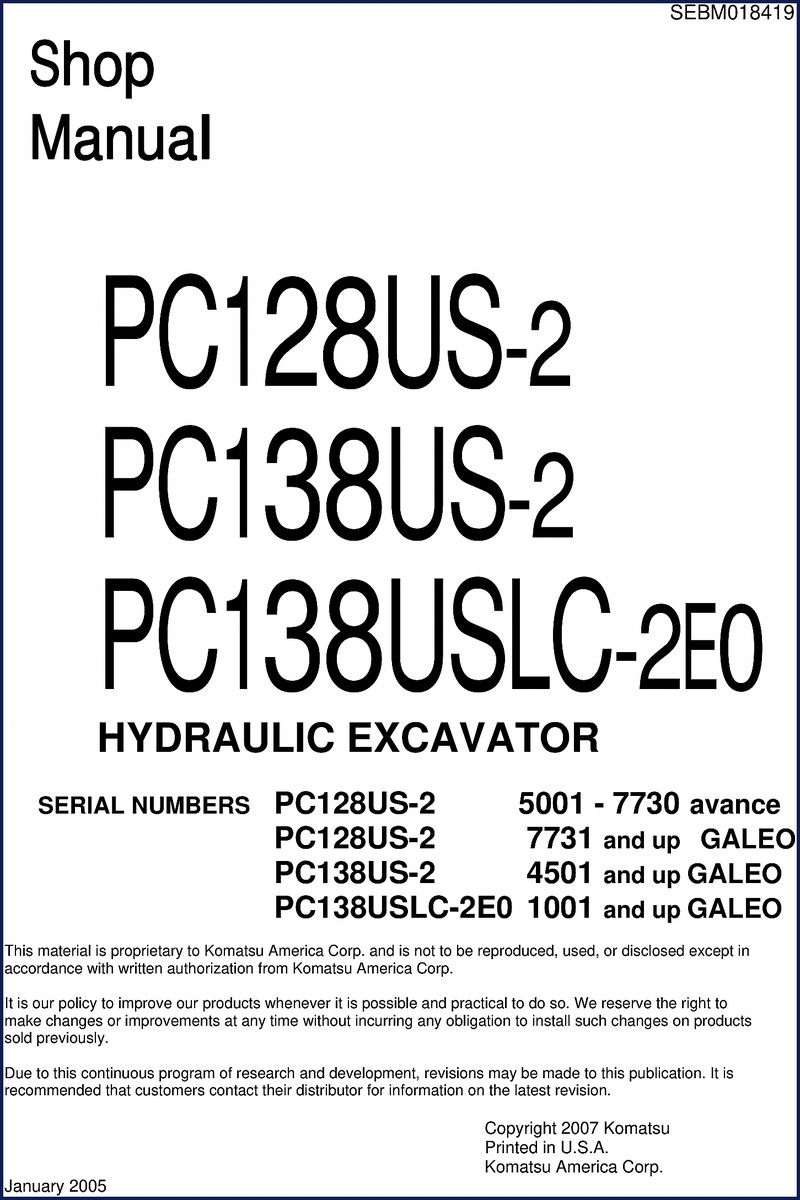
Komatsu PC128US-2, PC138US-2, PC138USLC-2E0 2007 Workshop Manual
If you’ve ever had a hydraulic line blow because you guessed the torque on a banjo bolt, or spent three hours chasing a swing brake code that turned out to be a bad connector pin, you know the difference between a factory manual and a third-party PDF. This Komatsu PC128US-2, PC138US-2, PC138USLC-2E0 2007 Workshop Manual is the real thing — 1029 pages, OEM from Komatsu America Corp., printed in 2007. It covers serial number splits: PC128US-2 from 5001–7730 and 7731 up (GALEO), PC138US-2 from 4501 up, and PC138USLC-2E0 from 1001 up. No generic reprint. No missing pages. This is what Komatsu dealers use.
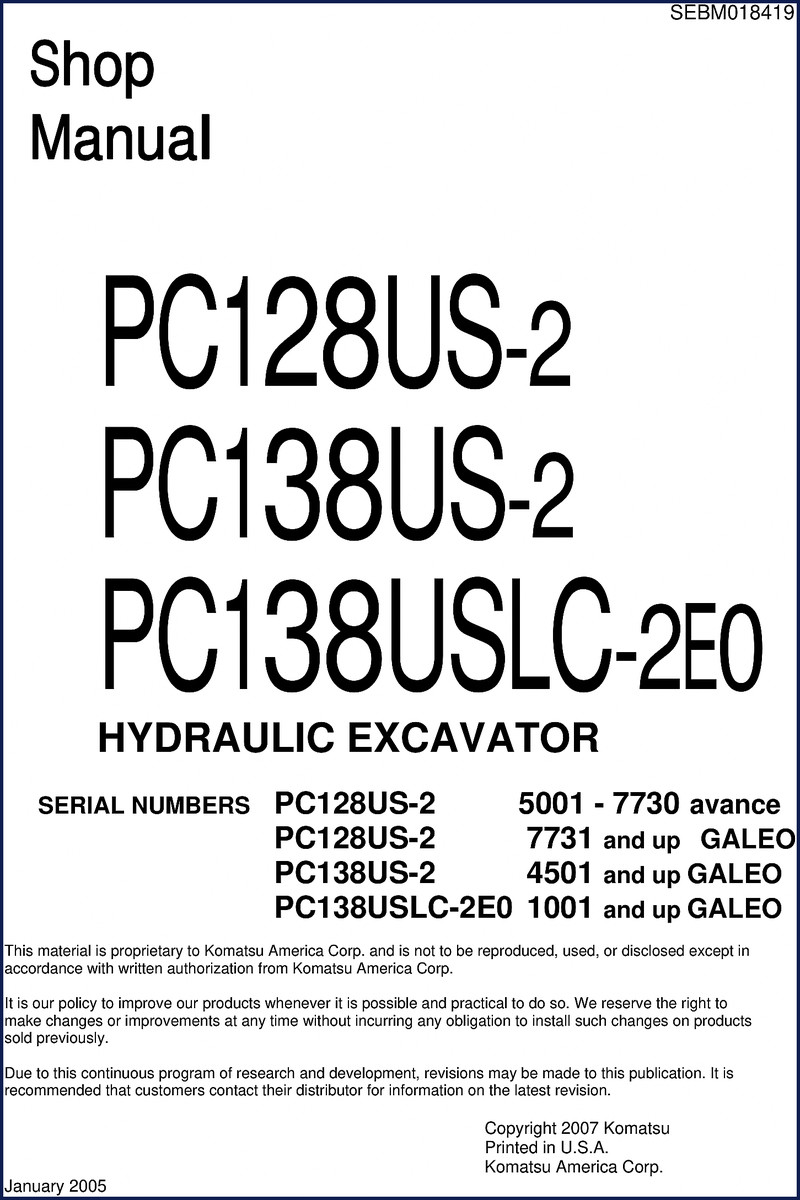
Standard Tightening Torque: Where the Manual Earns Its Keep
Look in the Foreword section and you’ll find the standard tightening torque table — the one that tells you exactly what ft-lbs to put on every bolt from the swing motor mount to the idler cushion. I’ve seen shops use a generic chart from a 1995 Ford truck and wonder why the counterbalance valve leaks. This manual gives you factory spec: inch-pounds for small fasteners, foot-pounds for the big ones, and a conversion table so you don’t mix up metric and imperial. The torque values are the same ones that come off the Komatsu assembly line in Japan. You don’t guess; you set the clicker and pull.
Testing and Adjusting: The Chapter That Saves Your Afternoon
Section 20 starts on page 20-1 and runs deep. Standard Value Tables for engine, chassis, and electrical parts give you the baseline — what should oil pressure read at idle? What’s acceptable blow-by? Then the actual testing procedures walk you through each step. Want to check the PC valve output pressure? There’s a specific port location and a table of acceptable ranges. Need to adjust the PPC valve? It shows you the locknut size and the exact stroke. The troubleshooting charts are broken by serial number range because Komatsu changed the electrical system around 7731. That matters when you’re trying to read a diagnostic code on a monitor panel — the connector arrangement diagram is different. Using the wrong chart will send you down the wrong pin. I’ve watched technicians waste half a day doing that. Don’t be that guy.
Hydraulic Component Layout: Know What’s There Before You Pull Wrenches
The Structure and Function section (Section 10) maps out every valve, motor, and accumulator. It covers the CLSS (Closed Center Load Sensing System), the self-pressure reducing valve, the center swivel joint, and the travel motor final drive. If you’re swapping a PPC accumulator or need to bleed air from the swing motor, you need the cross-sectional drawings and the location diagrams. The electric component layout shows you where the solenoid valve block sits relative to the control valve. The manual also details the hydraulic drift prevention valve for the arm — that’s a common failure point on these excavators. Without the factory schematic, you’ll be guessing which port is return and which is pressure. That’s how you blow a seal.
Does This Manual Cover Serial Number Splits?
Yes. And it does it the right way. The manual explicitly lists serial number ranges for each model: PC128US-2 5001–7730 and 7731 up, PC138US-2 4501 up, PC138USLC-2E0 1001 up. The troubleshooting section has separate judgment tables for the two ranges because the electrical system changed. You get the right wiring diagrams. You get the correct connector pin assignments. If you’re working on a PC138US-2 built after 4501, the manual tells you which E-mode troubleshooting chart to use. If your machine is in the 5001–7730 range for the PC128US-2, you follow the older judgment table. That level of detail is why OEM documentation beats aftermarket reprints every time. For a related model, check out the Komatsu PC128US-2 PC138US-2 2007 Workshop Manual 1029 Pages — same family, different serial range coverage.
3 Reasons OEM Documentation Beats Aftermarket Reprints
First, torque specs. Aftermarket manuals often round up or use a generic range. OEM gives you a specific value, like 58.8 ft-lbs for a certain bolt. Second, wiring colors and pin numbers. The Electric Wire Code in the Foreword lists the Japanese wire color abbreviations (e.g., L for blue, B for black). Aftermarket reprints blur those colors into grayscale or guess the stripe patterns. Third, the revision marks. This manual includes a List of Revised Pages with marks indicating which pages were added or replaced. You know the manual is current up to revision 19. That’s traceability you don’t get from a scanned copy on a forum. If you’re serious about keeping a machine running, you want the real thing. Another option is the Komatsu PC128US-2 PC138US-2 2007 Workshop Manual 1029 Pages — same content, different store location. For wheel loaders, see the Komatsu WA65-5 WA70-5 WA80-5 2005 Workshop Manual.
FAQ
- Will this manual help me rebuild the swing motor?
- Yes. Section 30 (Disassembly and Assembly) covers the swing motor, travel motor, control valve, and every hydraulic component. It includes step-by-step removal, inspection tolerances, and reassembly torque values. But if you don’t have the right pullers and a clean bench, don’t start.
- What torque values are listed?
- The Foreword has a Standard Tightening Torque table for metric bolts. It gives tightening torque for bolt diameter and grade. Specific component torques are in their respective sections.
- Does it include wiring diagrams for the monitor panel?
- Yes. The Troubleshooting section has connector arrangement diagrams and pin number tables. The monitor panel display special functions are described for serial numbers 7731 and up. For earlier models, the judgment table method is used. You get both.
- How do I download the manual after purchase?
- After checkout, you’ll receive a link to download the PDF directly. The file is fully bookmarked and searchable. No watermark, no password. It’s a direct copy of the OEM print.
I’ve been turning wrenches for 28 years. ASE Master, L1, the whole alphabet. I keep a copy of this manual in the shop tablet because when a customer brings in a Komatsu excavator that won’t swing right, I need the factory test procedure, not a guess. The PC138US-2 models with the CLSS system can trick you if you don’t understand the load-sensing differential pressures. But with the testing and adjusting procedures in this manual, you can isolate a bad LS valve in under an hour. That’s billable time saved. If you’re a home garage mechanic trying to fix a rental fleet machine, or a shop owner who wants to stop losing money on diagnostics, this is the manual you need. Don’t trust your Komatsu to aftermarket garbage. Download the Factory Manual and get back to work.
Reviews
There are no reviews yet.