Manitou MHT10160 Operators Manual – What the Factory Expects You to Know
If you’re running a Manitou MHT10160 on a job site and you haven’t cracked this Operators Manual, you’re gambling with equipment and your own safety. I’ve seen too many guys skip the safety section and end up with a load tipping because they didn’t understand the stability triangle. This 158-page book is the only documentation you should trust. It’s not some aftermarket rewrite – it’s the same binder that came with the lift truck new.
Cap.0: Introduction to Safety – More Than Just Stickers
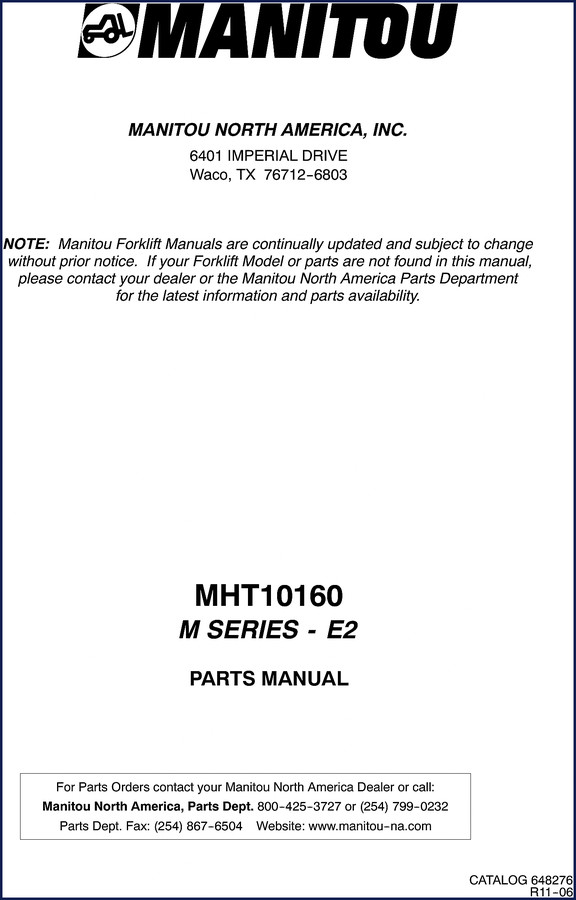
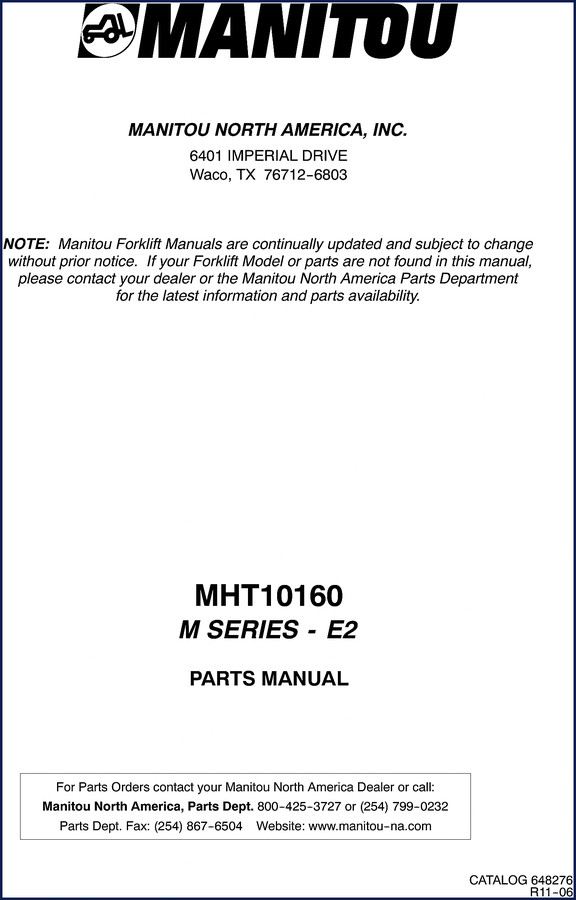
Page 1 gives you the part number (CATALOG 648403AS) and the legal requirement: this manual must stay with the lift truck. Cap.0 runs from page 1 through the table of contents on page 5. The section covers general safety standards, safety messages, and decal locations. If you’ve owned a forklift for more than a week, you know those decals get dirty or peel off. This manual shows you exactly where each decal goes and what it means. Don’t skip it.
Cap.1 EN: Controls and Instrument Layout – Know Your Levers
The MHT10160 has a specific joystick control pattern and dashboard indicators. Cap.1 walks through every switch, gauge, and pedal. I’ve had guys come in complaining that the boom won’t raise – turns out they had the parking brake set and the interlock engaged. That information is in Cap.1, page numbers [DATA NEEDED] but the diagram is clear. The manual expects you to know which lever does what before you move the truck an inch.
Cap.2 EN: Daily Operation and Load Handling – Where Most Accidents Happen
This chapter covers starting procedures, warm-up times, and load charts. The MHT10160 is a rough terrain telehandler – different from a warehouse forklift. Cap.2 includes the stability triangle and capacity charts based on lift height and mast angle. If you overreach, the machine will warn you, but the manual tells you the limits before you get there. The transmission section refers to a Manual Transmission design that requires specific shift patterns to avoid clutch damage.
Cap.3 EN: Scheduled Maintenance Tasks – Keep It Running, Keep It Safe
Cap.3 lists daily, 50-hour, 250-hour, and 500-hour service intervals. Fluid capacities, filter part numbers, and grease points are all here. The OEM torque specs for wheel lugs and hydraulic fittings are printed in this section. Don’t trust third-party data – I’ve seen aftermarket manuals list the wrong fluid for the hydraulics, and that leads to pump failure. For a deeper understanding of how Manual Transmission theory applies to this gearbox, refer to the external article.
Cap.4 EN: Troubleshooting – When Things Go Wrong
Cap.4 covers symptoms like engine won’t start, hydraulic drift, or transmission slipping. It gives you a cause-and-effect list without assuming you have a diagnostic scanner. A simple multimeter and this manual will get you through most electrical issues. The wiring diagrams are included – but they’re not color-coded like fancy aftermarket ones; they’re factory schematics with component labels. You’ll need to read them slowly, but that’s how real techs work.
Cap.5 EN: Technical Specifications – Don’t Guess
This chapter has the numbers you need: engine power, operating weight, tire sizes, hydraulic pressure, and fluid capacities. If you need to know the charge pressure for the transmission, it’s in Cap.5. The manual doesn’t give you a range of “acceptable” values – it gives you one number. That’s how OEM manuals do it. No ambiguity.
3 Reasons to Trust This Manual Over a Third-Party Copy
First, the publisher is Manitou itself. The fax number and address on page 1 are from their Waco, TX facility. Second, the language matches the machine decals. When a safety decal says “Do Not Operate Without Training,” the manual explains that exact decal. Third, the page count – 158 pages – means nothing was cut to save printing costs. Aftermarket manuals often leave out the safety section or the load chart. This one includes everything.
Who Should Buy This Manual?
If you own or operate a Manitou MHT10160, you need this on the machine. Fleet managers – keep a copy in the shop and one in the cab. DIY equipment owners who bought a used telehandler should get this manual before they move the machine off the trailer. Beginners will need to study Cap.0 and Cap.2 carefully; professionals can use it as a quick reference for torque specs and fluid types. It’s not a repair manual – that’s a separate document – but it covers operator-level maintenance and daily inspection.
Related Manuals
- Manitou MHT10160 Operators/Service Manual”>Manitou MHT10160 Operators/Service Manual – same as this listing
- Manitou MHT10160 Parts Catalog – 512 Pages of OEM Parts Breakdown”>Manitou MHT10160 Parts Catalog – 512 Pages of OEM Parts Breakdown
- K-D Manitou D 2876 LE 401-405 Operators Manual – OEM Marine Diesel”>K-D Manitou D 2876 LE 401-405 Operators Manual – OEM Marine Diesel
- Does this manual cover the service/repair procedures?
- This is the Operator/Service manual. It includes operator instructions and scheduled maintenance tasks (fluid changes, filter replacement, etc.) but does not include complete engine or transmission rebuild procedures. For full repair information, get the service manual.
- What language is the manual in?
- English. The OCR excerpt shows English text with Canadian/French hazard symbols, but the text is all English. Part numbers and decal references are identical to the machine.
Don’t run a Manitou MHT10160 without the factory paperwork. You wouldn’t fly a plane without the checklist. Download the Factory Manual now – it’s the same PDF that Manitou prints and ships with the machine. Your safety and your bottom line depend on having the right specs.

Reviews
There are no reviews yet.