
Manitowoc 4100W Ringer S3 Technical Manual
If you’re operating a Manitowoc 4100W Ringer S3 in the field, you know that guessing a capacity chart can get someone killed. I’ve seen too many riggers rely on photocopies of photocopies until a load drops. This is the real factory document – 152 pages of Manitowoc-issued data that tells you exactly where the limits are. No reprints, no third-party summaries. Just the original OEM print that came with the crane.

Safe Operating Practices: Electrical Contact and Electrocution Hazard
Section 1113 covers more than generic warnings. It breaks down Size of Load, Attaching Load, Lifting/Moving Load, and Multiple Load Line Operation. The part that catches most operators is the Electrocution Hazard subsection. It tells you the minimum clearance from power lines based on voltage – not a guess, but a number from the manufacturer. Page 3 of the manual lists the Electrical Contact protocol, including Electrocution Hazard Devices and what to do if contact happens. If you skip this section because you think you know it, you’re gambling.
Capacity Charts: Determining Total Load and Maximum Working Radius
This is the meat of the 4100W Ringer S3 Technical Manual. Section 2081 gives you worksheets to calculate total load and maximum working radius from every possible fall point – lower boom, upper boom, fixed jib, luffing jib, tower boom, tower jib, and intermediate fall points. Worksheet A through K each handle a specific configuration. You don’t guess; you plug in your numbers and get a safe lift radius. The Guide For Determining Total Load And Maximum Working Radius starts with an example, then walks you through the math. If you’ve ever derated a lift because you weren’t sure of the chart, these worksheets end that.
Pedestal/Barge Mounted Crane Setup
Section 1064 covers the specifics of mounting the 4100W Ringer S3 on a pedestal or barge. It defines Pedestal Mounted Crane and Barge Mounted Crane with examples, then goes into Shock Loading – a term that gets thrown around but rarely defined. The manual explains how wave action on a barge creates shock loads that change your capacity chart. There’s also a Crane Inspection checklist and procedures for Transporting Crane on Barge. If you’re setting up on water, this section is mandatory reading.
Why Factory Specs Matter for the 4100W Ringer S3
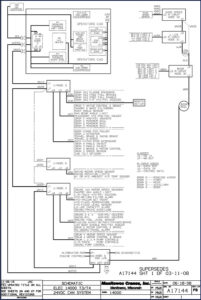
Aftermarket capacity charts often round up or simplify the rigging. This Technical Manual came from Manitowoc’s engineering department. It includes the original Crawler Blocking Diagram and Operating Radius data. The wire rope specifications on Capacity Chart 6144 are factory-tested. Trusting a third-party number for hoisting range can get you a snapped line. I’ve seen it. The Electrical diagrams in this manual are not generic – they match the serial number 10118 build. If you need to trace a sensor or check the contactor logic, this is the only source.
What’s Inside the 152-Page Document
The index on page 3 lists every folio and drawing number. You get the Basic Specification Sheet, Warning and Information Signs, Nameplate and Decal Assembly, and Standard Hand Signals for Controlling Crane Operations. Then come the liftcrane capacity charts (6281-A1 through 6733-B2), jib capacity charts (6732-A, 6734-A/B/C), range diagrams (6414, 6415, 65020), and wire rope specs. Every chart has a publication date – so you know your manual is current. No outdated numbers from a 1972 reprint.
FAQ – Four Questions You’ll Have
- Does this manual cover electrical systems?
- Yes. The Electrocution Hazard section includes device requirements and contact protocol. The Electrical Contact subsection is on page 3 of the safe operating practices folio.
- How do I read the capacity charts?
- Start with the Guide For Determining Total Load And Maximum Working Radius (section 2081). Pick the worksheet that matches your boom/jib configuration. Fill in the load weights and radius measurements from your rigging. The chart itself tells you the maximum allowable load at that radius. Always cross-check using the correct worksheet – using a tower boom worksheet for a luffing jib lift will give you a false number. The manual’s example walks through a lower boom point calculation step by step. If you take the time to run through that example with your own numbers, you’ll nail it every time. The capacity charts are organized by configuration and include date codes so you know which revision applies to your crane.
- Is this the same as the operator’s manual?
- No. The operator’s manual covers daily use and basic controls. This Technical Manual focuses on capacity, safe operating practices, and setup – including pedestal/barge mounting and shock loading. It’s a complement, not a replacement.
- Can I use this for other Manitowoc models?
- Only if they share the 4100W Ringer S3 platform with serial number 10118. The specific capacity charts and worksheets are unique to this configuration. For other models, look for their dedicated manuals.
Related Manuals and Resources
- Manitowoc 4100W Ringer S3 Service Manual
- Manitowoc 2300 Duracopy Capacity Charts Manual
- Manitowoc 4000W Ringer Laminated Lubrication Guide
- Manual Transmission
- Manual Transmission
Download the Factory Manual and stop relying on worn-out copies. Your rigging crew’s safety depends on accurate torque and load numbers – get them direct from the source.






Richard G. –
Great factory service manual. Quick download after checkout. Every wiring layout is provided for Manitowoc 4100W. Highly recommended for mechanics.
John D. –
Excellent workshop guide. It is easily zoomable on my iPad without blur. It helped me to fix my Manitowoc 4100W electrical connector. Saves me hundreds of dollars.
Thomas B. –
I am extremely satisfied with this transaction. The PDF looks clean. Every spec sheet is provided for Manitowoc 4100W. Saved my repair job! Thank you.