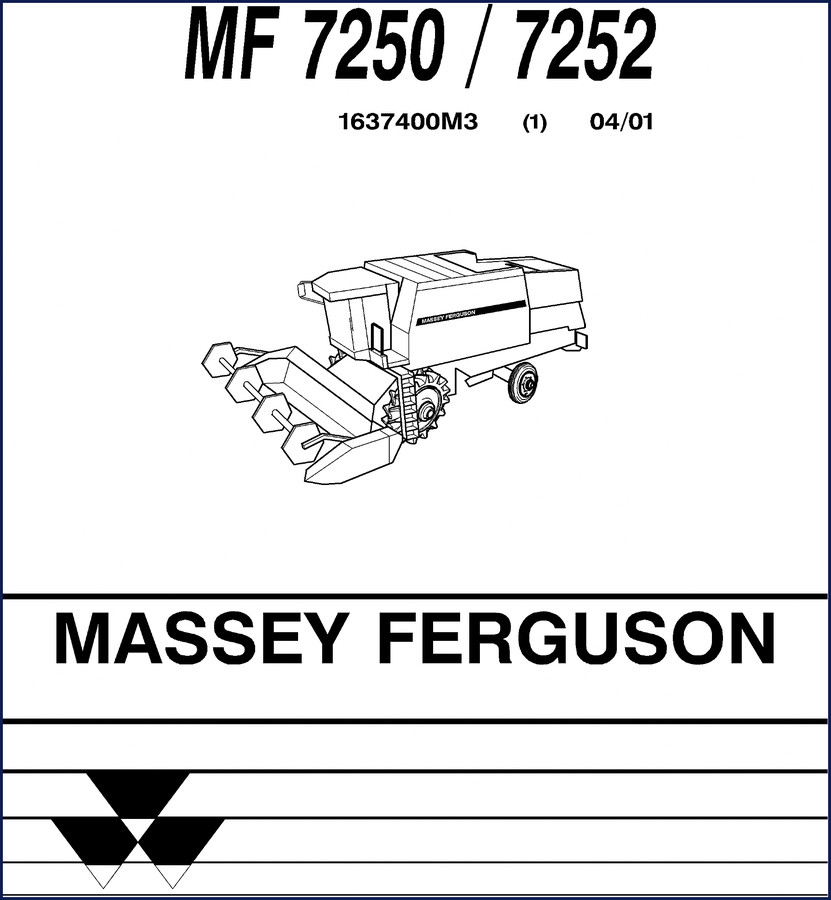
Massey Ferguson 7250, 7252 2001 Parts Catalog
If you’re ordering parts for a Massey Ferguson 7250, 7252 2001 Parts Catalog without the factory numbering system, you’re burning money and time. I’ve seen guys buy a header drive belt three times because the aftermarket cross-reference was off. This is an OEM document – 483 pages of what Massey Ferguson printed for their dealers. It’s not a repair manual. It’s a parts catalog. You get the exact part numbers, quantities, and assembly relationships you need to order the right piece the first time. No guesswork. No reprints.
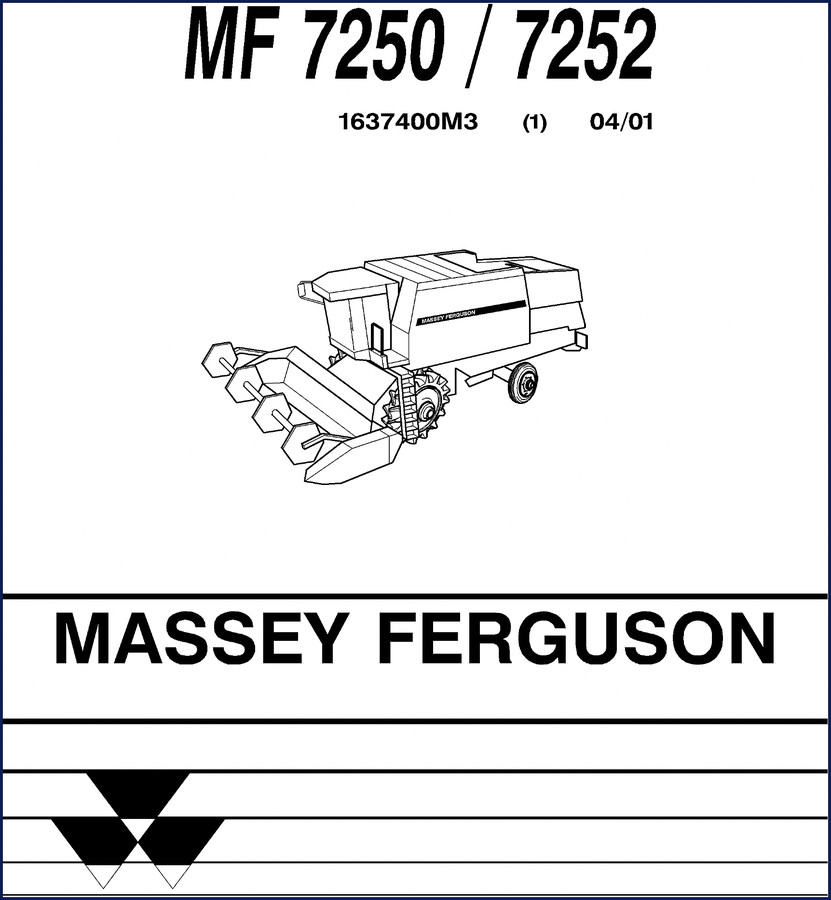
18 Groups Cover Every System on the 7250 and 7252
The catalog is built around 18 machine groups, each with its own illustrated parts breakdown. You get Group 1 (Table/Barre de Coupe) through Group 18 (Decals/Callomanias). Every group is cross-referenced in English, French, and German – because Massey shipped these combines worldwide and parts numbers aren’t language-specific. The Group Index Alpha at the front lets you jump straight to the system you need: ENGINE (Group 8), TRANSMISSIONS (Group 11), HYDRAULIC (Group 14), TOOLS AND ELECTRICAL SYSTEM (Group 16). Each group includes an illustration reference number and a part number reference list. That list tells you the quantity required, whether it’s a recommended stocking part, and if it’s also a component of a larger assembly. The safety note on page 4 is worth reading: if the part originally carried a safety decal, you must order and fit that decal when replacing it. That’s factory policy, not a suggestion.
What’s Inside the Numerical Index?
Three indexes. The Alphabetical Index lists parts by name (e.g., “Crownwheel” or “Bolt”). The Numerical Index lists every part number in ascending order. The Group Index Alpha lists groups by name. If you have a part number but don’t know where it lives, the Numerical Index points you to the correct group and illustration page. If you have a name but no number, the Alphabetical Index gives you the number. This is the same indexing system used in every major OEM parts catalog from the late 90s onward. It works. Automotive Industry Overview relies on similar structured data for parts management. The key is that every part number in this catalog is a genuine Massey Ferguson number – not a generic cross that may or may not fit. The example on page 4 shows how to read the reference list: column C is the part number, column F is quantity, columns G/H/J are English/French/German descriptions. An asterisk in column B means a change since last print. That’s information aftermarket catalogs almost never reproduce.
483 Pages of Factory-Coded Part Numbers
483 pages. That’s the entire machine, broken down into buying decisions. Each page has an issue number and date printed in the lower right corner. The catalog was released in 2001 (issue 04/01). Massey Ferguson didn’t combine multiple years into one book – this is specific to the 7250 and 7252 models. If you try to use a 1999 catalog for a 2001 machine, you’ll get superseded numbers or missing parts. The Recommended Stocking Parts list (at the front) includes a column QTY for the quantity used per fitting. Parts in that list are marked in the part number reference list with either a bold-italic font (marketing key parts) or italic font (stocking parts). Non-stocking parts appear in regular type. That tells you which parts are expected to fail most often – things like belts, bearings, and shear bolts. If you’re a dealer or a farmer with a fleet, that list is your inventory shortcut.
Use the Recommended Stocking Parts List to Save Time
Open the catalog to the Recommended Stocking Parts section. It’s indexed by group, and each entry includes the part number, description, and quantity used. If you’re rebuilding a straw chopper (Group 17) or a concave/threshing drum assembly (Group 4), start with that list. It tells you which parts you should have on hand before you tear anything down. The catalog also marks “marketing key parts” – these are the high-volume, common failure items. For a combine, that means knives, guard assemblies, elevator chains, and fan belts. Ordering those without the correct Massey Ferguson number is a waste. The aftermarket equivalents often have different thread pitches or material grades. I’ve seen a header drive sprocket fail because diameter was off by 0.015 inch. This catalog gives you the exact number. No speculation.
Hydraulic Systems: Why You Need the OEM Drawing
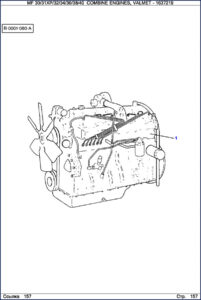
Group 14 (HYDRAULIC/HYDRAULIQUE/HYDRAULIK) covers the entire hydraulic system – lines, valves, cylinders, fittings. The illustration pages show the assembly with reference numbers that match the part number list. If you need a hose assembly for the reel lift circuit, you find it in Group 2 (REEL/RABATTEUR/HASPEL) or Group 14 depending on routing. The drawing includes the correct routing, fitting orientation, and clamp positions. Aftermarket drawings often merge multiple circuits into one generic diagram. The OEM catalog separates them by function. Massey Ferguson 7250 7252 2001 Parts Catalog is the only source for verified fitting sizes and port configurations. Don’t guess on hydraulic parts – a wrong O-ring or a mismatched thread can cost you a pump. The catalog also notes when a part is part of an assembly (column D) – so if you see that your bolt is also used in the differential assembly, you know you can order it as a component of that kit or separately.
Source Validity: Factory Print, Not Aftermarket Conversion
This PDF is a direct scan of the official Massey Ferguson parts catalog from 2001. It’s not a rewritten version, not a compilation from online sources. The OCR excerpt shows the original layout with table columns and part number examples like D61116894 and D61735293. The safety note about decals is verbatim from the factory. The issue number and date are printed on every page. Compare that to an aftermarket catalog that lists “fits Massey Ferguson 7250/7252” but doesn’t show the group index or the stocking parts list. Those catalogs are missing the logic Massey used to assign part numbers. They might give you a cross number that works, but they won’t tell you if the part was superseded in 2002. This manual will. Massey-ferguson MF300 Parts Catalog – 607 Pages – Factory OEM and Massey-Ferguson MF500 1977 Parts Catalog – 517 Pages Factory OEM are also factory prints for different series. If you need parts for older models, those are the right documents.
- Does this catalog include torque specifications or repair procedures?
- No. This is a parts catalog. It lists part numbers and assembly relationships. Use the service manual for torque values and repair steps. Automotive Industry Overview conventions keep services and parts documentation separate.
- How do I find a specific part number if I only have the old number?
- Open the Numerical Index at the back of the catalog. It lists every part number in ascending order. Each entry includes the group number and illustration page where that part appears. For example, if you have a bolt number D61735293 from the OCR excerpt, look it up in the Numerical Index. It will tell you which group (likely Group 11 for transmissions or Group 4 for the threshing drum) and the illustration page number. Then go to that group’s illustration and the part number reference list to verify the quantity and description. If the part number is missing from the index, it may have been superseded – check the Recommended Stocking Parts list for updated numbers. The Alphabetical Index can also help if you know the part name but not the number (e.g., “crownwheel” leads to Group 4). This catalog is designed to be worked through in order: start with your symptom or old part, use the index to find the group, then the illustration to confirm the assembly.
Download the Factory Manual from AutoRepairManuals and get the exact parts catalog Massey Ferguson dealers used. 483 pages. 18 groups. Three indexes. No reprints. No third-party conversions. This is the real OEM document for the 7250 and 7252.

Reviews
There are no reviews yet.