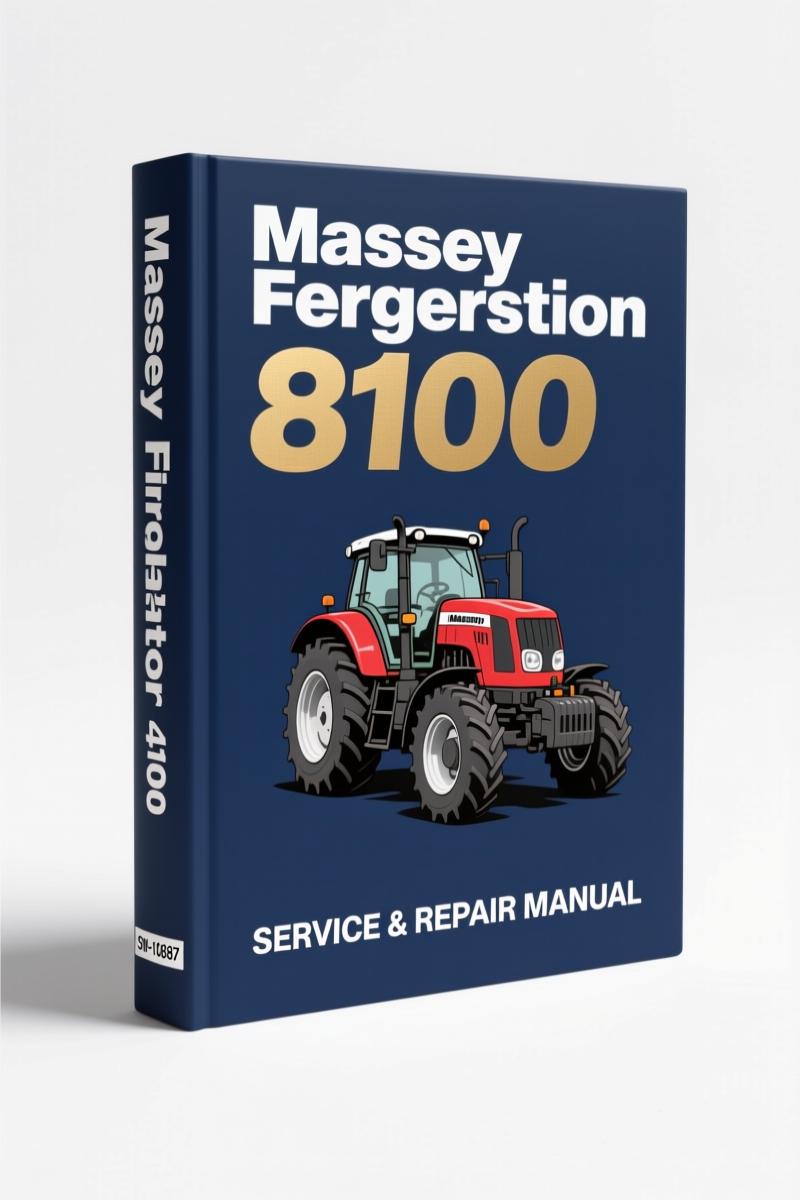
You got a Massey Ferguson 8100 in the bay and the customer wants the PTO fixed by Friday. You grab some aftermarket manual and it tells you the clutch adjustment is “hand tight” — that’s how seals get blown. Massey Ferguson 8100 Workshop Manual runs 625 pages of original factory print. No guesswork, no third-party rewrites. This is the same binder the dealer techs had back in 1995.
What You Get Inside the 625-Page Factory Manual
Flip to page 1 and you see the full contents: 14 sections from Introduction to Service Tools. Each section is broken into parts with their own page numbering system — example 6.802.2 tells you section 6, part 802, page 2. The manual expects you to use genuine Massey Ferguson parts and the listed service tools. Torque wrenches are not optional.
Splitting the Tractor: Why You Need the Specs
Section 2 covers splitting the tractor. That’s where you separate the engine from the transmission — and if you don’t have the exact support points and lifting sequence, you bend a half-shaft. The factory manual shows chassis mounting points and dimensions on page 4 of the introduction. Get the weight distribution wrong and you’re looking at a shop floor disaster.
Torque Specs: The Difference Between a Leak and a Seal
Section 1, part I lists tightening torques on page 30. Not “tighten to feel” — these are the OEM values for every bolt, from the cylinder head to the hydraulic cover. I’ve seen guys strip threads on a rear axle housing because they used a generic chart. The Manual Transmission section (Section 5) has gearbox torque values specific to the 8100 series. Use the wrong spec and the input shaft bearing walks out of its bore.
Does This Manual Cover Hydraulics and Electronics?
Section 9 is Hydraulics — the whole system, not just a generic diagram. Section 10 covers Electrical equipment, and Section 11 goes into Electronics. That’s where you find the control unit pinouts and diagnostic procedures. If the tractor’s dash isn’t communicating with the transmission ECU, you need the factory troubleshooting flowcharts printed in those pages. Aftermarket manuals skip the logic sequence and leave you swapping parts.
Source Authenticity: OEM vs Aftermarket
This is the original Massey Ferguson publication from February 1995. Every amendment page has an issue number and date — you throw away the old pages. No aftermarket publisher gets that right. The Manual Transmission overhaul procedures in Section 5 specify genuine MF seals and shims. Aftermarket manuals tell you to “use equivalent” — that’s how you get a gear noise complaint six months later.
Audience Fit and Real-World Use
If you run a shop that sees Massey 8100 series tractors, this manual lives on the tech’s cart. For the DIY owner who maintains his own farm equipment, this is the difference between a weekend job and a tow to the dealer. Section 13 covers Accessories, Section 14 lists Service Tools with part numbers so you can order the correct puller instead of making one out of threaded rod. The safety precautions in Section 1D are written for actual hazards — hydraulic pressure bleeds, battery disconnection, PTO lockout.
Related manuals you might need on the same shelf:
- Massey Ferguson 8100 Series Workshop Manual
- Massey Ferguson FF30 1956 Workshop Manual – Factory Specs for the FF30 Tractor
- Massey Ferguson 825 Workshop Manual – Factory Specs & Procedures
FAQ
- Can I use this manual for the 8100 series with cab?
- Yes. Section 12 covers Cab and Equipment.
- What is the difference between this factory manual and a Clymer or Haynes manual?
- A Clymer is a reprint of selected procedures with aftermarket torque values. This Massey Ferguson 8100 Workshop Manual is the original dealer document — 625 pages, full wiring schematics, splitter procedures, and the same safety warnings printed by the engineers. When a head bolt has a two-step torque sequence with an angle mark, this manual shows you which socket to use and which sealing compound from Section 1H. Aftermarket manuals condense the steps and omit the lock washer thickness specs. On a 8100 series, the rear axle preload alone has six different measurements depending on the build date. Only the OEM manual tracks that.
Don’t throw another afternoon away guessing. 625 pages of factory procedure designed to keep the 8100 running at full drawbar power. Download the Factory Manual and put the right spec on the job.

John D. –
This is just what I needed. Quick download after payment. Every torque spec is included for Massey Ferguson 8100. Worth every penny.
Michael S. –
I am extremely satisfied with this purchase. The document looks clean. A must-have for any Massey Ferguson 8100 mechanic doing maintenance. Saved my weekend project! Thanks.