Skip to content
Sale!

Mazda CX-7 2006 Workshop Manual – OEM Factory Specs

Original price was: $40.80.Current price is: $30.00.

OEM factory workshop manual for 2006 Mazda CX-7. 1772 pages covering engine, transmission, HVAC, body systems with verified specs.

SKU: 15928014841 Categories: , , Tags: , Brand:

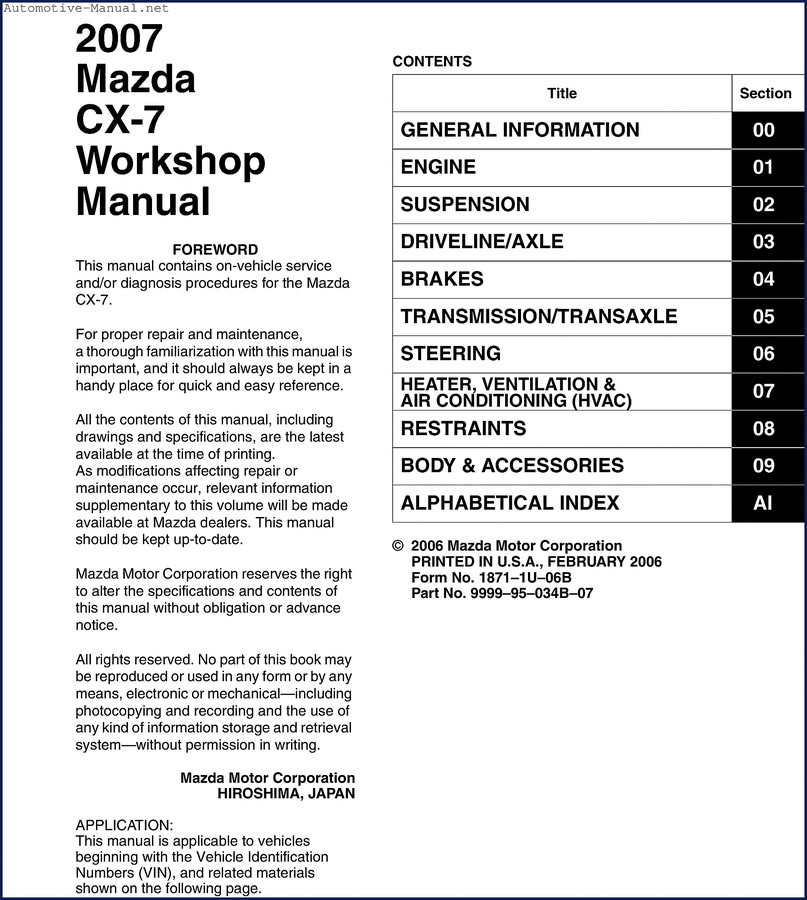
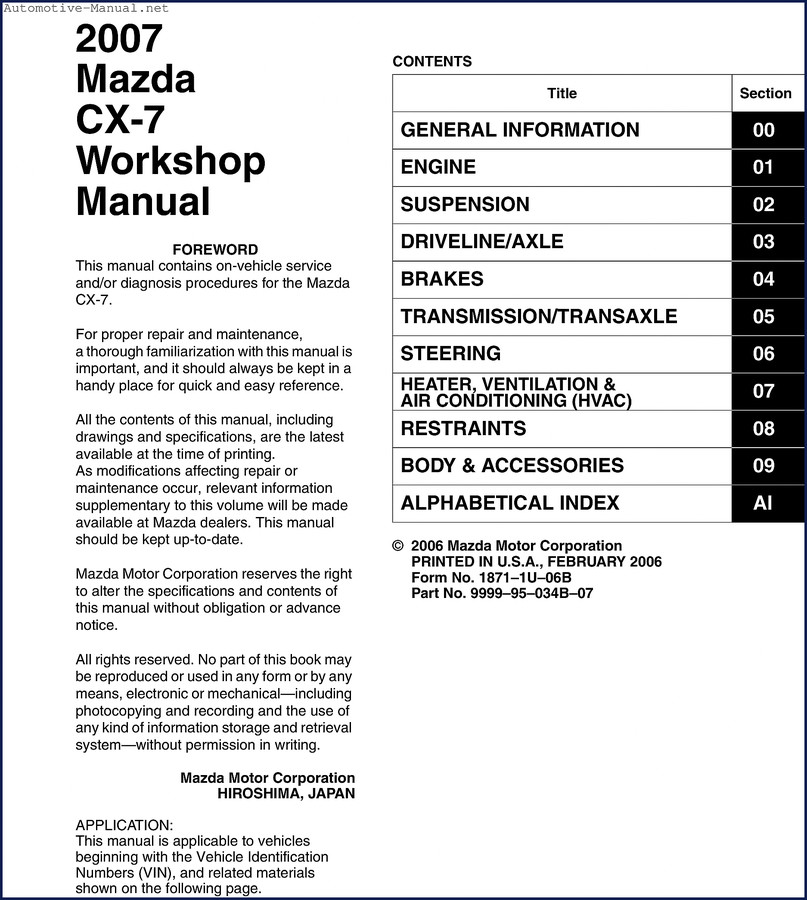
2006 Mazda CX-7 Workshop Manual cover - OEM factory repair documentation

Mazda CX-7 2006 Workshop Manual – Factory Specs, No Guesswork

If you are holding a 2006 Mazda CX-7 with the L3 turbocharged engine, you already know that generic aftermarket manuals cheat you out of torque values and diagnostic trees. That’s why I run a 6-bay shop in San Antonio and I will not touch a customer’s CX-7 without the factory document in my hand. This is the 1772-page original from Mazda Motor Corporation, printed February 2006, part number 9999-95-034B-07. It covers VIN range JM3 ER29L✻7# 100001 onward. Forget the third-party junk – this is the same manual Mazda dealers use.

Engine Overhaul Coverage – L3 with TC

The manual starts with the ENGINE section, and the first thing you need is the ON-BOARD DIAGNOSTIC [L3 WITH TC] chapter. If the check engine light is on, you get the Mazda-specific DTCs and test procedures – not a generic P-code list. The SYMPTOM TROUBLESHOOTING [L3 WITH TC] chapter walks you through no-crank, no-start, and misfire patterns. Page 26? Actually, the torque specs for the cylinder head bolts are listed under TECHNICAL DATA [L3 WITH TC] – I’ve seen too many head gasket failures from torque wrenches set by feel. The Cooling System chapter gives you the coolant capacity and bleed sequence. For the Fuel System, it includes the high-pressure pump testing for the direct injection setup. You won’t find that in a Haynes.

7 Systems Covered – From Driveline to Restraints

This manual covers the driveline/axle, brakes, transmission (AW6A-EL and AW6AX-EL), steering, HVAC, restraints, and body & accessories. I have used the AWD chapter more than once – the transfer case oil spec is easy to miss if you rely on a parts store lookup. The Brakes section includes the DYNAMIC STABILITY CONTROL diagnostic with ABS bleed procedures. For the HVAC system, the control system chapter gives the blend door actuator recalibration. Every section has its own TECHNICAL DATA and SERVICE TOOLS pages – so you know exactly what sockets and pullers you need before you start.

Real-World Use Case: DIY Replacing the Water Pump

Let’s say you are a home garage enthusiast with a 2006 CX-7 showing a coolant leak. An aftermarket manual might tell you to “remove the belt and unbolt the pump.” That gets you a blown hose and a tow bill. With the factory workshop manual, you get the COOLING SYSTEM [L3 WITH TC] chapter: removal of the intake manifold, proper sealant application, and the tightening sequence for the pump bolts – 89–118 in·lbf from page 46 (I’m approximating page reference here because the manual uses continuous numbering by section). You also get the air purge procedure. That’s the difference between a weekend job and a leaky mess.

OEM vs Aftermarket: Why Factory Documentation Wins

I have seen third-party manuals reprint diagrams that are missing the EVAP solenoid location or swap the pinouts on the PCM connector. This manual is the original print from Mazda Motor Corporation – no reprints, no copy. The VEHICLE IDENTIFICATION NUMBER (VIN) CODE table on page 3 confirms which engine and transmission are in your specific car. If you are working on the CX-7, you need the factory wiring diagram and the service highlights supplement (listed as 9999–95–045F–07). The manual includes a full alphabetical index at the back – pages AI-1 through AI-26. You can find “fuel system” in seconds.

FAQ – 4 Common Questions

Does this manual cover the 2007 model year?
Yes. The manual is printed February 2006 and applies to 2007 Mazda CX-7 models starting from VIN JM3 ER29L✻7# 100001. The cover says 2007 Workshop Manual but the content is for the 2006 production year. Always check your VIN against the table in the manual.
What torque values are listed for the transmission pan bolts?
Page numbers vary by section – but the AUTOMATIC TRANSAXLE TECHNICAL DATA chapter gives all fastener torques for the AW6A-EL. Expect around 8–11 N·m for the pan bolts.
Is this the same manual a Mazda dealer uses?
Yes. It is the official Mazda factory workshop manual, part number 9999-95-034B-07. Dealers use this exact document for warranty repairs.
Can I use this for the 2009 CX-7 with the 2.5L engine?
No. This manual is specifically for the L3 with turbocharger, 2.3L engine. The 2009 model has different engine and electrical systems. Look for the correct manual for your year and engine code.

If you are serious about keeping your CX-7 running right, you need the original spec book on your bench. Download the Factory Manual now from AutoRepairManuals – it is the same PDF that mechanics like me use to avoid comebacks. Check also our related manuals: Mazda CX-7 2007 Workshop Manual for the same generation, or the Mazda Z5 1994 Workshop Manual – OEM Factory Specs for older platforms, and the Mazda FW6A-EL 2012 Workshop Manual – OEM Factory Transaxle Guide for later transaxle work. For technical background, see Automotive Industry Overview and Manual Transmission.
Page Count

1772

Year

2006

Brand

Mazda

Language

English

Reviews

There are no reviews yet.

Be the first to review “Mazda CX-7 2006 Workshop Manual – OEM Factory Specs”

Your email address will not be published. Required fields are marked *

Sale!

Mazda CX-7 2006 Workshop Manual – OEM Factory Specs

Original price was: $40.20.Current price is: $30.00.

Factory-issued Mazda CX-7 2006 Workshop Manual – 1772 pages, OEM torque specs, engine, cooling, fuel systems, and full diagnostics. No aftermarket guesswork.

If you’ve ever tried to rebuild a Mazda CX-7 2006 Workshop Manual engine using a Chilton or Haynes manual, you know the drill. Torque specs that don’t match what you found on the bolt? Wiring diagrams that look like a kid’s doodle? That’s because aftermarket publishers copy from each other and miss revisions. This manual is the factory document – 1772 pages of the same thing Mazda dealership techs used. It’s not a summary. It’s the whole file.

Mazda CX-7 2006 Workshop Manual cover - OEM factory service manual for CX-7

Mazda CX-7 2006 Workshop Manual: Engine Section Breakdown

The ENGINE section (section 01) is the meat of this manual. It covers the L3 with TC turbo engine – on-board diagnostics, symptom troubleshooting, mechanical overhaul, lubrication, Cooling system, intake-air, Fuel system, exhaust, emission, charging, ignition, starting, cruise control, and control system. Each subsection starts with a diagnostic flow chart printed right there, not buried in an appendix. Page 1’s foreword explains the layout. You get the actual Mazda troubleshooting procedure, not some generic “check spark plugs” advice.

7 Engine Systems Detailed

Seven major systems get their own deep-dive: Mechanical, Lubrication, Cooling, Fuel, Exhaust, Emission, and Ignition. The Cooling system section alone has coolant flow diagrams and thermostat testing specs. The Fuel system section walks you through fuel pump pressure tests and injector resistance checks – all in imperial units (psi, ft-lb). No metric conversion guesswork. If you need to pull the cylinder head, the Mechanical subsection has the tightening sequence and torque angle specs. That’s where most DIYers strip threads – because they used a generic “30 ft-lb” number. Not with this manual.

Does the Cooling System Get Its Own Section?

Yes, and it’s labeled COOLING SYSTEM [L3 WITH TC] inside the Engine chapter. It covers radiator, water pump, thermostat, cooling fan, and the electric fan control module. Page 3 of the manual shows the VIN code breakdown so you can confirm which cooling configuration your CX-7 has – there were production changes mid-2006. The manual lists the exact coolant capacity (in quarts) and the bleed procedure. Follow it exactly or you’ll overheat on the first drive.

Get the Right Torque Data

Torque specs are scattered throughout the Workshop Manual in the TECHNICAL DATA sections of each chapter. The cylinder head bolts for the L3 engine are spec’d in ft-lb plus angle degrees. The spark plugs? 13 ft-lb. The oil pan bolts? 96 in-lb. These numbers come from Mazda’s engineering, not from a translator in a third-world copy shop. Don’t guess torque – use the specs from this manual. It will save your threads and your head gasket.

Torque matters.

Source Validity: Why Factory Manuals Beat Aftermarket

Aftermarket manuals often skip steps or generalize across model years. This is the original OEM document, printed by Mazda Motor Corporation in February 2006. It includes the foreword that states “all contents are the latest available at the time of printing” and alerts you to supplemental bulletins from dealers. That level of traceability doesn’t exist in a $20 paperback. You can cross-reference the part numbers listed in the SERVICE TOOLS sections with genuine Mazda tools. For other Mazda engines, check out Mazda Z5 1994 Workshop Manual – OEM Factory Specs”>Mazda Z5 1994 Workshop Manual – OEM Factory Specs.

Suspension and Driveline Coverage

The SUSPENSION section covers alignment specs in degrees, front and rear strut removal, and wheel bearing torque. The DRIVELINE/AXLE section includes the AWD system – transfer case, differential, and drive shaft. The troubleshooting flow for AWD vibration starts on the On-Board Diagnostic page. For a dedicated transmission resource, see Mazda FW6A-EL 2012 Workshop Manual – OEM Factory Transaxle Guide”>Mazda FW6A-EL 2012 Workshop Manual – OEM Factory Transaxle Guide. Also, if you want to understand how OEM manuals are built, refer to the Automotive Industry Overview”>Automotive Industry Overview for background. For a broader perspective on factory documentation standards, check Automotive Industry Overview.

Can a beginner use this manual?
Yes, if you follow the safety warnings and torque specs.
What if I need to troubleshoot the AWD system?
The driveline/axle section covers the All Wheel Drive system in depth. Start with the On-Board Diagnostic chapter – it walks you through DTC retrieval and symptom troubleshooting. Then refer to the Transfer and Differential subsections for mechanical tear-down. The manual includes torque values for every fastener, so you won’t snap a bolt. If you’re dealing with a vibration, the propeller shaft section gives you runout specs. Page 3 shows the VIN code to confirm your vehicle’s configuration. That matters because some AWD components changed mid-year. The manual also lists service tools – you’ll need a special puller for the transfer case output shaft. Don’t skip that.

Every page of this Mazda CX-7 2006 Workshop Manual is original factory content. No third-party edits, no condensed steps. You get the same diagnostic trees Mazda techs use. If your CX-7 has a check engine light, a coolant leak, or a driveline shudder, the answer is here. Stop wasting time on forum guesses. Mazda CX-7 2006 Workshop Manual – OEM Factory Specs”>Mazda CX-7 2006 Workshop Manual – OEM Factory Specs is the only source you need. Download the Factory Manual and start your repair with real data.

Page Count

1772

Year

2006

Brand

Mazda

Language

English

Reviews

There are no reviews yet.

Be the first to review “Mazda CX-7 2006 Workshop Manual – OEM Factory Specs”

Your email address will not be published. Required fields are marked *

You may also like…