Nissan Sentra 2008 Diagnostics Manual – Factory Specs for CVT and Engine
I’ve seen guys on YouTube skip half the steps and then wonder why their Sentra won’t shift right. Aftermarket manuals gloss over the critical stuff – like the Nissan Sentra 2008 Diagnostics Manual factory procedure for resetting the TCM after a replacement. This 197-page document is what Nissan issued to their dealers. It’s not a reprint, not a scan of a scan. You get the original OEM file with every torque spec, every DTC code, and every safety precaution that keeps you from deploying an airbag in your face. If you’re working on the CVT or the engine, you need this on your bench.
Index for DTC – Alphabetical and Numerical
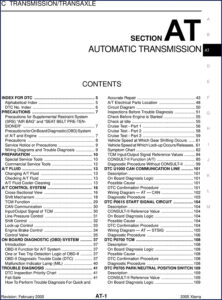
Flip to page 5 and you’ll find the DTC No. Index. That’s the first thing I use when a Sentra rolls in with a check-engine light. Instead of guessing which sensor is throwing the code, you look up the DTC number in the index and it tells you exactly which section to jump to. The manual also includes an Alphabetical Index – handy when you remember the symptom but not the code. No generic descriptions. This is the factory list from Nissan, including every CVT-specific code for the RE0F10A transaxle.
Precaution for SRS and OBD System
Before you even disconnect the battery, you need to read the Precaution for Supplemental Restraint System (SRS) on page 7. That section tells you exactly how long to wait after turning off the ignition before you can safely work around the airbags. Ignore it and you could get a face full of bag – or worse, set off a seatbelt pretensioner. The manual also covers Precaution for On Board Diagnosis (OBD) System of CVT and Engine – a must-read if you plan to use a scan tool without frying the ECU. That’s the kind of detail you don’t get from a third-party manual.
CVT Fluid Checks and Line Pressure Test
The “Inspections before Trouble Diagnosis” chapter (page 36) walks you through the CVT fluid level check, the stall test, and the line pressure test. Want to know if the secondary pressure sensor is lying to you? Hook up a gauge to the line pressure test port and compare your reading against the factory specs listed in the manual. It gives you the exact procedure – warm up the CVT, shift through each gear, then read the pressure at idle. No guesswork. I’ve used this on a 2008 Sentra that wouldn’t accelerate above 40 mph; turned out the line pressure solenoid was stuck. The manual’s fail-safe table (page 28) confirmed the symptom.
Fail-Safe Functions and TCM Replacement
When the TCM goes bad, you can’t just swap in a new one and drive off. The manual includes a section called “Service After Replacing TCM and Transaxle Assembly” with three patterns A, B, and C. Pattern B even tells you about Calibration Data – something aftermarket sources never mention. Without that calibration, the CVT will shift erratically. The manual also lists every fail-safe mode: what happens if the input speed sensor fails, how the step motor defaults, and what the TCM does when power memory backup kicks in. That’s on page 28. If you’re a DIYer, this part saves you from replacing parts that aren’t broken.
Why Factory Documentation Beats Aftermarket
I’ve seen reprints that say “use standard torque” – worthless. The factory manual calls out specific torque for the CVT unit connector (page 9) and for the torque converter service (page 10). It also references the On-board Diagnostics (OBD) standards that Nissan used to design this system. If you want to understand how the one-trip and two-trip detection logic works, the manual’s OBD-II section (page 25) explains it. No third-party manual has that depth. For related documents, you can grab the Nissan Sentra 2006 User Manual for basic owner info, or the Nissan Sentra Body, Lock & Security System Service Manual – Section: Trunk Lid O if you’re doing body work. The Nissan Sentra Transmission/Transaxle Service Manual dives even deeper into the mechanical rebuild, but for diagnostics this one is your go-to.
Speaking of the automotive industry in general, Automotive Industry Overview shows why OEM documentation is still the gold standard – manufacturers don’t hide critical error codes or calibration steps in the aftermarket.
Frequently Asked Questions
- Does this manual cover the 2.0L engine as well as the CVT?
- Yes. The OBD-II section applies to both the engine and the CVT system. The DTC index includes engine-related codes, and the failure analysis covers the QR25DE engine in the “M” position shift control. It’s a diagnostics manual, so it focuses on why something fails, not just how to replace it. If you need rebuild procedures, pair it with the Transmission/Transaxle Service Manual.
- What page has the MIL description?
- Page 26.
You can keep fighting with generic instructions that leave you stranded halfway through a job, or you can work off the real deal. Download the Factory Manual and get the exact specs Nissan put into the dealerships. No more guesswork.
Reviews
There are no reviews yet.