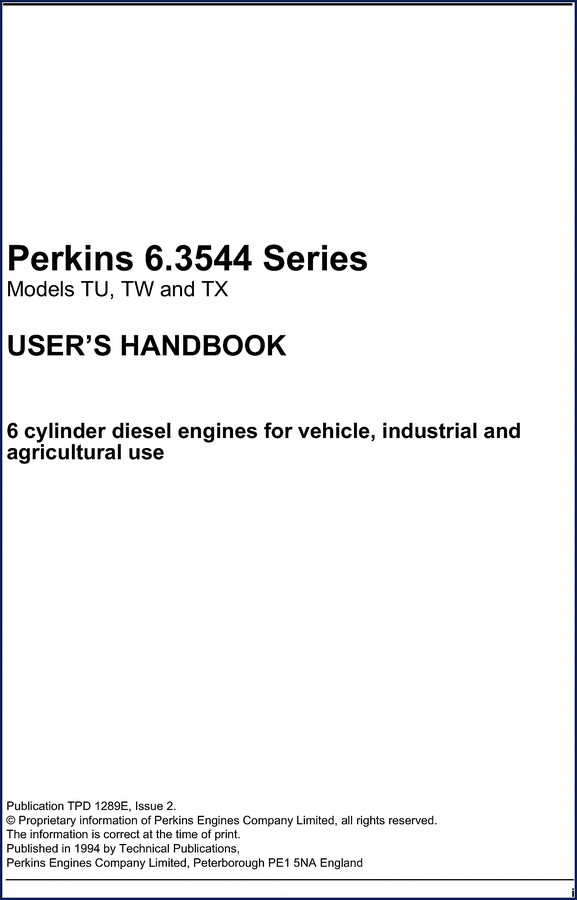
Perkins TU, TW, TX 1994 User Manual – Factory Handbook for the 6.3544 Series
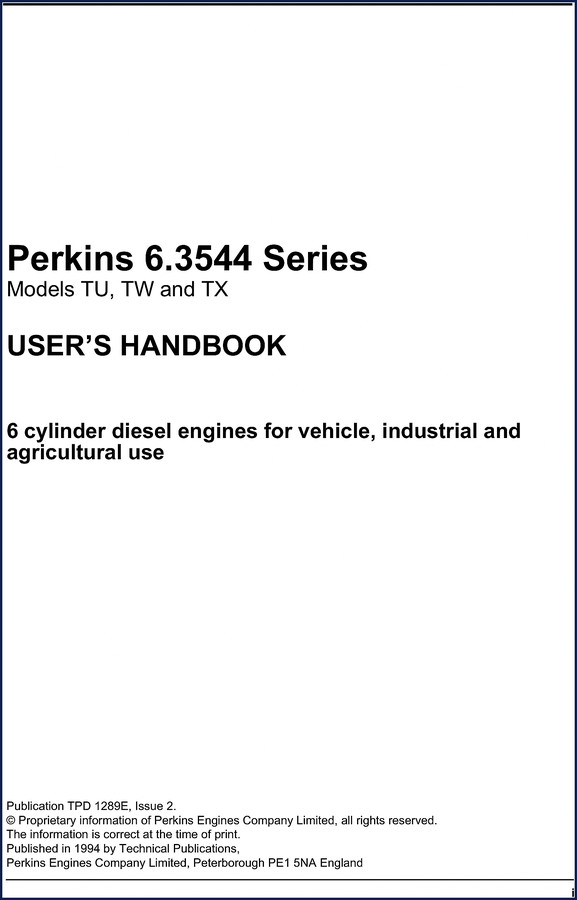
I’ve seen too many guys pull a head on a 6.3544 using a generic torque chart from some forum. Three weeks later they’re tearing it back down because the gasket blew. That’s what happens when you skip the factory source. The Perkins TU, TW, TX 1994 User Manual isn’t a reprint or a copy – it’s the original 56-page handbook Perkins issued for these six-cylinder diesels used in vehicles, industrial kit, and ag equipment. If you’re touching a TU, TW, or TX engine and you don’t have this on the bench, you’re guessing. I don’t guess.
Engine Data and Preventive Maintenance Schedules
Page 9 packs the full engine data – bore, stroke, firing order, and compression ratios for TU, TW, and TX variants. The preventive maintenance chapter (starts page 25) breaks down intervals by hours of operation. The schedule table on page 26 is the same one Perkins stamped into their workshop manuals. You get specific drain intervals for the cooling system (page 27) and a real sequence for checking drive belt tension (page 29). Aftermarket guides always leave out the breather valve cleaning procedure. This manual covers it on page 37. You’ll also find the exact method to check valve tip clearances on page 41 – not a generic “adjust to spec,” but the factory tolerance range.
Fault Diagnosis Chapter
Section six (page 47) lists problems and possible causes in a two-column chart. Below that, a code list of possible causes cross-references the symptoms. If you’ve ever chased a no-start on a TX and wasted an hour swapping parts, you’ll appreciate that the manual tells you to check the fuel lift pump gauze strainer first (page 30) before touching the injectors. It’s the difference between a 10-minute fix and a three-hour disassembly. I’ve used that exact flowchart on a TW that was surging – turned out to be a restriction indicator clog on page 40. Saved a tow bill.
What the Manual Covers: Start, Stop, Speed Range
Section three (operation instructions) goes from “How to start the engine” (page 17) to “How to stop the engine” (page 23). That might sound basic, but the altitude compensation table on page 24 is critical for anyone running a TU at elevation. The running-in procedure for a fresh rebuild is on page 23 – it specifies load and speed limits for the first 50 hours. If you skip that, you glaze the rings. The manual also covers adjustment of engine speed range (page 23) for governor settings. You won’t find that in Haynes or Chilton.
Engine Fluids: Fuel, Lube, Coolant Specs
Section five (page 43-45) gives fuel specification, lubricating oil specification, and coolant specification. The oil spec isn’t a vague “use 15W-40” – it lists API service classifications and viscosity grades for ambient temperatures from -20°F to 110°F. Coolant spec on page 45 includes freeze protection ratios and inhibitor requirements. If you mix coolants and the seals start leaking, don’t say I didn’t warn you.
Source Validity: Why OEM Beats Aftermarket
This is a Perkins publication – TPD 1289E, Issue 2, written in Perkins Approved Clear English. The safety precautions on page 2 aren’t boilerplate; they’re specific to 6.3544 cooling system pressure and fan blade clearance. The parts and service section (page 6) lists genuine Perkins part numbers and POWERPART consumable products (page 7). Aftermarket manuals often skip those details because they don’t have access to the OEM parts catalog. If you’re trying to order a fuel pre-filter (page 30) or the correct canister for the lube oil filter (page 36), the part numbers here are the ones a dealer will recognize. I’ve tried cross-referencing aftermarket numbers on a TW – got the wrong filter twice. Never again.
For related engine families, check out the Perkins 4.41 Model LM User’s Handbook and the Perkins 4.236 Series User’s Handbook. If you need a smaller displacement reference, the Perkins 3.152 Series User’s Handbook TPD 1285E Issue 2 follows the same format. For readers interested in powertrain integration, check Manual Transmission basics or Manual Transmission videos showing these engines in the field.
FAQ
- Does this manual cover all three models TU, TW, TX?
- Yes. The engine data table on page 9 lists specifications for each model separately. Location of engine parts diagrams on pages 11-15 cover naturally aspirated, turbocharged, and turbocharged with intercooler versions.
- Are torque values included for head bolts?
- The manual does not list specific torque values in the user handbook – that information is in the service manual, not the user manual. This book focuses on operation and preventive maintenance.
- Can I use this for a rebuild?
- You can use it for running-in procedures, oil/filter specs, and coolant capacity, but a full rebuild requires the Perkins service manual. This is the user handbook – think of it as the daily operator’s reference.
- Is this a factory original or a reprint?
- Factory original PDF – scanned from the 1994 Perkins publication TPD 1289E Issue 2. 56 pages, no missing sections. Not a reprint or aftermarket transcription.
If you’re serious about keeping a 6.3544 Series engine running without chasing phantom problems, this is the document that pays for itself the first time you avoid a misdiagnosis. Download the Factory Manual now and put the correct procedure on your bench.
Reviews
There are no reviews yet.