Zoomlion RT60 2013 Technical Manual – Factory Load Chart & Safety Data
I’ve been turning wrenches for 28 years. I’ve seen what happens when guys skip the factory data and rely on a photocopy or a PDF from some third-party site. On a crane, that mistake kills. The Zoomlion RT60 2013 Technical Manual is the only set of OEM load charts and safety specs you should trust for this rough terrain crane. 47 pages, direct from Zoomlion Heavy Industry Science and Technology. No aftermarket interpretation, no missing pages – just the factory specs that keep the hook in the air and the operator alive.
You’re working on or operating an RT60? Then you need the actual load ratings from Edition 1, December 2013. These aren’t generic numbers. They are tested, stamped, and certified for that specific chassis and boom combination. The operator’s manual that ships with the crane—this one—stays in the cab. But if you’re a mechanic, an owner, or a fleet manager, you want your own copy on the bench and in the file. That way you don’t have to dig through a greasy cab in the rain to find the rated capacity at a specific radius.
I’ll walk you through what’s inside, why it matters, and why you shouldn’t settle for anything less than the factory original.
Load Ratings for Rough Terrain Crane – Section Breakdown
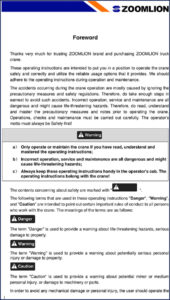
The manual opens with a “To owners, users and operators” page that spells out liability clearly: Zoomlion is not responsible for damages if you ignore the manual. Page 5 gives you the hazard indicator system – DANGER, WARNING, CAUTION, ATTENTION, NOTE, IMPORTANT. Each one defined, each one mandatory reading. The rest of the 47 pages contain load rating tables that specify maximum capacities at different boom angles, radii, and outrigger positions. These tables are the backbone of safe crane operation. Without them, you’re guessing. Guessing bends booms and kills people.
Safety Information: Why Every Warning Matters
Hazard indicators in this manual are not lawyer fluff. They use three levels: DANGER (will cause death or injury if not prevented), WARNING (could cause death or injury), CAUTION (may cause light or moderate injury). Plus ATTENTION for property damage, NOTE for operation tips, and IMPORTANT for data emphasis. That’s seven distinct signal words. If you are training a new operator or refresher course for an experienced one, this section alone saves you time writing your own safety brief. Page 5 covers it all. Memorize it.
Operator Responsibilities – Keep the Manual in the Cab
The manual states flat out: “No one should operate the crane unless they read and understand the information in this manual.” It also says the operator must keep the manual in the cab. If you sell the crane, the manual stays with it. That’s not a suggestion – it’s factory policy. For a shop that does pre-purchase inspections or rental fleet prep, having this PDF means you can verify that the manual in the cab is complete. Missing pages? Print a fresh copy from the factory file. Related: the ZOOMLION RT60 Rough Terrain Crane Operator’s Manual gives you the daily operation and maintenance procedures that complement this load chart manual.
7 Critical Specs Covered in the Load Charts
You need the correct capacity for the crane’s configuration. The charts cover: 1) Boom length and radius combinations, 2) Outrigger extended vs. retracted settings, 3) Pick-and-carry capacities, 4) Jib configurations where applicable, 5) Maximum allowable loads without stabilizers, 6) Working area limitations (over front, side, rear), 7) Reduction factors for non-level ground. All in imperial units (pounds, feet). No metric conversion headaches – these charts were built for the North American market as well. Remember: load ratings assume proper maintenance and tire pressure per the Manual Transmission specs for the driveline components? Not directly, but the crane’s transmission plays a role in travel stability – check the manufacturer’s data.
Why Factory OEM Documentation Beats Aftermarket Every Time
I’ve seen aftermarket load charts that had the wrong boom angle increments or missing footnotes. On a crane, a 5° error in boom angle changes the safe capacity by hundreds or thousands of pounds. Zoomlion’s own manual – the RT60 2013 Technical Manual – is the only source for the exact tables from the factory. Aftermarket publishers don’t get the stamped approval. They don’t have the copyright. And they sure don’t have the liability insurance for when a chart is incorrect. Save the guesswork. If you need the drivetrain torque specs for the carrier, grab the Zoomlion ZLJ5325 Technical Manual – Factory OEM Specs or the Zoomlion QY30V Technical Manual – Factory OEM 336 Pages for heavier applications. But for the RT60 load chart, this 47-page manual is the one you want.
Also note: The manual includes copyright protection – no photocopying, no reproducing, no electronic duplication without written consent from Zoomlion. So buying the official download from AutoRepairManuals keeps you legal and ensures you have a clean, complete copy. For transmission-related data on the crane’s road gear, see Manual Transmission references in the operator’s manual.
FAQ – Zoomlion RT60 Load Chart Manual
- Does this manual include engine or transmission repair procedures?
- No. This is a load chart and safety manual – 47 pages focused on capacity ratings, hazard warnings, and operating instructions. For component service, you need the dedicated shop manuals.
- What year was this manual published, and is it the latest version?
- 2013 – Edition 1, December 2013. Zoomlion updates load charts when crane configurations change. This is the factory version for the RT60. No later revision has been released as of this listing.
- Can I print this manual for multiple operators in my fleet?
- You can print one copy for the crane cab and one for the shop file. But the copyright forbids mass reproduction. If you need copies for multiple cranes, buy a license or purchase a separate download for each unit. That keeps you in compliance with Zoomlion’s terms.
- How do I use the load chart tables correctly without misreading the capacities?
- Start by identifying your crane’s configuration – outriggers extended or retracted, boom length, and working area quadrant. The chart lists capacities in bold for standard configurations, with footnotes for reductions. Always check the “WARNING” notes below each table. If the manual says “do not exceed 80% of tipping load” – obey it. That is not a suggestion. For complex lifts, consult a lift plan with an engineer. This manual is the authority for maximum safe capacities, not a substitute for proper rigging practice.
Look – if you run a shop, own an RT60, or operate one daily, this PDF pays for itself the first time you reference the correct capacity instead of guessing. No one gets hurt, no boom gets bent, no fines for overloading. Download the Factory Manual from AutoRepairManuals and put it on your tablet or print it for the cab. 47 pages, OEM stamped, no aftermarket nonsense. That’s how you keep a crane safe.
Reviews
There are no reviews yet.