
Bentley MARK VI 1947 Service Manual – Factory Specs for Post-War Luxury

If you’ve ever torqued a bolt on a 1940s British car without the right number from the factory, you know the feeling of watching a silentbloc bushing twist into a pretzel. I’ve seen it happen. The post-war Bentley MARK VI 1947 Service Manual is what you need before you touch that rear suspension or start drilling into a frame rail. This isn’t some third-party reprint. It’s the actual service bulletins from Bentley Motors (1931) Ltd., printed in England. Fourteen pages of OEM directives that tell you exactly how to relieve strain on shock absorber linkages and which bumper bracket modification to use when the body exceeds 8 inches of overhang. You skip this, you’ll be ordering new spindle assemblies.
Rear Shock Absorber Linkage – Factory Procedure
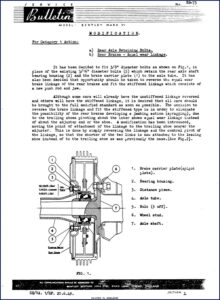
Page 1 of this Service Manual covers Service Bulletin BB-12. The problem? The rear shock absorber linkage gets assembled and tightened at the chassis stage, before the body goes on. That puts a permanent strain on the silentbloc bushes when the car is normally loaded. The factory solution is to leave the final tightening until the car is laden with the body. Then you slack off the silentbloc fixing bolt at the lower end of the forked connecting link, bounce the car a few times, let it settle, and retighten. The bulletin warns: if the spindle looks tilted relative to the knuckle joint after retightening, you haven’t released the strain correctly. Common mistake? Skipping the bounce step. Don’t. This is the exact procedure Bentley dealers in 1947 ran on every car that came through. Bentley Mark VI 1947 Service Manual is the only source for this data.
Rear Bumper Support Brackets – Modification Specs
Service Bulletin BB-28 (page 2) addresses a real-world problem: bumper sag. On the MARK VI, if the rear support bracket length from fixing bolt (A) to rear face (B) exceeds 8 inches (20.3 cm), you need a reinforcement. The bulletin calls for a 5/16″ BSF bolt (8 mm), a distance piece 3/4″ diameter, a plain washer 7/8″ diameter 0.100″ thick, and drilling a 5/16″ clearance hole 1/2″ from the end of the chassis frame and 1-1/16″ from the top face. You bolt the stiffening web to the side wall of the chassis member with a washer on the outside. These dimensions aren’t suggestions. They’re the difference between a bumper that stays put and one that drags on the road. If your customer is asking why the rear bumper sits crooked, this is your answer. Bentley Mark VI Service Manual Bulletin BB-13 covers additional shock absorber data that pairs with this.
14 Pages of Factory Service Bulletins
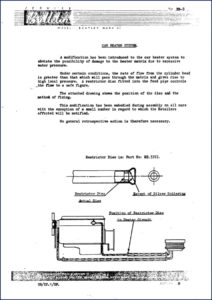
Don’t let the page count fool you. These 14 pages are dense with the kind of information that keeps a Bentley on the road rather than in a museum. Every page is a Service Bulletin with a number (BB-12, BB-28, and others), specific tool callouts, and torque sequences written for factory-trained mechanics. The manual includes instructions for both Category 2 modifications and routine maintenance procedures. I’ve seen techs ignore these bulletins and end up with rear links that bind on the first test drive. That’s a warranty claim you don’t want. The 1947 publication year means this is the exact documentation that came with the first production run of the MARK VI – the same car that set the standard for post-war British luxury. For heater system specifics, check Bentley MARK VI Service Manual Car Heater System.
Who Should Use This Manual?
If you’re a home garage enthusiast who bought a barn-find Bentley and wants to get it roadworthy without butchering the silentbloc bushes, this manual is your insurance. If you’re a professional shop specializing in classic British iron, you already know that aftermarket diagrams of a 1947 rear axle are usually wrong. This manual gives you the factory procedure that the original Bentley service stations used. The audience is anyone who handles a Bentley MARK VI and cares about doing it the way the engineers intended. That includes doing the “bounce test” with the car properly laden – not with an empty fuel tank and no spare tire.
Source Validity: Why OEM Matters
I’ve been burned by aftermarket manuals that claim to cover a 1947 Bentley but substitute generic torque values. Those manuals are how you snap a 5/16″ BSF bolt in a frame rail. This Service Manual is a direct scan of the original Bentley Motors (1931) Ltd. publication. You can see the printing notations: “SB/RF.3/SF.16.12.47.” That’s a real production date. The document includes the instruction to notify the London Service Depot of chassis numbers when modifications are carried out – that’s the kind of traceability you only get from OEM. The Automotive Industry Overview shows how far documentation standards have come, but for a 1947 car, this is the only authoritative source. Automotive Industry Overview further emphasizes that factory documentation prevents costly errors.
- Does this manual cover the engine or transmission?
- This 14-page Service Manual focuses on rear suspension, bumper brackets, and related modifications. It does not include engine or transmission overhaul procedures. For full mechanical coverage, look for the Bentley MARK VI Workshop Manual.
- What tools do I need to do the shock absorber linkage procedure?
- A jack, a set of axle stands, a 5/16″ BSF wrench or socket, and possibly a torque wrench if you have the factory spec – though the bulletin doesn’t list a specific torque value, just “retighten” after settling. A decent floor jack and something to bounce the car with are enough.
- Is this an original Bentley Motors publication or a reproduction?
- It is a high-resolution scan of the original printed service bulletins from 1947. The text, headers, and section markings (e.g., SECTION R) are exactly as published by Bentley Motors (1931) Ltd., Crewe, England.
- Why does the bumper bracket modification require drilling into the chassis frame?
- Because the original chassis did not have the bracket stiffening web bolted to the side wall. The modification adds a 5/16″ clearance hole and a distance piece to transfer load directly into the frame. This prevents the bracket from flexing under load, which caused cracks on early production cars. Drilling into the frame is necessary, but only at the exact location specified – 1/2″ from the end and 1-1/16″ from the top face. Measure twice.
You’ve got 14 pages of factory truth. Every time I see someone try to improvise on a Bentley rear end, I think of that tilted spindle – the one I fixed by following BB-12. Don’t learn that lesson the hard way. Download the Factory Manual now and keep it on your workbench next to the grease rag.


Reviews
There are no reviews yet.