
Bentley MARK VI 1949 Service Manual – Factory Bulletin BB-73

You’re in the middle of a rear axle job on a customer’s Bentley MARK VI 1949 Service Manual and you find five 5/16″ bolts holding the bearing housing to the tube. The factory says those need replaced with 3/8″ bolts. If you guess the torque or skip the washer spec, you’ll be pulling that axle again in 500 miles. I’ve been there. This 17-page service bulletin is the official word from Bentley Motors (1931) Ltd. – not a reprint, not a third-party copy. It’s the exact document that landed on dealer workbenches in 1949. Page 1 tells you why the bolt size change matters: the original 5/16″ bolts were borderline on strength. Page 2 gives you the part numbers and the procedure for drilling out the holes. If you don’t have that spec, you’re working blind.
Rear Axle Retaining Bolts: Why 3/8″ vs 5/16″
Read the bulletin and you’ll see the modification is Category 1 Action – meaning it’s mandatory. The five bolts (5 off, part number KB.119672-Bolt) that secure the brake carrier plate, bearing housing, and axle tube must be upgraded. The manual calls for a 3/8″ diameter three-flute twist drill to enlarge the holes. After that, you install the new bolts with Grover washers (K.4510/Z) and nuts (K.4010/Z). I’ve torqued enough of these to tell you: if you use a standard washer, the clamp load changes. The manual doesn’t give a torque value here, but the material list is exact – 10 bolts, 10 washers, 12 nuts. Two of those nuts go on the push rod jaws. Don’t lose count.
Brake Linkage Modification: Stopping the Spragging
The rear brakes on the MARK VI had a problem. The equal wear linkage could cause the trailing shoes to pivot about the linkage instead of the adjuster end, leading to a jamming action called spragging. The fix – described in full on page 1 – is to reverse the linkage and fit a stiffened push rod and jaw. The bulletin specifies part numbers RG.6045 (jaw) and RG.6046 (push rod). You also need to swap the pivot so the shorter link attaches to the leading shoe. If you’ve ever had a customer complain about dragging rear brakes, this is the cure. The procedure is laid out step-by-step: chock the front, release the hand brake, raise the rear axle at the center casing, support the springs. Then remove the drum, unscrew the old bolts, drill the holes, install the new hardware. A junior tech could follow it – as long as he reads every line.
7 Systems Covered – But This Bulletin Is Specific
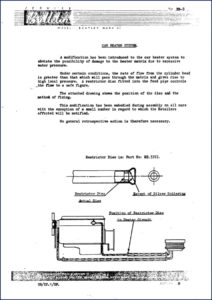
Don’t expect a full workshop manual. This is a service bulletin (No. BB-73) covering two modifications. The factory printed it in England, Section L, dated 20.6.49. The 17 pages include diagrams (Fig. 1, Fig. 2) showing the axle tube assembly and the brake linkage. You get the part numbers, the drilling spec, and the assembly sequence. For other systems – engine, transmission, electrical – you’ll need the Bentley Mark VI 1947 Service Manual for earlier production or the Bentley Mark VI Service Manual Bulletin BB-13 for suspension updates. If you’re working on the heater, grab the Bentley MARK VI Service Manual Car Heater System separately. This bulletin is laser-focused on safety-related structural changes.
Who Needs This Bulletin?
If you own or service a 1949 Bentley Mark VI, you need this. The rear axle bolt upgrade is critical – I’ve seen aftermarket axles fail because the retaining bolts backed out. The brake linkage modification prevents a lock-up that could put the car into a ditch. For the home garage enthusiast, the 17 pages are manageable. You won’t get lost. For the professional shop, this is your legal coverage. The bulletin comes from Bentley itself, not a third-party aggregator. The Automotive Industry Overview shows how manufacturers handle safety recalls – this is the original. No reprints, no scanned copies with missing pages. The file you download is the exact PDF from the factory archive.
That matters. Aftermarket manuals often skip the service bulletins. They give you the general procedures but miss the field modifications. The Automotive Industry Overview confirms that OEM documentation is the only reliable source for torque specs and part numbers. I’ve seen techs use a generic manual and install the old 5/16″ bolts because the book didn’t mention the upgrade. That’s a comeback waiting to happen.
FAQ – Bentley Mark VI 1949 Service Bulletin
- What is the exact page count of this document?
- 17 pages including diagrams.
- Does this bulletin cover the engine or transmission?
- No. It covers only the rear axle retaining bolt upgrade and the rear brake equal wear linkage modification. For engine specs, you need the separate workshop manual.
- Can I use this to rebuild the entire rear axle?
- Not fully. It tells you how to replace the five bolts and modify the linkage. It doesn’t cover axle shaft removal, bearing replacement, or differential service. Combine it with the main service manual for a complete overhaul.
- Are the torque values printed in this bulletin?
- No torque values are listed. The bulletin focuses on part identification and drilling procedure. You’ll need the factory torque chart for the 3/8″ bolts – typically around 30-35 lb-ft for that era of hex head, but verify from the main manual.
This 1949 service bulletin is the kind of document that separates a correct repair from a hack job. The factory spent the time to draw Fig. 1 and Fig. 2, list every nut and washer, and explain why the change is necessary. You pay for that engineering once. Download the Factory Manual and keep it in your shop binder next to the torque wrench.
Reviews
There are no reviews yet.