
Chevrolet Camaro 1967 Workshop Manual
I’ve seen too many guys tear down a 1967 Camaro and then spend weeks trying to figure out what bolt goes where. Aftermarket service manuals skip the assembly sequence – they assume you already know it. That’s not what you need when you’re putting a first-gen back together. What you need is the Chevrolet Camaro 1967 Workshop Manual – 442 pages of the exact factory assembly instructions that Chevrolet used on the line in 1967. This isn’t a generic reprint; it’s the OEM document that tells you how every clip, fastener, and seal goes on.
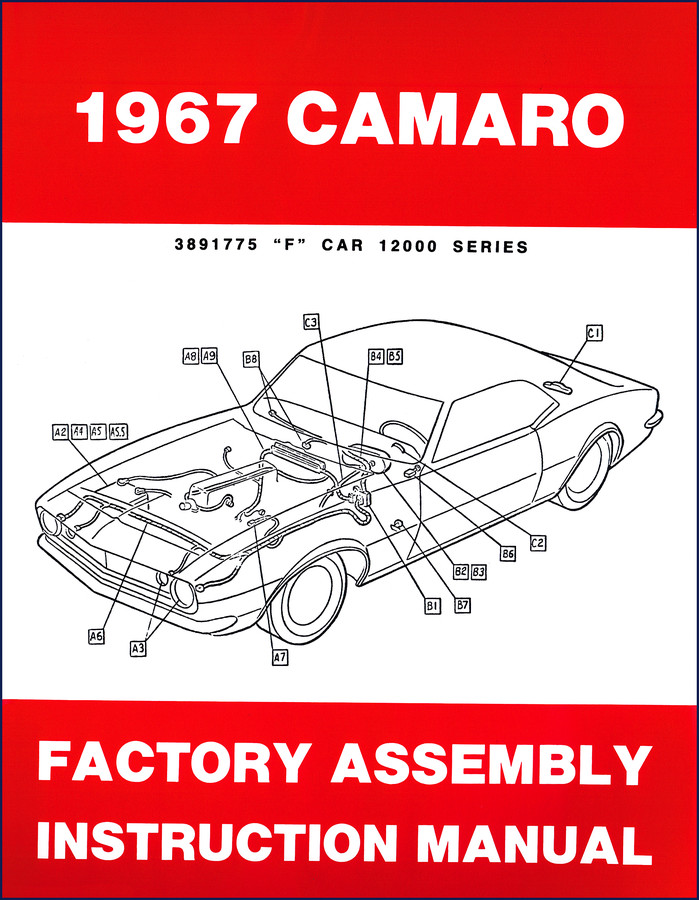
Factory Assembly Instructions – Not a Service Manual
Most manuals you find online are service manuals written for dealership technicians who fix broken cars. This one was written for the assembly plant. Page 3 states clearly: “THIS 1967 INSTRUCTION MANUAL ILLUSTRATES THE OPERATIONS REQUIRED FOR THE FINAL ASSEMBLY OF THE VEHICLE.” That means you get the sequence for installing the instrument panel, the body mounts, the driveline – in the order Chevrolet intended. If you’re doing a body-off restoration, this is the document that keeps parts from fighting each other.
What Does the UPC 6 Engines Chapter Cover?
Engine installation on the 1967 Camaro involved more than dropping a block in. The manual breaks it into four sub-sections: Belt Trains, Cooling Electrical & Mounting, Carburetion & Exhaust, and Controls. Each section has its own sheet numbers (A, B, C, D prefixes). You get the routing for the alternator wiring, the exact placement of the exhaust hangers, and the torque sequence for the engine mounts. No guessing – it’s all there.
3 Sections That Save You Hours on a Body-Off Restoration
UPC 1 (Body) covers dash panel, instrument panel, and body complete mounting. UPC 2 (Frame) and UPC 3 (Front Suspension) give you the jig points and bushing orientations. Combine those with UPC 11-13 (Sheet Metal – Radiator Grille) and you have the sequence for hanging fenders, grille, and inner panels without having to rework gaps. The manual uses the Uniform Parts Classification (UPC) system – each component has a group number that matches the parts catalog. That makes cross-referencing fast.
Check the Vehicle Identification Plate Before You Start
Section B2 in General Information shows the Vehicle Identification Plate location and the Protect-O-Plate (B3). For a 1967 Camaro, the VIN tells you the engine, plant, and body style. This manual includes the factory instructions for stamping and attaching those plates – useful if you’re replacing a firewall or dealing with a missing tag. Page 4 has the Quick Reference Index so you can jump straight to any UPC section without flipping through all 442 pages.
Brakes Section: Cylinder Mounting and Pipe Routing
UPC 5 divides brakes into Cylinder Mounting & Lever, Pipes, and Parking. The pipe routing diagrams show the exact bends for the front-to-rear line and the distribution block mounting. If you’ve ever tried to bend hard lines by eye and had them interfere with the frame, you’ll appreciate having the factory bend angles. No aftermarket diagram matches this accuracy.
Who Should Buy This Manual?
If you own a 1967 Camaro and plan to restore it to factory specs, this manual is for you. It’s not for oil changes or tune-ups – those require a regular service manual. This document is for the person installing a new body shell, replacing a transmission crossmember, or rebuilding the car from the ground up. Beginners can use it too, but you need to read the General Instructions (A5-A7) first to understand the notation and fastener callouts. The manual assumes you have basic mechanical skills, so if you’re new, take it slow.
Source Authenticity – OEM vs. Aftermarket
This is a direct reprint of the original Chevrolet Motor Division document (license 0710896 from General Motors). It’s not a third-party interpretation. The pages show the drafting marks, revision records, and the “DRAFTING CHEVROLET ASSEMBLY INSTRUCTIONS” header that appears on every sheet. Aftermarket manuals often omit the shipping protection section (C2) or the cements and sealers tables (D5-D6.5). This one has all of them. Verify your parts against the factory specs – that’s the only way to ensure the car goes together correctly. For a broader understanding of how OEM documentation compares across manufacturers, read this Automotive Industry Overview. More generally, the Automotive Industry Overview shows why factory data matters.
Related Manuals for Your Camaro
If you’re working on other years or need electrical diagrams, check these: Chevrolet Chevelle Camaro Chevy II Corvette 1967 Service, Chevrolet Camaro 1969 Workshop Manual, and Chevrolet Camaro 2001 Wiring Diagram – Factory Electrical Schematics.
- Is this manual the same as a factory service manual?
- No. It’s the factory assembly instruction manual used on the production line. It shows how to assemble the car, not how to repair it.
- Does it include torque specs for the engine bolts?
- Yes, but torque values are given in the context of assembly operations – for example, the cylinder head bolt torque sequence is referenced under the engine section. However, the manual does not list every single fastener spec in a separate table. You will find them embedded in the operation descriptions. For a full list of torque values, you would want the 1967 Camaro Chassis Service Manual as a supplement. The assembly manual gives you the “how” of putting parts together, not the diagnostic procedures.
This manual belongs on your workbench beside your torque wrench and micrometer. It’s 442 pages of assembly data that eliminates the back-and-forth of trying to guess what goes where. If you want to put a 1967 Camaro back together the way Chevrolet built it, download the Factory Manual.


James L. –
I am so happy with this manual. The document is very clear. It helped me to rebuild my Chevrolet Camaro engine. Saved my repair job! Thanks.
John D. –
This is exactly what I was looking for. The text is searchable and well indexed. A must-have for any Chevrolet Camaro DIYer doing maintenance. Saved my weekend project! Thank you.
Richard G. –
Perfect workshop guide. The pages are clean and well indexed. It helped me to rebuild my Chevrolet Camaro transmission. Saved my repair job! Thanks.