
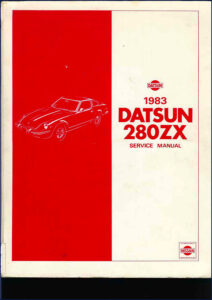
Datsun 280ZX 1981 Service Manual – Factory Shop Repair

You bought a used 280ZX, it’s leaking oil from the front cover, and the idle bounces between 800 and 1200 rpm. The aftermarket “repair guide” you grabbed at the auto parts store says to tighten the timing chain tensioner bolt to “snug” – that’s how you snap a bolt in an aluminum head. What you need is the Datsun 280ZX 1981 Service Manual. This is the same 708-page binder that sat on the tech’s bench at the Nissan dealer in ’81. It doesn’t guess. It gives you the OEM torque spec for every fastener, the exact procedure for bleeding the hydraulic lifters, and the factory flow chart for the EF & EC fuel and emission control system. If you touch a single bolt on a model S130 chassis without this book, you’re working blind.
I’ve seen a twenty-year-old kid bring a 280ZX back to life with this manual and a set of metric sockets. I’ve also seen a guy strip the oil pan threads because he used a generic spec from some online forum. The manual tells you on page 26 that the oil pan bolts get 5.1–6.9 lb-ft – not “snug,” not “tight,” but a torque wrench number. That’s the difference between a running engine and a weekend of chasing leaks.
Engine Mechanical: What the Manual Covers
The EM – Engine Mechanical section walks you through the L28E six-cylinder. Cylinder head bolt torque sequence, piston ring gap, valve clearance adjustment – it’s all there with factory measurements. The manual lists special service tools like the valve spring compressor (KV10115600) but doesn’t make you buy them; you can improvise once you know the spring height. I’ve used this section to reseal a front cover without pulling the engine. The trick is knowing the oil pump drive spindle alignment, which the manual shows in a silhouette diagram. Skip that step and you’ll have no oil pressure at idle.
LC – Engine Lubrication & Cooling Systems
Of the 708 pages, the LC – ENGINE LUBRICATION & COOLING SYSTEMS chapter alone saves you from frying a head gasket. It gives you the cooling system capacity (11.0 qt including reserve tank) and the thermostat opening temperature (82° C, or about 180° F if you prefer imperial). But what I appreciate is the oil pressure check procedure: warm engine at 2,000 rpm, oil pressure should be 56–72 psi. Below that? Pull the relief valve and inspect the spring. The manual shows the spring free length (2.035–2.075 in). If it’s shorter, you’re losing pressure. Generic manuals skip that measurement.
Does This Manual Cover the Fuel System?
Covers it in two separate chapters: EF & EC – ENGINE FUEL & EMISSION CONTROL SYSTEM and FE – ENGINE CONTROL, FUEL & EXHAUST SYSTEMS. The EF & EC section covers the Bosch L-Jetronic injection, including the air flow meter resistance values and cold start valve operation. The FE section gets into the electronic control unit (ECU) pinouts and the closed-loop feedback system. If your 1981 280ZX stumbles under load, you’ll find the diagnostic tree for the throttle position switch and the coolant temperature sensor. I rebuilt a harness using the wire colors from this manual – yellow with red stripe for power to the injector, black for ground. No guessing.
Torque Specs and Fluid Capacities – Why OEM Matters
Factory spec data is the entire reason you’re here. The aftermarket manuals I’ve used for other cars had torque values transposed (ft-lb versus in-lb) on at least one fastener. Every spec in this Datsun manual was verified by the engineers who designed the car. Datsun published this for the 1981 model year of the 280ZX. The Transmission section lists the tightness for the speedometer pinion nut (2.2–3.6 ft-lb) – that’s the kind of detail that keeps a seal from weeping. The Brake section gives you the disc brake pad thickness limit (0.079 in) and the caliper bolt torque (17–22 ft-lb). The Suspension chapter – FA – Front Axle & Front Suspension and RA – Rear Axle & Rear Suspension – shows you the strut cartridge replacement steps with torque for the gland nut (43–58 ft-lb). Miss that spec and the strut rattles loose at 70 mph.
3 Reasons to Choose a Factory Service Manual Over Aftermarket
- Accuracy – Aftermarket guides often reuse illustrations from older models. The 1981 280ZX S130 had unique engine bay wiring and a different fuel pump relay. Only the OEM manual shows the relay location behind the passenger side kick panel.
- Diagnostic Flow Charts – The OEM manual gives you decision trees for trouble codes. For example, the EL – ELECTRICAL SYSTEM chapter has a step-by-step for no-crank: check fusible link, then ignition switch, then starter solenoid. Aftermarket manuals dump a list of possibilities and skip the order.
- Safety Warnings – Factory manuals warn you about hazards like trapped fuel pressure in the injection system. One of the few aftermarket books I read told me to “pinch the fuel hose” to check pressure. That’s how you get a face full of gasoline. The OEM manual says release pressure at the service fitting with a rag.
If you need a manual for a sibling model, check the Datsun 280Z 1972 Chilton’s Repair & Tune-Up Guide for the earlier L-series, or the 1983 Datsun 280ZX S130 Series Service Manual if you’ve got the later year. For a completely different platform, the 1982 Datsun Pick-Up Service Manual covers the Z22 engine.
For a broader perspective on vehicle diagnostics, the Automotive Industry Overview at Wikipedia provides historical context on L-Jetronic systems. And if you’re rebuilding the 5-speed, the Manual Transmission article breaks down the gear ratios used in the FS5W71B unit.
FAQ
- Does this manual cover the 1981 280ZX turbo models?
- It covers the naturally aspirated L28E. Turbo models had additional components (boost sensor, wastegate actuator) that are not in this edition. You would need the turbo supplement from 1982–83 manuals.
- Will this manual help me adjust the valve lash on a 1981 280ZX?
- Yes. Section EM gives the clearance: intake 0.012 in, exhaust 0.014 in (cold) with the specified feeler gauge and adjustment procedure.
I’ve seen three 280ZX engines come into my shop this year with blown head gaskets because the owner used a Chilton spec (queationable at best) and torqued the head bolts to 61 ft-lb instead of the factory 58–65 ft-lb in three stages. The OEM manual saves you that kind of mistake. Whether you’re swapping a clutch, bleeding the brakes, or chasing a vacuum leak in the EF & EC system, this Datsun 280ZX 1981 Service Manual puts the factory engineer’s intent back on your bench. Download the Factory Manual and get the job done right the first time.

Reviews
There are no reviews yet.