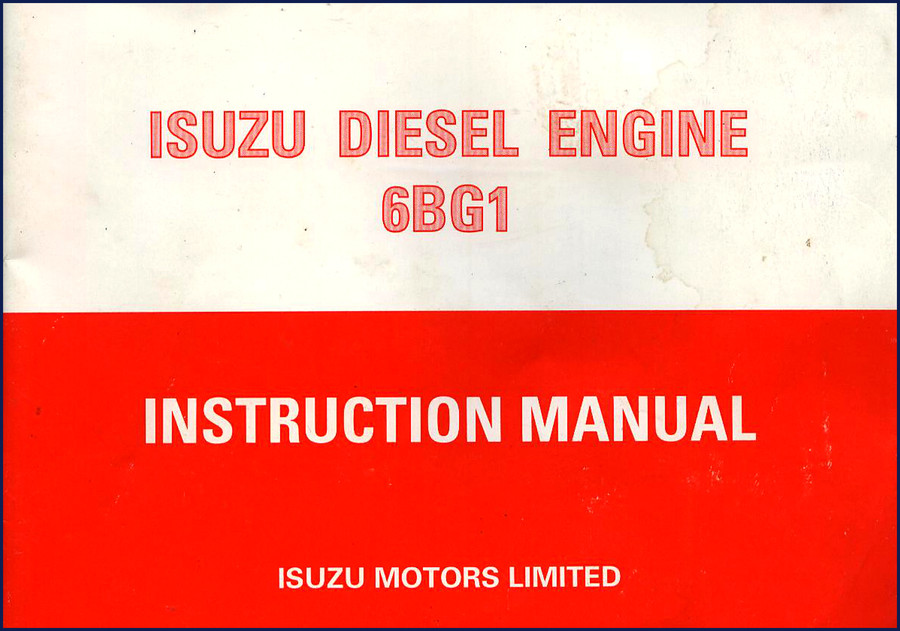
Isuzu 6BG1 User Manual – Factory Operator’s Guide for the Diesel Engine
If you’re tired of chasing down wrong torque specs on a 6BG1 swap because some internet forum said “snug it,” then you need the real factory document. The Isuzu 6BG1 User Manual is a 113-page instruction manual that covers everything from cold-start procedures to periodic maintenance intervals. This isn’t a reprint of a reprint — it’s scanned from an original Isuzu Motors Limited publication. I’ve been turning wrenches for 28 years and I can tell you: when you’re dealing with a Japanese industrial diesel, the factory manual is the only thing that keeps you from scrapping a head gasket.

External views start on page 1 so you can identify every port, plug, and sensor before you begin. General information follows — standard engine data and specs, EPA and CARB certified data, emission control labels, and engine identification numbers. If you’re swapping a 6BG1 into a truck or generator, the serial number location and after-service bulletins are in there. Page 5 lists the standard specs: bore, stroke, displacement, firing order, injection timing. All factory verified, not copied from a chiltons.
Engine External Views: A Quick Walkaround
Before you torque anything, look at the external views. The manual uses figure references (labeled “Рисунок” in the original — they’re simply figure numbers) that tag the alternator, starter, injection pump, turbo (if equipped), oil cooler, and every bracket. You don’t need to guess which hose goes where. The factory takes you through each component location. That alone saves you from pulling the wrong bolt and dropping a bracket into the oil pan.
General Information Section – Standard Engine Data
Compression ratio, valve clearance (cold setting), lash adjustments, oil capacity with filter, coolant capacity, and firing order. Aftermarket books sometimes list the firing order as 1-2-3-4-5-6 for inline sixes — that’s wrong for a 6BG1. Isuzu specifies 1-5-3-6-2-4. If you set the timing based on an aftermarket source, you’ll be pulling the head off again. The manual also includes the engine identification number location and the meaning of each digit in the serial. That matters when ordering parts.
Fuel, Lubricant, and Coolant – The Fluids That Keep It Running
Isuzu is particular about fuel. The manual tells you the required cetane rating, sulfur content limits, and acceptable biodiesel blends. Lubricant viscosity is spelled out for different ambient temperatures — 15W-40 above 32°F, 10W-30 below. Coolant type and concentration: ethylene glycol with SCA (supplemental coolant additive). Don’t mix conventional with OAT coolant. The chart on page 20 covers fuel specifications; page 26 covers lubricant. Follow those numbers and your engine won’t sludge up or cavitate.
Engine Operation: Starting and Stopping Procedures
Glow plug operation, preheat time, cranking limits, cold-start aids — all covered. The operation section details starting after long storage, turbocharged engine care (idle-down before shutdown), and over-cooling prevention. If you skip the idle-down on a turbo 6BG1, you’ll cook the turbo bearings. The manual tells you exactly how long to idle: 30 seconds minimum after a hard run. Also covers cold-weather starting with ether – safe limit and location for the intake port. Don’t toss a whole can into the air filter.
Periodical Inspection and Maintenance – The Meat of the Manual
This is where the manual pays for itself. Lubricating system, cooling system, fuel system, air intake system, engine electrical, and engine assembly — each has a periodic inspection table with intervals in hours of operation. Oil change every 250 hours, fuel filter replacement at 500 hours, valve lash inspection at 1000 hours, injector timing check at 1000 hours, cooling system flush every 2000 hours. There’s a dedicated section for cold-season operation addressing coolant ratio and block heater requirements. If you’re running this engine in northern Alberta or south Texas, the coolant concentration changes.
Source Authenticity – Why This Is the Real Factory Document
Aftermarket manuals often skip pages or generalize torque values — not this one. This is a direct scan of the Isuzu Motors Limited instruction manual. It’s not a reprint or a third-party compilation. Every figure, every spec traces back to the OEM. For a broader look at why OEM documentation matters, read the Automotive Industry Overview at [LINK_ID_EXT_0]. The industry consensus is clear: factory specs are the only reliable source. Automotive Industry Overview
- Does this manual cover the fuel injection pump adjustment?
- Yes, but it’s in the periodical inspection section under fuel system. The manual describes the injection timing procedure with the timing mark alignment and the required tools. You’ll see a figure showing the pump gear and camshaft gear alignment marks. If you’re rebuilding the pump, you’ll need the separate pump service manual — this is the operator’s manual, so it covers adjustment and removal, not full overhaul. The factory procedure is specific about the order of tightening the pump mounting bolts and the locking pin location. Don’t skip that.
- How many pages is the manual?
- 113 pages.
If you work on these engines, get the factory document on your tablet or print it out. Download the Factory Manual from the AutoRepairManuals store and keep it with the engine. You’ll save yourself lost time and avoid burning a piston.
- Isuzu F Series 2011 User Manual – OEM Shop Specs”>Isuzu F Series 2011 User Manual – OEM Shop Specs
- Isuzu F Series 2011 User Manual – OEM Factory Operator’s Guide”>Isuzu F Series 2011 User Manual – OEM Factory Operator’s Guide
- Isuzu TFR/TFS, UCR/UCS Training Manual – 4JJ1-TC Engine”>Isuzu TFR/TFS, UCR/UCS Training Manual – 4JJ1-TC Engine

Reviews
There are no reviews yet.