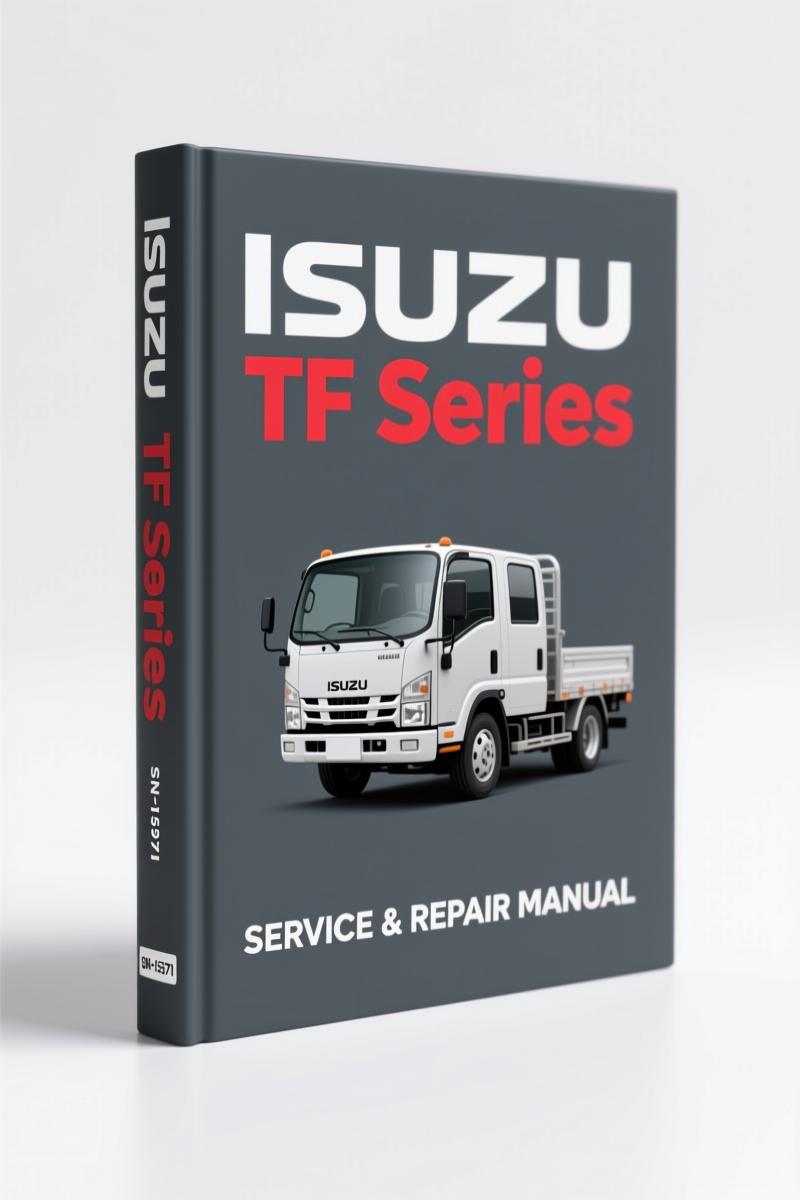

If you are digging into an Isuzu TF Series Workshop Manual transfer case and don’t have the factory binder open, you are working blind. I have seen techs use aftermarket data to R&R a transfer control unit, only to get the wiring wrong because the pinout was reversed. That costs hours. This 92-page OEM manual covers Section 7D (transfer case mechanical) and Section 7D1 (electrical diagnostics). It was printed by Isuzu International Service & Parts, Tokyo. No third-party reprint. No guesses.
Let me walk you through what is actually inside—because the table of contents alone tells you whether you will chase a leak or fix it right the first time.
Transfer Rear Oil Seal: Removal and Installation Procedure
Page 7D-4 lays out the oil seal replacement with the associated parts diagram. The manual specifies the exact sequence: remove the propeller shaft, mark the companion flange orientation, then pull the seal. It tells you to inspect the seal bore for burrs before driving the new one. I have seen guys skip that step and wonder why the new seal leaks within a week. The installation section includes a note on lubricating the seal lip—something the aftermarket summaries leave out.
Transfer Case Assembly: Removal and Installation
The removal procedure starts on page 7D-7. It calls for draining the transfer oil first, then supporting the assembly with a jack. The manual gives the bolt torque sequence for the adapter housing. If you own an Isuzu TF Series Brakes Workshop Manual”>Isuzu TF Series Brakes Workshop Manual for the other end of the truck, you know the pattern: OEM manuals always include the torque sequence, not just a single value. Here it covers the 10 bolts that hold the transfer case to the transmission extension housing. Installation reverses removal, but the manual includes a check for the shift lever alignment. That detail saves you a binding linkage.
Control Unit Diagnosis and Memory Erasing
Section 7D1 is where the electrical work lives. The circuit diagram covers LHD and RHD harness layouts. The manual includes a connector list with pin numbers. Before you replace the control unit, the diagnostics section tells you to run a non-trouble mode check. I have seen guys throw parts at a flashing indicator lamp when all they needed was the memory erasing procedure on page 7D1-?—the manual does not give a page number for that, but it is in the Diagnosis chapter. Follow that sequence, and you avoid a half-hour of head scratching. For background on how transfer cases interact with the drivetrain, read about Manual Transmission”>Manual Transmission fundamentals. The automotive industry standard for these OEM documents is consistent across manufacturers; you can verify that at Automotive Industry Overview”>Automotive Industry Overview.
Main Data and Specifications: Torque Values and Clearances
Page 7D-33 is the reference you will mark with a grease pencil. It lists the main data and specs for the transfer case: gear backlash, bearing preload, and the torque for the output shaft nut. The manual gives the value in N·m and lb-ft. I do not trust aftermarket books for these numbers—they often copy one spec from a different model year. This is Isuzu’s own data. If you need the companion manuals for the rest of the drivetrain, check the Isuzu TF Series Workshop Manual”>Isuzu TF Series Workshop Manual for the engine and transmission sections, or the Isuzu TF Series Clutch Workshop Manual”>Isuzu TF Series Clutch Workshop Manual for clutch hydraulics.
Why This Isuzu TF Series Workshop Manual Belongs on Your Bench
Because it is the only source that gives you the OEM service precaution—the SRS warning tells you to disconnect the battery before working near the airbag system. The manual also includes the special tool list (page 7D-36) so you know exactly what you need before you start. No guessing. No flipping between three different PDFs. 92 pages, two sections, one focus: get the transfer case fixed with factory accuracy.
- Does this manual cover the entire Isuzu TF Series vehicle?
- No. It covers only the transfer case sections 7D and 7D1. You need the full workshop manual set for engine, transmission, brakes, and body.
- Can I use this to diagnose transfer case electrical problems?
- Yes. Section 7D1 includes the circuit diagram, connector list, function of switches and indicator lamps, and a symptom-based diagnosis procedure. It also walks you through memory erasing for the control unit. If you follow the steps in the diagnosis chapter, you will identify the root cause without replacing parts unnecessarily. The manual explicitly warns you to check non-trouble mode before diving into component swaps. That alone keeps you from buying a control unit you do not need.
Stop chasing leaks with aftermarket data. Download the Factory Manual and keep this PDF within arm’s reach of the hoist. Your hours and your customers’ trust depend on it.

diy_master –
Excellent quality! Immediate link after checkout. A must-have for any Isuzu TF mechanic doing repairs. Saved my weekend project! Thank you.
gearhead88 –
I am extremely satisfied with this manual. It is very easy to read on my phone without losing quality. It helped me to repair my Isuzu TF transmission. Great value for money.
Richard G. –
This is just what I was looking for. The text is searchable and easy to navigate. Contains detailed wiring diagrams for Isuzu. Saved my weekend project! Thanks.