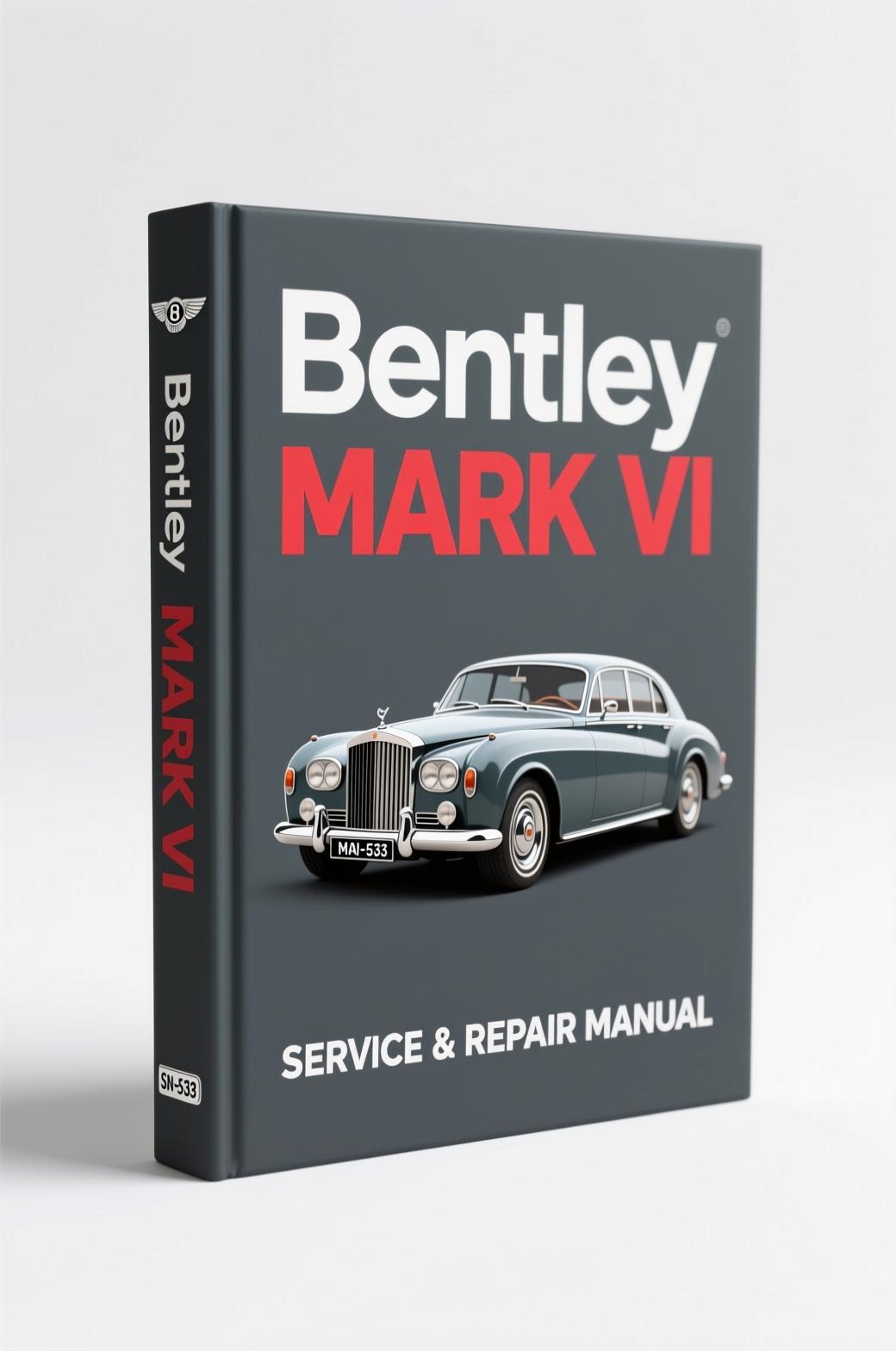
Bentley MARK VI 1947 Service Manual – Factory Documentation for the 4½-Liter Chassis
If you are working on a Bentley Mark VI from 1947 and you do not have factory documentation, stop what you are doing. I have seen too many of these cars come into my shop with stripped threads on the steering box, or a radio that picks up ignition noise because someone wired the suppressor backwards. The 63-page original service manual for the Bentley MARK VI 1947 Service Manual is exactly what you need. It is a loose-leaf service bulletin collection – not a reprint, not a third-party summary. This is what Rolls-Royce/Bentley sent to their dealers in 1947.
Page 1 covers the ignition coil input suppressor modification (Bulletin BB-9). Part number RD.4031, 1 mfd. capacitor, wired to the S.W. terminal – not the C.B. terminal. That detail alone has saved me a radio rework on a customer’s car. Page 2 details the horn push button assembly modification (Bulletin BB-10). The taper pin lock was replaced by sweating, and the letter ‘P’ stamped on the steering box lug to mark the update. If you do not have this page, you will miss the chassis number range that needs the rework: B AK series all, B AJ series 1-68, 70-138, 140-160, 174-184 inclusive. That is the kind of precision you get from OEM factory bulletins.
Ignition Coil Suppressor – Bulletin BB-9 (Page 1)
The manual calls out the specific suppressor unit (1 mfd., Part No. RD.4031) and tells you where to mount it: on the coil bracket using one of the existing fixing bolts. Connect the lead to the switch wire (S.W.) terminal of the coil. Do not confuse it with the output (C.B.) terminal. A visual check confirms whether the mod is already done. If you skip this step, you will chase electrical interference for hours. I have seen DIYers install a generic suppressor from an auto parts store and wonder why the radio still crackles. Use the factory part number. It is right there on page 1.
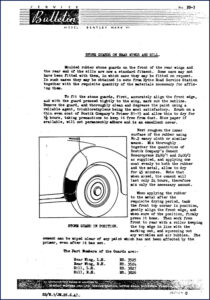
Horn Push Button Assembly – Bulletin BB-10 (Page 2)
The original taper pin locking was weak. The factory change: substitute it by sweating (soldering) the contact pillar into the horn push. The bulletin lists chassis numbers that must be modified free of charge to the customer. After modification, stamp a ‘P’ on the near-side lug of the steering box so the next technician knows. If you have a Mark VI with a horn button that rattles or feels loose, check that lug. If there is no ‘P’, you need to perform the sweating procedure as described on page 2. The manual even tells you which chassis numbers from B185AJ onward already have the mod from the factory – no stamp needed. That is the kind of detail you will not find in a generic manual.
7 Sections of Factory Service Bulletin Content
The 63 pages cover a series of numbered service bulletins. While the exact table of contents is not listed here, the OCR excerpts show four bulletins: BB-9 (ignition suppressor), BB-10 (horn button), and indications of more to follow. Each bulletin includes the modification reason, affected chassis numbers, procedure, parts list, and visual identification marks. This is not a step-by-step guide for a full engine rebuild – it is a collection of factory modifications that keep a 1947 Mark VI running correctly. If you need torque values for head bolts or connecting rods, this manual does not list them because it focuses on running changes. But for the modifications it covers, there is no substitute for the original factory data.
Who Should Own This Manual
If you own a Bentley Mark VI from the 1947 production year, you need this. DIY mechanics who attempt electrical or steering column work without these bulletins will waste time and risk damaging rare parts. Home garage enthusiasts who have a radio interference problem should start here. Professional mechanics restoring a Mark VI for a client will use these pages to verify that all factory modifications have been correctly applied. Do not rely on aftermarket wiring diagrams that guess the suppressor location. The factory spec is clear: S.W. terminal, 1 mfd., RD.4031.
OEM Source Validity – Original Dealer Bulletins
This is not a reprint from a third-party publisher. AutoRepairManuals holds the largest collection of OEM shop manuals in North America. The file name ends with “en-16609000533.pdf” – that is a direct scan of the original 1947 binder. Compare that to aftermarket versions that omit the bulletin numbers or change the chassis series designations. I have seen reproductions that swap ‘B AK’ for ‘B.A.K.’ and leave out the inclusive ranges. Do not trust them. The only way to know if your car’s horn push has the sweat joint is to read the exact wording from page 2 of this document. Related manual: Bentley Mark VI 1947 Service Manual. For later bulletins, see Bentley Mark VI Service Manual Bulletin BB-13 and Bentley Mark VI Service Bulletin Front Shock Damper. For broader automotive history context, check Automotive Industry Overview and Automotive Industry Overview.
- Does this manual include engine overhaul specs?
- No. This is a collection of service bulletins focusing on modifications. It does not include full engine assembly torque values or clearance tolerances. For that, you would need the Bentley factory workshop manual.
- What year Bentley Mark VI does this cover?
- 1947 specifically – chassis series B AK and early B AJ. Later chassis numbers may have additional bulletins not included here.
- Can I use this to fix my radio interference?
- Yes. The ignition coil suppressor bulletin on page 1 gives the exact part number and wiring connection. If your car already has the suppressor, check that it is on the S.W. terminal, not C.B.
- Why do I need a factory bulletin instead of a generic diagram?
- Because the factory bulletin includes the chassis number ranges that require the modification. A generic diagram will not tell you whether your particular chassis was built before or after the change. That is the difference between a correct repair and a guess. I have seen a 1947 Mark VI with a non-functional horn because someone used a generic push button kit instead of performing the sweating modification described on page 2. The factory bulletin saves you from making that mistake.
If you are serious about keeping a Bentley Mark VI on the road the way it was built, you need the factory documentation. Stop chasing aftermarket diagrams and part number approximations. Download the Factory Manual now and get the real data from 1947.

Reviews
There are no reviews yet.