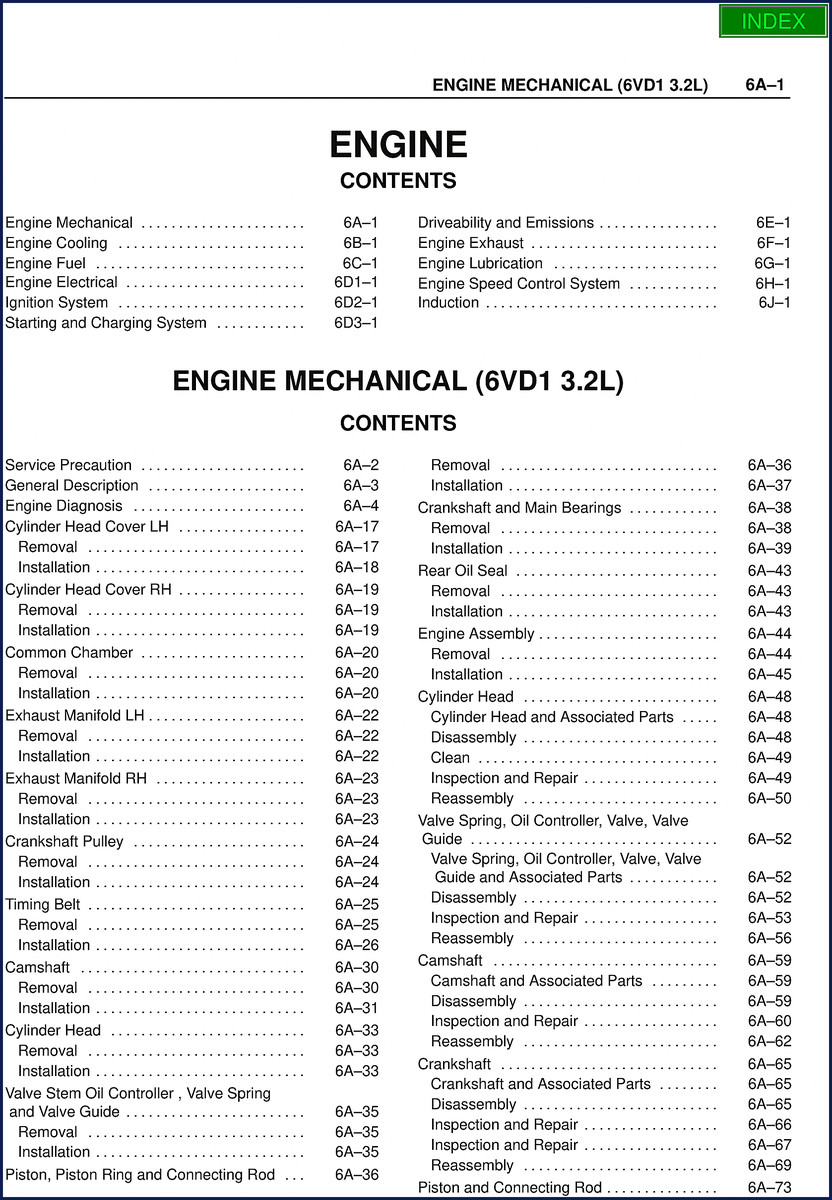
If you’re wrenching on an Isuzu 6VD1 Service Manual and don’t have the factory book on the bench, you’re working blind. I’ve seen more engines destroyed by guesswork than by parts wear. The 442-page OEM manual is what the dealership techs use. It’s what I used when I had to pull a crankshaft that someone else had already torqued wrong. You want the exact removal sequence for the camshaft? It’s in Section 6A. The cylinder head bolt torque? Same section, main data page. This isn’t a condensed reprint or a third-party summary. It’s the actual Isuzu publication.
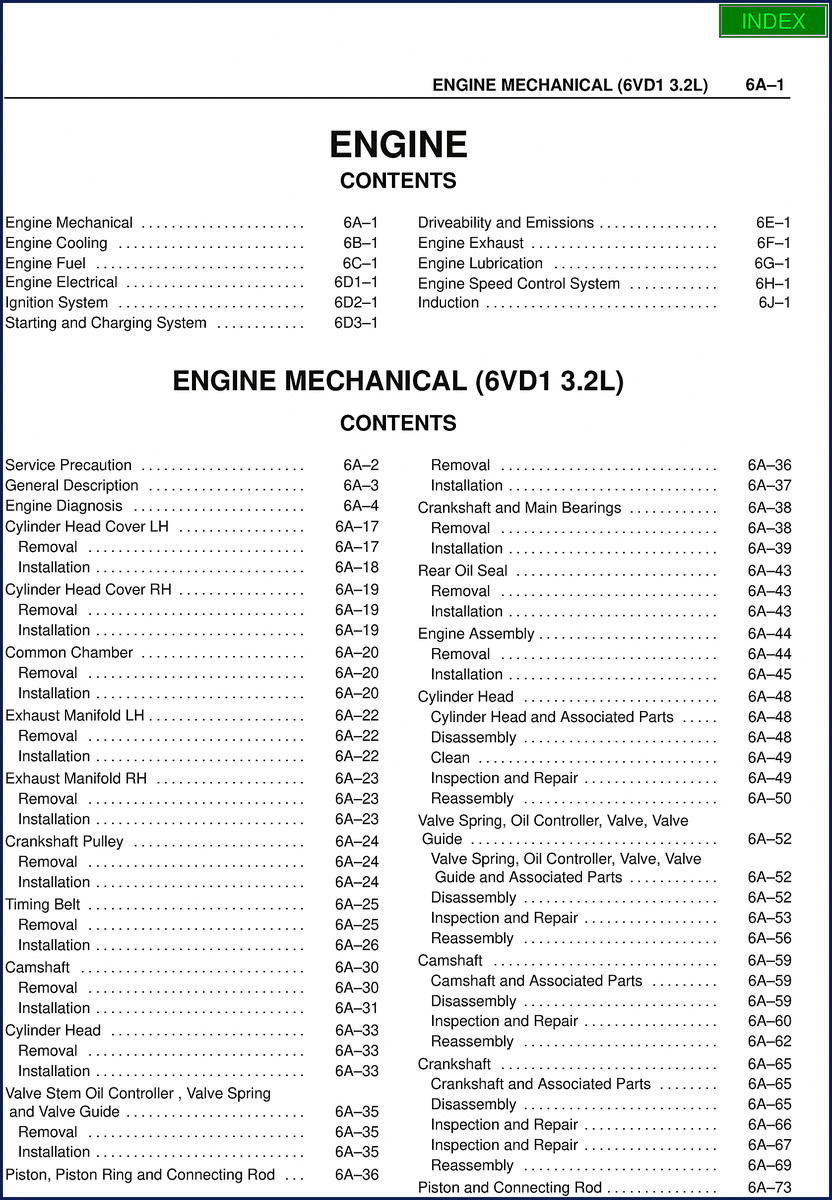
Engine Mechanical Coverage: Cylinder, Crankshaft, Camshaft
Section 6A is the meat of this manual. It starts with service precautions – including the SRS warning that most aftermarket books leave out. Then it walks you through every Engine component: cylinder head cover removal (both LH and RH), common chamber, exhaust manifolds, crankshaft pulley, timing belt, camshaft, cylinder head, valve stem oil controllers, pistons, rings, connecting rods, main bearings, rear oil seal, and the full engine assembly removal/installation. Each subsection has its own removal, inspection, and installation steps. There’s a dedicated disassembly and reassembly section for the cylinder head, valve spring, camshaft, crankshaft, piston/rod assemblies, and the cylinder block. The Main Data and Specification page near the end of Section 6A lists every clearance and torque value you need. That’s where you stop guessing and start measuring.
Does This Manual Cover the Fuel System?
Yes – Section 6C goes through the engine fuel system: fuel metering, fuel filter replacement, in-tank filter, pump flow test, fuel pump relay, tank removal, gauge unit, and filler cap inspection. It even includes the fuel pump flow test procedure – something I rarely see in aftermarket manuals. If you’re diagnosing a no-start on a 6VD1, that flow test can save you hours. The wiring diagrams in Section 6E show the ECM pinouts (six pages of them) so you can trace power and ground without a multimeter symphony.
3 Systems You Cannot Skip for a Proper Rebuild
Engine cooling (Section 6B) – draining, refilling, water pump, thermostat, radiator, and drive belt inspection. Engine electrical (Section 6D1) – battery charging, jump starting, and removal. Ignition system (Section 6D2) – coil, spark plug gap specs, crankshaft angle sensor. Starting and charging (Section 6D3) – starter and generator disassembly and bench test. These sections have their own main data tables. Skip them and you’ll be chasing overheating or no-crank issues later. I’ve done that. It’s not fun.
Get the Correct Torque Specs from Factory Data
The “Main Data and Specification” pages at the end of each section are where the factory publishes exact torque values – not ranges, not “tighten until snug.” In Section 6A alone you’ll find specs for cylinder head bolts, main bearing cap bolts, connecting rod nuts, and the crankshaft pulley bolt. I’ve rebuilt half a dozen 6VD1 engines using this manual and never had a head gasket leak or a rod knock from under-torquing. That’s because the factory gives you the sequence and the angle. If you trust an aftermarket book, you’re taking a gamble. This manual eliminates that gamble.
Timing Belt and Cylinder Head: Step-by-Step Removal
The timing belt procedure in Section 6A includes removal and installation steps with the correct tension. The camshaft removal section tells you exactly how to lock the sprockets and mark the belt. The cylinder head removal lists the bolt loosening sequence – something that matters when you’re dealing with an aluminum head on an iron block. I’ve seen techs skip the sequence and warp a head. This manual won’t let you do that. If you’re also working on other Isuzu platforms, the Isuzu NPR W3500 NPR HD W4500 NQR 2002 Service Manual – OEM and the Isuzu NPR W3500 NPR HD W4500 NQR 2000 Service Manual follow the same factory standard.
Why Factory Documentation Is Worth the Money
I’ve been an ASE Master for 28 years. I’ve seen aftermarket manuals that copy the OEM text but leave out critical torque tables or scribble the wrong part numbers. This is the original Isuzu publication – 442 pages, no condensation, no reprints. The wiring diagrams in Section 6E are the actual factory schematics. For an industry overview of why OEM documentation matters, see Automotive Industry Overview. (Yes, it’s Toyota’s site, but the principle applies across all manufacturers.) For more context on service manual standards, read the Automotive Industry Overview.
- Does the manual include the engine assembly removal procedure?
- Yes – Section 6A has a dedicated removal and installation sequence for the complete engine assembly.
- How do I know the torque spec for the cylinder head bolts is correct?
- The manual provides the factory torque sequence and values from the Isuzu engineering team. Unlike aftermarket manuals that often reprint generic values or skip the critical angle-tightening steps, this one gives you the exact procedure from the OEM. You’ll find the data in Section 6A, Main Data and Specification. I’ve used it on dozens of 6VD1 builds and never had a head gasket failure when I followed it to the letter. Don’t trust a forum post – trust the factory spec.
You need this on your bench before you pull the first bolt. Download the Factory Manual and start working with the same documentation that the dealership uses.


Reviews
There are no reviews yet.