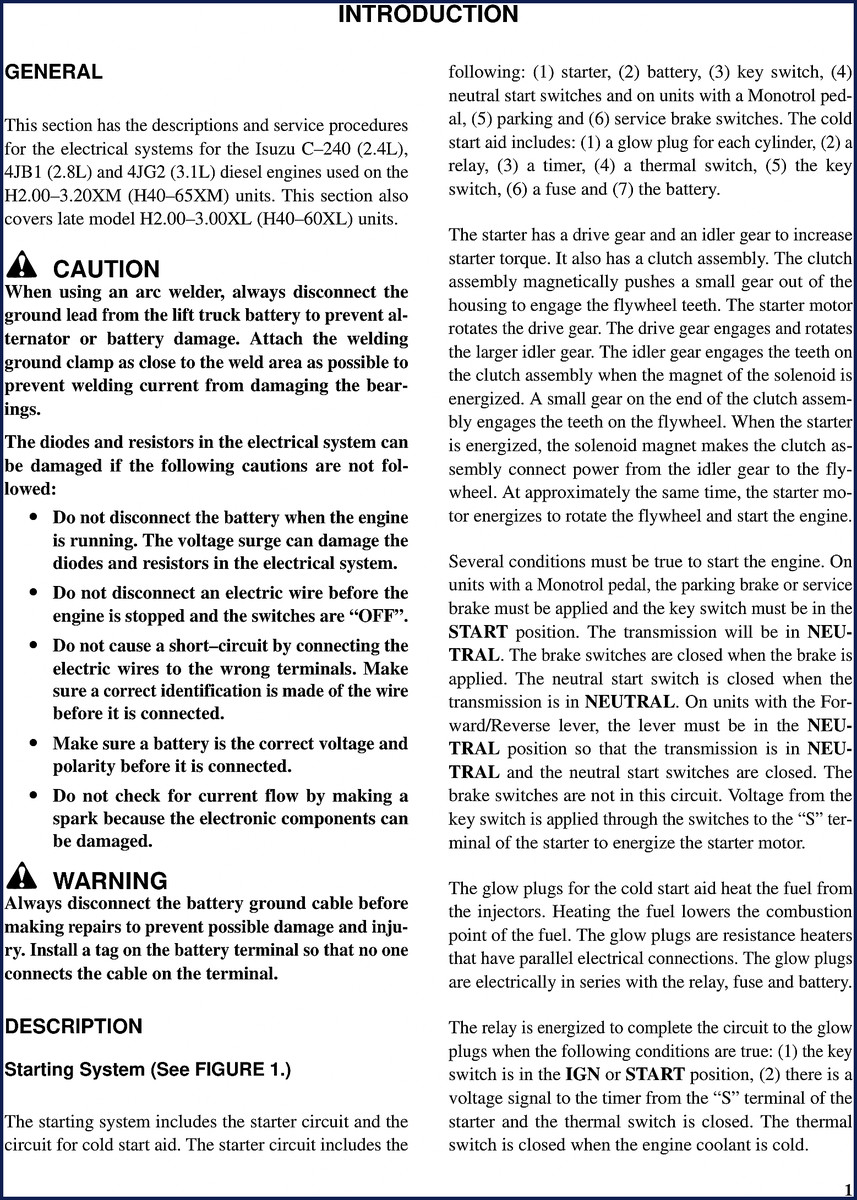
Isuzu H2.00-3.20XM, H40-65XM, H2.00-3.00XL, H40-60XL Service Manual
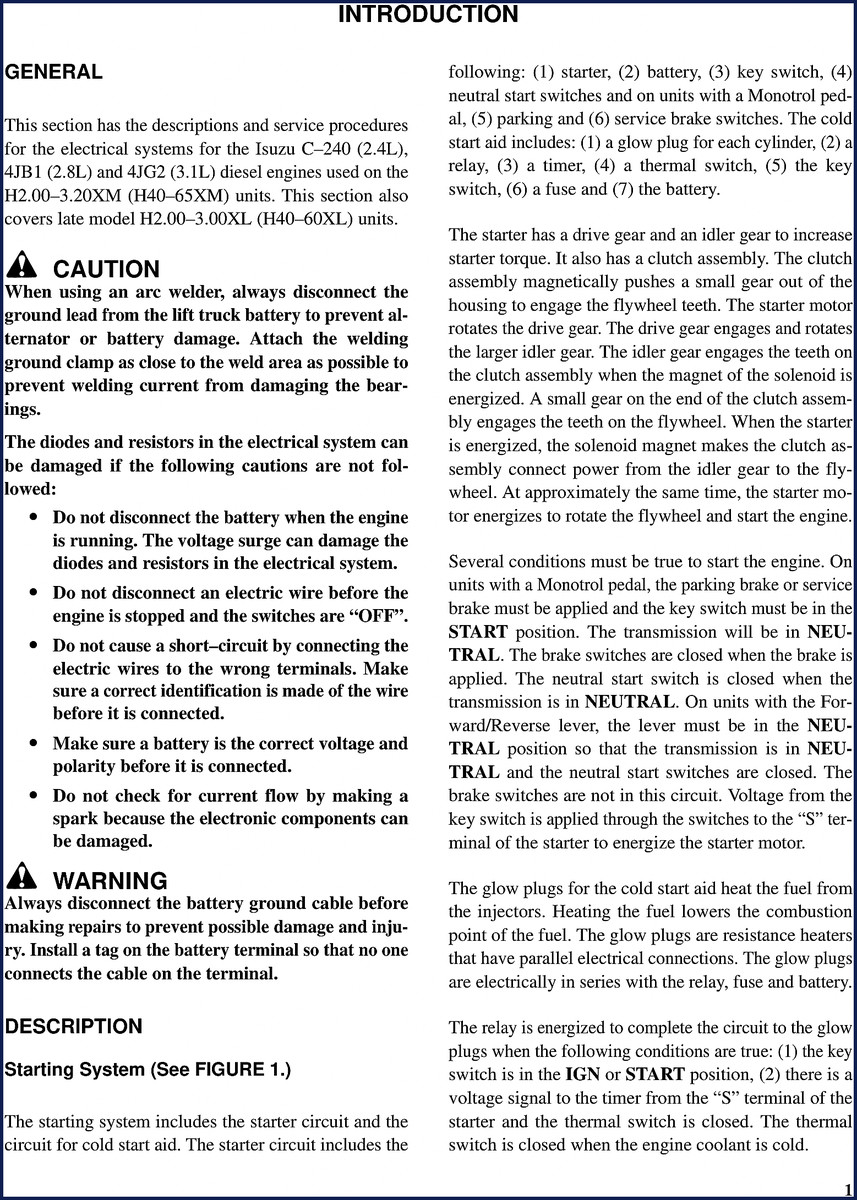
Ever had a starter that wouldn’t crank, but you didn’t know if it was the solenoid, the brushes, or the wiring? I’ve seen guys replace three perfectly good starters because they skipped the bench checks. This 19-page Isuzu H2.00-3.20XM, H40-65XM, H2.00-3.00XL, H40-60XL Service Manual gives you the factory procedure for isolating the problem before you pull a part. It’s the actual Isuzu electrical section for C-240, 4JB1, and 4JG2 diesel engines used in those lift trucks. Page 1 opens with a caution about arc welders and battery disconnection — that’s the kind of detail aftermarket reprints miss.
Starting System Repairs – What’s Inside
The breakdown covers the starter circuit, cold start aid, and charging system. It walks through the starter removal, disassembly, and reinstallation with clutch and bearing checks. One section lists the solenoid coil checks and brush length limits — numbers you need to know before ordering parts. Manual has a dedicated procedure for the idler gear and drive engagement. These are not generic instructions; they match the factory tooling.
Alternator Removal and Disassembly
Separate procedures are given for the C-240 engine and the 4JB1 / 4JG2 engines. Cleaning steps are included, plus the diode circuit, rotor coil, stator coil, and brush checks. It also covers checking the voltage regulator without special testers. Use the rotor coil resistance spec from the Checks section — if you use a wrong value, you’ll condemn a good alternator. That’s exactly the kind of mistake this 19-page manual prevents.
3 Engine Types Covered: C-240, 4JB1, 4JG2
If you work on Isuzu forklifts or industrial equipment, you’ll encounter these three diesels. The C-240 is a 2.4L, the 4JB1 is a 2.8L, and the 4JG2 is a 3.1L. This manual groups them together because the electrical architecture is nearly identical. The starter removal for the C-240 is on a different bolt pattern than the 4JB1, and the document flags that difference. No need to cross-reference multiple books.
Check the Charging Circuit Before You Swap Parts
Low output? High output? The Charging Circuit section tells you exactly which checks to run: battery voltage at idle, ripple, regulator operation. Stator coil resistance measurements are given for the C-240 versus the 4JB1. Do not skip the diode circuit test — a single shorted diode can drain a battery overnight. Page 1 warns you not to disconnect the battery with the engine running. That rule applies here.
Isuzu H2.00-3.20XM, H40-65XM, H2.00-3.00XL, H40-60XL Service Manual: Electrical System Focus
This is not a general chassis manual. It zeroes in on the electricals: starting, charging, and cold start aid. The Troubleshooting section at the end gives a symptom-based flow chart for no-crank, slow-crank, and no-start in cold weather. For glow plug replacement, the manual lists the exact relay and timer tests. If you need related manuals for other Isuzu models, take a look at Isuzu NPR W3500 NPR HD W4500 NQR 2002 Service Manual – OEM or Isuzu NPR W3500 NPR HD W4500 NQR 2000 Service Manual or Isuzu NPR, W4 1996 Service Manual – Factory Driveability & Emissions.
For an overview of how these systems fit into broader commercial vehicle design, see Automotive Industry Overview. And Automotive Industry Overview provides additional context on OEM documentation standards.
That’s it. Period.
These checks save you hours of theoretical hunting. If you want to actually fix the starting or charging system on an Isuzu lift truck with the C-240, 4JB1, or 4JG2 engine, this manual is your single source for the factory procedure. Grab it, print the necessary page, and put it in a clear sleeve on your workbench. Download the Factory Manual from AutoRepairManuals and get back to turning wrenches.
Frequently Asked Questions
- Does this manual cover the fuel system?
- No. This is strictly the electrical section: starting, charging, and glow plugs.
- How do I check the alternator diodes without a special tool?
- The manual describes using a multimeter set to diode test mode. Disconnect the alternator, then measure between the B+ terminal and the case. Reverse the leads. A good diode shows conduction in one direction only. If you get conduction both ways or neither way, the diode is bad. The document gives acceptable forward voltage drop values for the C-240 and 4JB1/4JG2 alternators. Do this test before removing any parts — it’s in the Checks section alongside the rotor and stator coil tests. That way you confirm the alternator is the problem, not a wiring fault.

John D. –
Great workshop guide. The scan is high-quality and easy to navigate. A must-have for any Isuzu H2.00 owner doing maintenance. Highly recommended for mechanics.
Thomas B. –
Highly recommended! The scan is high-quality and well indexed. It guided me to fix my Isuzu H2.00 engine. Saved my weekend project! Thank you.
Charles W. –
Great factory service manual. Immediate link after checkout. Contains clear bolt torque specs for Isuzu. I will definitely buy again.